The Complete Guide to Wicked, Dark & Powerful Names for Every Type of Witch
Evil | Dark | Wicked | Voodoo | Historical | Gothic | Norse | Poison Flora
| 700+Total Names | 10+Witch Traditions | 30+Historical Witches | 27Name Categories |
700+ Evil Witch Names Female: The Complete Guide to Wicked, Dark & Powerful Names for Every Type of Witch
The word ‘witch’ has carried more weight than almost any other word applied to women throughout history. It has meant healer and poisoner, wise woman and villain, religious rebel and social outcast, literary archetype and genuine historical victim. The Vampire Names attached to witches in legend, in trial records, in fiction carry all of that complexity. A witch’s name is never just a name.
This guide takes witch naming seriously. There are five distinct types of evil or dark witches, and they require completely different naming approaches. There are historical records of real women accused of witchcraft at Salem, at Pendle, at Würzburg and their real names are among the most powerful witch names available, because they carry real history. There are Vodou and Voodoo naming traditions that most guides either ignore entirely or handle carelessly. There is the poison-plant tradition belladonna, hemlock, nightshade which has its own rich naming history. And there is the ancient question of why certain names feel witch-like, which has a real linguistic answer.
This guide covers 700+ evil witch names female across 27 categories evil, dark, wicked, mean, powerful, historical, mythological, pop culture, good witch antihero, Voodoo/Vodou, poison flora, nature-inspired, gothic, Norse völva tradition, Slavic, African/Caribbean, Japanese, baby names, pet names, surnames, and alphabetical by starting letter. Plus five construction methods and eight FAQ answers that actually go deep.
Whether you’re naming a novel’s villain, building a DnD character, choosing a Halloween persona, looking for a gothic baby name, or deep in witchcraft history this is the guide that respects the complexity.
The Etymology of Witch Names — Why Certain Names Carry Dark Power
The Old English word ‘wicce’ (feminine) and ‘wicca’ (masculine) are the roots of ‘witch’ and their original meaning was simply ‘one who practices sorcery or magic’. The moral judgment came later, layered on by Christian interpretation of pre-existing Germanic magical practitioners. The word may relate to ‘wigle’ (divination) or ‘wig’ (idol, ritual object). It was descriptive before it was condemnatory.
This matters for naming because the names that feel most genuinely witch-like aren’t the ones that sound evil they’re the ones that sound old. Names that predate the Christian moral framework, names from linguistic roots that carry the original meaning of ‘one who knows’, ‘one who sees’, ‘one who works with forces others cannot’. The most powerful witch names feel ancient because the concept of the witch is ancient.
Linguistically, names associated with witches tend to use sibilants (s, sh, z), fricatives (f, v, th), and back-of-mouth consonants (k, g, r). They often end in open vowels (-a, -e, -ia) or in -th, -x, -s. They tend toward two or three syllables with one stressed syllable carrying the weight. ‘Hecate’, ‘Medea’, ‘Circe’, ‘Morgana’, ‘Lilith’ count the sibilants and fricatives. Now count them in ‘Belinda’. Different world.
The Five Types of Evil Witch — How Type Shapes the Name
Not all evil witches are the same, and their names shouldn’t be either. Understanding which type of witch you’re naming produces a completely different kind of name.
| Witch Type | Naming Philosophy & Examples |
| The Pure Villain Witch | Evil for its own sake, or evil as a complete worldview. Names should be blunt, threatening, and carry no ambiguity. ‘Maleficent’, ‘Malice’, ‘Ruin’, ‘Vexathra’. The name announces the intention before the character acts. |
| The Gothic Sorceress | Dark but elegant — beauty and menace combined. She’s not chaotic; she’s precise. Names should be beautiful and slightly wrong: ‘Seraphine’, ‘Celestine’, ‘Morgayne’, ‘Vesperine’. The name sounds like it belongs to someone admired. |
| The Wicked Witch Archetype | The classic fairy tale villain — theatrical, overtly dramatic, occasionally funny in her excess. Names should sound like they’re being declaimed: ‘Griselda’, ‘Hexademia’, ‘Morvaine’, ‘Beldame’. They have rhythm. |
| The Tragic Witch / Antihero | Was wronged before becoming dark. Her name should carry beauty and loss — something that once fit someone less dangerous. ‘Isolde’, ‘Ophelia’, ‘Thessaly’, ‘Elspeth’. The name humanises even as the character darkens. |
| The Ancient Power | A witch so old she predates the category — Baba Yaga doesn’t think of herself as a witch because ‘witch’ is a word invented after her kind. Names should feel geological and pre-linguistic: ‘Hekate’, ‘Nyx’, ‘Ereshkigal’, ‘Morrigan’. Not names chosen — names accreted over millennia. |
Female Witch Names with Meanings — Full Etymology Table
These are witch names built on genuine etymology real words from real languages that carry authentic meaning. The meaning does work the cute island names couldn’t do alone.
| Name | Meaning / Notes |
| Hecate (Hekate) | Greek — possibly ‘far-reaching’ or ‘one who works from afar’. Goddess of witchcraft, crossroads, and the night. The original witch deity. |
| Circe | Greek — possibly related to ‘kirkos’ (hawk) or ‘kirkoō’ (to secure with a ring). The sorceress who turned men into animals. |
| Medea | Greek — possibly from ‘medomai’ (to think, to plan) or ‘mēdea’ (cunning). The prototype of the wronged-woman-turned-dangerous. |
| Lilith | Hebrew — from ‘layil’ (night) or Akkadian ‘lilu’ (wind demon). Adam’s first wife in later tradition; now the archetypal dark feminine. |
| Morgana | Celtic/Welsh — ‘mor’ (sea) + ‘gana’ (born, woman). Morgan le Fay: the sea-born enchantress. |
| Belladonna | Italian — ‘beautiful woman’. The deadly nightshade poison plant, named for its use in eye drops to dilate pupils. |
| Thessaly | Greek region associated with witchcraft in antiquity. ‘Thessalian women’ was synonymous with witches in Roman literature. |
| Morvaine | Invented compound — ‘mor’ (dark/sea, Welsh/Celtic) + ‘vaine’ (vein/path). The dark path. |
| Sybil / Sibyl | Latin/Greek — a prophetess who receives divine revelation. From ‘sibylla’, possibly meaning ‘divine will’. |
| Mania | Greek — madness, frenzy. Also a Roman goddess of the dead. The witch who operates through induced chaos. |
| Eris | Greek — discord, strife. The goddess who threw the apple that started the Trojan War. |
| Nyx | Greek — night. Older than the Olympians; feared even by Zeus. The personification of darkness itself. |
| Morrigan | Irish/Celtic — possibly ‘great queen’ or ‘terror queen’. Goddess of fate, war, and death; appears as a crow. |
| Nemesis | Greek — retribution, divine vengeance. The inevitable consequence. |
| Hecuba | Greek — possibly ‘far-gleaming’. The Trojan queen who became a monstrous avenger after her children’s deaths. |
| Melusine | French/Celtic — a supernatural water fairy; half woman, half serpent. Appears in medieval French romance. |
| Lorelei | German — from the Rhine legend. A siren-witch who lured boatmen to their deaths with her singing. |
| Cirsa | Invented — feminine evolution of Circe. Carries the phonetic pattern without the exact association. |
| Erzulie | Vodou loa — the spirit of love, beauty, and jealousy. Her darker aspect is Erzulie Dantor, fierce and protective. |
| Maman Brigitte | Vodou loa — death and cemeteries. Works alongside Baron Samedi. French-Creole witch-spirit name. |
Evil Witch Names — Pure Villain Tradition
Evil witch names for the pure villain the witch who has made her peace with darkness and requires no sympathy from the audience. These names announce their intention clearly. They’re theatrical without being ridiculous, threatening without being cartoonish.
| Maleficent | Vexathra | Nightshade | Darkhollow |
| Morvaine | Grimhilde | Ravenna | Morgause |
| Bellatrix | Voltera | Hexademia | Sortiara |
| Malphas | Cruella | Ursula | Narissa |
| Dreadmara | Hexvaine | Darkspell | Shadowmere |
| Venomora | Spitethorn | Blightrose | Curseveil |
| Maledictia | Hexoria | Toxicara | Veneficara |
| Malivenara | Nocturnia | Obsidiara | Vexomara |
| Darkspire | Shadowveil | Nightcraw | Duskfall |
| Ruin | Malice | Spite | Venom |
| Plague | Blight | Wrath | Curse |
| Hexthorn | Grimveil | Hexrose | Darkbloom |
Dark Witch Names — The Gothic Sorceress Tradition
Dark witch names sit in the aesthetic tradition of darkness-as-beauty. The Gothic sorceress is not simply evil she is complex, she is powerful, and she is often the most interesting person in the room. These names carry elegance and threat simultaneously.
| Name | Meaning / Notes |
| Seraphine | From ‘seraph’ (highest order of angel). The most divine name worn by someone who fell away from it. |
| Celestine | Latin ‘caelestis’ (heavenly). Heaven’s name on darkness’s bearer — the contrast is the character. |
| Vesperine | From ‘vesper’ (evening star, Latin). The witch who is most powerful in the between-time. |
| Obsidiana | Obsidian (volcanic glass) + feminine suffix. Hard, sharp, beautiful, formed by ancient fire. |
| Ravenscroft | English surname — ravens + enclosed place. The place where ravens gather. Gothic and grounded. |
| Moonsorrow | Compound noun — the sorrow that comes with the full moon. A name that implies a cycle of pain. |
| Nightbloom | What flowers in darkness. The witch who thrives when everything else sleeps. |
| Ashenveil | The veil of ash — what remains after burning. The witch who survived her own destruction. |
| Shadowmend | One who repairs with darkness. Unusual — a dark witch who heals. |
| Thornwick | Gothic place-name as personal name. The witch who is herself a place. |
| Grimoire | French — a book of magical instructions. Using the tool as the name. |
| Requiem | Latin — rest. A mass for the dead. The witch who officiates at endings. |
| Elegra | Invented — ‘elegy’ + feminine suffix. The witch who mourns everything, including you. |
| Sepulchrine | From ‘sepulchre’ (tomb). The witch whose domain is the place after death. |
| Noctivela | Latin ‘nox’ (night) + ‘vela’ (veil). The night veil — the darkness that hides. |
| Umbraveth | Latin ‘umbra’ (shadow) + invented suffix. The shadow that has a will. |
| Melanthe | Greek ‘melas’ (black) + ‘anthos’ (flower). The black flower — rare, beautiful, toxic. |
| Phanthora | Greek ‘phanthos’ (visible) + invented suffix. What can be seen when nothing should be visible. |
| Corvina | Latin ‘corvus’ (crow/raven) + feminine suffix. The crow-woman. |
| Vesperina | Extended ‘vesper’ form. The evening star in a name that takes three syllables to arrive. |
Wicked Witch Names — The Classic Archetype
The Wicked Witch archetype from the Wizard of Oz’s Margaret Hamilton to Disney’s Evil Queen has its own naming tradition. These names are theatrical, have strong rhythm, and are designed to be announced. They work for Halloween costumes, fictional villains, and any witch who embraces the theatricality of her own wickedness.
| Griselda | Winifred | Hermione Dark | Morwenna |
| Edna the Dread | Hexabella | Beldame | Hag Margot |
| Winifred Sanderson | Mary Sanderson | Maleficent | Evil Queen |
| Cruella | Ursula | Narissa | Gothel |
| Ravenna | Bavmorda | Mombi | Nome King’s Witch |
| Grand High Witch | Miss Trunchbull | White Witch | Jadis |
| Zelena | Cora Mills | Regina Mills | Rumplestiltskin (fem) |
| Theodora | Evanora | Glinda-Gone-Wrong | Hexabelle |
| Witchipoo | Hazel | Witch Hazel | Old Meg |
| Gruntilda | Baba Yaga | Old Crone | Dame Gothel |
| Hexademia | Malificara | Wickedoria | Hexeltrude |
| Grimhilde | Drizella | Anastasia | Lucifer (fem) |
Mean & Cruel Witch Names
Mean witch names are specifically for petty cruelty rather than grand evil the witch who curses a shepherd because his sheep wandered into her garden, who turns a tailor into a frog because he charged too much for her robe. These Fursona Names sound like they belong to someone who holds a permanent grudge.
| Gripen | Snarl | Spite | Grudge |
| Vinegar Rose | Bitterroot | Sourberry | Thornberry |
| Vexillara | Malcontent | Peeve | Rankle |
| Chafe | Nettle | Sting | Goad |
| Prickle | Prod | Needle | Stick |
| Wormwood | Gall | Bile | Acid |
| Sharp Edna | Cold Mary | Hard Jane | Mean Agatha |
| Lady Spite | Dame Grudge | Mistress Vex | Madam Malice |
| Hexithorn | Gripethorn | Spitethorn | Grudgethorn |
| Sourwitch | Bitterwitch | Grumpwitch | Grudgewitch |
| Vinegara | Bitterina | Sourina | Grumpelina |
| Crankshaw | Grumblewood | Snarleton | Vexworth |
Powerful Sorceress Names
Powerful sorceress names aren’t about evil they’re about competence, scale, and the specific quality of someone who has mastered forces that would destroy most people. A powerful sorceress name should feel like an achievement. Like something earned.
| Morgana le Fay | Nimue | Viviane | The Lady of the Lake |
| Scheherazade | Zenobia | Artemisia | Cleopatra |
| Hypatia | Aspasia | Dido | Boudicca |
| Arachne | Cassandra | Tiresias (fem) | Pythia |
| Arianrhod | Cerridwen | Rhiannon | Blodeuwedd |
| Semiramis | Nefertiti | Hatshepsut | Meritaten |
| Meridiana | Thaïs | Phryne | Pamphile |
| Thessalonica | Erichtho | Canidia | Sagana |
| Veleda | Aurinia | Ganna | Waluburg |
| Jadwiga | Kunigunde | Hedwig | Mechthild |
| Beatrix of Este | Caterina Sforza | Isabella d’Este | Lucrezia Borgia |
| Almathea | Seraphiel | Cassiel | Raziel (fem) |
Historical Witch Names — Real Women from the Witch Trials
These are real names of women accused of witchcraft during the great European and American witch trials of the 15th–18th centuries. Using them as fictional witch names is a way of acknowledging their history. These women existed. Most were innocent of anything except being old, female, poor, or inconvenient to someone with more power than them.
Salem Witch Trials (Massachusetts, 1692)
| Name | Meaning / Notes |
| Tituba | An enslaved woman from Barbados — the first accused at Salem. Her confession (likely coerced) named others and ignited the trials. |
| Sarah Good | A homeless beggar woman — one of the first accused. Maintained her innocence. Hanged July 19, 1692. |
| Elizabeth Howe | Accused by her neighbors. Hanged July 19, 1692. Her husband spent years clearing her name. |
| Susannah Martin | A widow who had been accused of witchcraft twice before. Hanged July 19, 1692. |
| Martha Carrier | Called ‘the Queen of Hell’ by Cotton Mather. A fierce defender of her innocence. Hanged August 19, 1692. |
| Mary Easty | Wrote a petition not for herself but asking the court to spare others. Hanged September 22, 1692. |
| Ann Hibbins | A wealthy widow hanged in Boston in 1656 — earlier than Salem, but often cited as the beginning. |
| Bridget Bishop | The first person hanged in the Salem trials, June 10, 1692. |
Pendle Witch Trials (Lancashire, England, 1612)
| Name | Meaning / Notes |
| Old Demdike (Elizabeth Southerns) | The matriarch of one of the two accused families — blind, nearly ninety, died in prison before trial. |
| Old Chattox (Anne Whittle) | The matriarch of the rival family. Confessed (under duress) and was hanged. |
| Alizon Device | Granddaughter of Old Demdike. Confessed to harming a pedlar. Hanged. |
| Anne Redfearne | Daughter of Old Chattox. Hanged despite jury initially finding her not guilty. |
| Elizabeth Device | Daughter of Old Demdike. Confessed to attending the Malkin Tower meeting. Hanged. |
| Alice Nutter | A wealthy woman — unusual in the trials. Her motive for involvement remains mysterious. |
| Jennet Preston | Accused by the Pendle group; tried separately in Yorkshire. Hanged. |
| Margaret Pearson | The Padiham witch — sentenced to the pillory and imprisonment rather than death. |
European Witch Trials — Other Notable Names
| Agnes Sampson | Geillis Duncan | Barbara Napier | Euphame MacCalzean |
| Walpurga Hausmännin | Anna Goldi | Clara Geissler | Veronica Zeritschee |
| Anna Maria Schwagel | Maria Renata Singer | Katharina Kepler | Margaret Barclay |
| Janet Horne | Isabel Gowdie | Bessie Dunlop | Alison Peirson |
| Elizabeth Sawyer | Joan Flower | Ursula Kemp | Mother Samuel |
| Maret Jonsdotter | Anna Eriksdotter | Karin Persdotter | Barbro Matsdotter |
Famous Witch Names from Mythology
Mythological witch names come with centuries of accumulated meaning. Each of these names implies an entire mythology, a specific type of power, and a cultural context. They’re the witch names that never go out of style because they never entirely left the cultural consciousness.
| Name | Meaning / Notes |
| Circe | Greek — transforms men into pigs. Daughter of the Sun god Helios. Works on an island. |
| Medea | Greek — kills her own children to punish her husband. The wronged woman who goes furthest. |
| Hecate | Greek — triple goddess of witchcraft, crossroads, and the moon. Older than Olympus. |
| Erichtho | Roman (Lucan’s Pharsalia) — a Thessalian witch who raised the dead for prophecy. Genuinely horrifying. |
| Canidia | Roman (Horace’s Epodes) — a witch who buries a boy alive to make a love potion from his organs. |
| Baba Yaga | Slavic — the ambiguous forest witch who lives in a hut on chicken legs. Helper and devourer. |
| Morrigan | Celtic — the crow goddess of war, fate, and death. Not exactly a witch, but the prototype. |
| Cerridwen | Welsh — the goddess of the cauldron, keeper of the Cauldron of Inspiration. |
| Frau Holle | Germanic — the keeper of winter and the underworld. The original European witch figure. |
| Kali | Hindu — the dark mother goddess of time, death, and transformation. Terrifying, liberating. |
| Rangda | Balinese — the demon queen, enemy of Barong. Represents chaos and black magic. |
| Izanami | Japanese — the goddess of death and the underworld. Became dangerous after dying in childbirth. |
| La Llorona | Latin American — the weeping woman who drowned her children and now haunts rivers. |
| Tlazolteotl | Aztec — goddess who ate filth/sin, associated with witchcraft and sexuality. |
| Coyolxauhqui | Aztec — the moon goddess; the severed head. A goddess of the dark feminine. |
Witch Names from Pop Culture & Literature
Fiction has given us some of the most enduring witch names in modern culture. Understanding why these names work helps build better witch characters.
| Name | Meaning / Notes |
| Hermione Granger | J.K. Rowling — Greek ‘Hermes’ origin. Carries classical weight, slightly unusual phonetics, absolutely right for a brilliant witch. |
| Bellatrix Lestrange | Rowling — Latin ‘bellatrix’ (female warrior). A star in Orion. Martial and celestial at once. |
| Minerva McGonagall | Rowling — Roman goddess of wisdom. The witch who chose wisdom over power. |
| Morgause | Arthurian — Morgan le Fay’s sister; mother of Mordred. The witch who worked through lineage. |
| Nimue | Arthurian — the Lady of the Lake. Imprisoned Merlin. One of the greatest witch triumphs. |
| Elphaba | Gregory Maguire’s Wicked — named for L. Frank Baum (L.F.B. → Elphaba). A name invented from an author’s initials. |
| Glinda | L. Frank Baum — the ‘good witch’, but Maguire recontextualises her as morally compromised. |
| Sanderson Sisters | Hocus Pocus — Winifred, Sarah, Mary. Old New England names that feel period-appropriate. |
| Sabrina Spellman | Archie Comics/Netflix — ‘Sabrina’ is a Celtic river goddess name. ‘Spellman’ does all the work. |
| Willow Rosenberg | Buffy — named for a tree associated with mourning. The witch who became too powerful. |
| Jadis | C.S. Lewis’s White Witch — ‘jadis’ is French for ‘formerly, once’. The witch who belongs to a previous age. |
| Bavmorda | Willow film — invented, sounds archaic and threatening in equal measure. |
| Serafina Pekkala | Philip Pullman — a lyrical name for the chief witch in Northern Lights. |
| Thessaly | Neil Gaiman’s Sandman — a very old witch who happens to look young. Classical region as personal name. |
| Nanny Ogg / Granny Weatherwax | Terry Pratchett — brilliantly ordinary names for witches of extraordinary power. |
| Maleficent | Disney Sleeping Beauty — from Latin ‘maleficent’ (doing evil). Made canonical by Angelina Jolie’s portrayal. |
Good Witch Names — For Complex Antiheroes
‘Good witch’ is often a more interesting character than ‘evil witch’ the witch who uses dark power for good, who operates outside social norms but toward humane ends, who is feared and yet necessary. These Male Dragonborn Names carry warmth and edge simultaneously.
| Glinda | Elphaba | Sabrina | Willow |
| Serafina | Thessaly | Nanny Ogg | Granny Weatherwax |
| Tiffany Aching | Agnes Nitt | Magrat Garlick | Petunia |
| Practical | Gillian | Sally | Jennifer |
| Hazel | Briar | Laurel | Rowan |
| Sage | Rue | Wormwood (kinder) | Yarrow |
| Clover | Heather | Violet | Iris |
| Primrose | Rosemary | Lavender | Thyme |
| Meadow | River | Brook | Rain |
| Aurora | Dawn | Solstice | Equinox |
| Bright | Clear | True | Light |
| Gentle | Kind | Wise | True |
Voodoo & Vodou Female Names
Vodou (the Haitian spelling) and Voodoo (the Louisiana and popular culture spelling) are distinct religious and cultural traditions. Haitian Vodou is a genuine religion with roots in West African Fon and Ewe religious traditions; its female spiritual figures the loa have specific names, personalities, and domains. Using these names with respect means understanding their actual context.
Louisiana Voodoo has its own tradition, famously associated with Marie Laveau (1801–1881), the Voodoo Queen of New Orleans, who was a real person a powerful, politically connected woman who used her reputation and social network to protect her community. Her name is the most important name in the American Voodoo tradition.
🌺 Haitian Vodou Loa Names (Female)
| Name | Meaning / Notes |
| Erzulie Freda | The loa of love, beauty, and femininity — wears three gold rings, never fully satisfied. |
| Erzulie Dantor | Fierce protective mother — has a scar on her cheek, holds a knife, associated with single mothers. |
| Maman Brigitte | The loa of death and cemeteries — wife of Baron Samedi, protector of gravestones. |
| La Sirene | The mermaid loa — queen of the sea, beauty, music, and wealth. |
| Ezili Je Wouj | ‘Ezili Red Eyes’ — the aspect of grief and rage. She weeps blood. |
| Gran Bwa | The spirits of the forest and nature. Sometimes female-aspected. |
| Ayizan | The first mambo (priestess), loa of the marketplace and purification. |
| Filomez | A loa associated with magic and transformation. |
🌙 Louisiana Voodoo Names
| Name | Meaning / Notes |
| Marie Laveau | The Voodoo Queen of New Orleans (1801–1881). A real, remarkable woman. The most powerful name in American Voodoo tradition. |
| Marie Laveau II | Her daughter, who continued her work. Some historians believe the mother lived so long because the daughter continued under her name. |
| Doctor John | Actually male, but influential on naming conventions — the ‘Doctor’ title as witch/healer honorific is used for women too. |
| Sanité Dédé | An earlier Voodoo queen of New Orleans; possibly a former enslaved woman from Saint-Domingue. |
| Malvina Latour | Another New Orleans Voodoo queen who succeeded the Laveaus. |
| Catherine Henry | A late 19th-century New Orleans Voodoo practitioner. |
| Mam’zelle Marie | A title/name hybrid used for respected female Voodoo practitioners. |
| Queen Lala | A symbolic title for the highest-ranking female practitioner in certain New Orleans traditions. |
Voodoo-inspired witch names for fiction (respecting rather than appropriating the tradition):
| Mambo Seraphine | La Sirène | Ezili Nova | Brigitte Noir |
| Marie Celeste | Laveau-Born | Dédéine | Mam’zelle Dark |
| Cimetière Rose | Peristyle | Crossroads Queen | Cemetery Girl |
| Bayou Witch | Swamp Queen | River Mother | Sea Mambo |
| Baron’s Wife | Samedi’s Dark | Ghede’s Own | Legba’s Gate |
| Haitian Moon | Creole Night | Louisiana Dark | New Orleans Queen |
Female Poison Names — The Deadly Flora Tradition
The association between witches and poisonous plants is ancient and real the pharmacopeia of the traditional wise woman included digitalis (foxglove), atropa belladonna (deadly nightshade), conium maculatum (hemlock), and dozens of other plants that heal in small doses and kill in large ones. The witch’s plant knowledge was both her power and the evidence used against her in trials. Using poison plant names as witch names is one of the oldest and most authentic naming traditions available.
| Name | Meaning / Notes |
| Belladonna | Italian — ‘beautiful woman’. Deadly nightshade. Dilates pupils; was used cosmetically and as a poison. |
| Hemlock | Old English ‘hymlice’. The plant that killed Socrates. A name that carries philosophical weight. |
| Nightshade | The common name for belladonna and related plants. The ‘shade’ of night — darkness growing from the earth. |
| Foxglove | The source of digitalis — treats heart conditions in small doses, kills in large ones. |
| Monkshood / Aconite | One of the most toxic plants known — used in flying ointments in witch trial confessions. |
| Henbane | Hyoscyamus niger — used in witches’ flying ointments. Causes hallucinations and delirium. |
| Mandrake | The root that screams when pulled — a staple of magical herbalism since antiquity. |
| Wormwood | Artemisia absinthium — the plant in absinthe. Mildly toxic, strongly aromatic, deeply associated with bitter herbs. |
| Wolfsbane | Aconitum — another name for monkshood. Associated with werewolves and witches both. |
| Pennyroyal | Mentha pulegium — historically used as an abortifacient. A plant with power over women’s bodies. |
| Rue | Ruta graveolens — ‘herb of grace’; used in purification and curse-breaking. To ‘rue’ something is to regret it. |
| Elder | The elderberry and elderflower plant. Associated with witches in European folklore. |
| Yarrow | Achillea millefolium — a wound healer and divination herb. Named for Achilles. |
| Mugwort | Artemisia vulgaris — associated with dreams, divination, and feminine power. |
| Thornapple / Jimsonweed | Datura stramonium — extremely toxic hallucinogen. Associated with witches’ sabbat ointments. |
| Black Hellebore | Helleborus niger — the Christmas rose. Extremely toxic; used in ancient Greek medicine for madness. |
Poison-plant-inspired witch names for fiction:
| Bella Donna | Nighshara | Hemlocke | Foxglova |
| Monkshora | Henbara | Mandrika | Wormara |
| Wolfsbara | Pennara | Ruevaine | Elderina |
| Yarrina | Mugwara | Thornapla | Hellebora |
| Aconita | Digitala | Bellarosa | Noctishara |
| Solanara | Atropa | Daturina | Stramonara |
| Cicutara | Taxina | Colchara | Venefica |
| Toxicara | Venomara | Poisonveil | Deadlyvine |
Nature-Inspired Witch Names
Witches have always been associated with the natural world — not nature as romantic landscape, but nature as raw force, indifferent and powerful. These Monk names draw from weather, terrain, animal, and seasonal imagery.
| Stormveil | Ravenwood | Thornmere | Mossgate |
| Briarwood | Fernhollow | Willowmere | Ashwood |
| Oakridge | Elmgate | Birchvale | Cedarhollow |
| Winterborn | Autumnveil | Springdark | Summerend |
| Solstice | Equinox | Eclipse | Penumbra |
| Moonrise | Moonset | Fullmoon | Darkmoon |
| Stormcrow | Ravenclaw | Foxfire | Wolfmoon |
| Serpentine | Viper | Cobra | Asp |
| Nightjar | Owlstone | Bathollow | Mothwing |
| Frostveil | Snowthorn | Icebark | Glaciera |
| Thundermere | Lightningwood | Stormgate | Galewood |
| Deepwater | Darkpool | Blackmere | Voidlake |
Gothic Witch Names — Dark Elegance
Gothic witch names occupy the aesthetic space where beauty and darkness are the same thing — where a name can be both a compliment and a warning. These are the names that appear in Victorian sensation novels, in Angela Carter’s fairy tales, in Anne Rice’s novels.
| Arabella | Seraphina | Evangeline | Celestine |
| Theodora | Valentina | Constance | Patience |
| Prudence | Verity | Charity | Mercy |
| Ophelia | Isolde | Elsinore | Lavinia |
| Carmilla | Mircalla | Millarca | Clarimonde |
| Ligeia | Berenice | Morella | Eleonora |
| Rowena | Madeline Usher | Lucrezia | Elara |
| Rosamund | Imogen | Cordelia | Desdemona |
| Genevieve | Guinevere | Elspeth | Griselda |
| Hortensia | Persephone | Cassandra | Sibyl |
| Walpurga | Hildegard | Mechthild | Kunigunde |
| Threnody | Elegy | Requiem | Dirge |
Norse & Viking Witch Names — The Völva Tradition
The völva (plural völur) was the Norse female seeress — a practitioner of seiðr (Old Norse magic) who travelled between communities offering prophecy and magical services. Unlike the Christian concept of the witch, the völva was often respected, feared, and well-compensated. The most famous völva in Norse mythology is the Völuspá’s seeress, whose name we don’t know but whose vision encompasses the entire history and future of the Norse cosmos.
| Name | Meaning / Notes |
| Heiðr | The völva named in the Völuspá — possibly meaning ‘brightness’ or ‘glory’. The witch who was paid in gold and rings for her prophecies. |
| Göndul | A valkyrie name — possibly ‘wand-wielder’. Crosses the line between warrior, fate-weaver, and witch. |
| Skuld | One of the three Norns — the norn of the future. ‘Skuld’ means ‘what shall be’. |
| Verdandi | The norn of the present — ‘what is becoming’. The witch who works in the immediate. |
| Urð | The norn of the past — the oldest, the deepest. ‘Urð’ relates to ‘wyrd’ (fate, destiny). |
| Angrboda | ‘One who brings grief’ — mother of Fenrir, Jormungandr, and Hel. A giantess-witch of enormous power. |
| Gullveig | A sorceress who was burned three times and reborn each time as Heiðr. The witch who cannot be destroyed. |
| Rán | Goddess of the sea who drowns sailors and collects the dead in her net. A witch of the deep. |
| Iðunn | Keeper of the golden apples of youth. More benevolent, but her knowledge is power. |
| Freyja | The primary Norse deity of magic, seiðr, love, and war. Every völva practices in her tradition. |
| Skadi | The giantess-goddess of winter, hunting, and mountains. Cold and utterly competent. |
| Hel | Half-living, half-dead ruler of the realm of the ordinary dead. Her name gave us ‘hell’. |
| Sigrun | Valkyrie name — ‘victory rune’. A warrior-witch of Odin’s choosing. |
| Brynhildr | The valkyrie punished for disobedience — ‘battle armour’. Sleeps within a fire. |
| Hyndla | A giantess and volva who Freyja consults for genealogical knowledge. |
Slavic & Eastern European Witch Names
Slavic witch traditions center around the baba (old woman/grandmother) as the figure of magical power — Baba Yaga being the supreme example. But there are many other Slavic magical female figures, each with their own specific powers and naming traditions.
| Name | Meaning / Notes |
| Baba Yaga | ‘Baba’ (old woman/grandmother) + ‘Yaga’ (possibly ‘terrible’, ‘horror’, or from Slavic ‘ega’ meaning forest). The ambiguous forest witch. |
| Kikimora | A malicious household spirit. Her name may derive from ‘kika’ (ugly) or ‘mara’ (nightmare spirit). |
| Rusalka | The spirit of a drowned woman who haunts rivers. From ‘rusa’ (fair-haired). Beautiful and lethal. |
| Mavka (Navka) | Spirits of women who died in childbirth or before marriage. Ukrainian forest spirits. |
| Poludnitsa | ‘Lady Midday’ — appears at noon in summer to cause sunstroke. Her name literally means ‘noon’. |
| Morozko (fem: Moroznaya) | The frost spirit. A winter witch who rewards virtue and punishes laziness. |
| Strigeata | Romanian feminine form of strigă — a witch who can transform into an animal. |
| Muma Padurii | Romanian — ‘Mother of the Forest’. The witch who rules the dangerous woodland. |
| Dziwożona | Polish — a creature who swaps babies. Name means ‘wild woman’. |
| Ježibaba | Czech/Slovak version of Baba Yaga. Same fundamental figure, different regional name. |
| Gamayun | A prophetic bird-woman of Slavic mythology. Head of a woman on a bird’s body. |
| Alkonost | Another bird-woman — her song causes those who hear it to forget everything. |
| Yishna | Invented — Slavic phonetics + ‘-shna’ suffix. Feels authentic to the tradition. |
| Vasilisa | The protagonist of Vasilisa the Beautiful — the young woman who outwits Baba Yaga. |
| Marena (Marzanna) | Slavic goddess of winter, death, and witchcraft. Effigies burned each spring. |
African & Caribbean Witch Names
African and Caribbean magical traditions have their own distinct female figures of power — and they deserve more than a single throwaway section. Here are names from specific traditions, approached with the respect they’re due.
🌺 West African Traditions
| Name | Meaning / Notes |
| Mami Wata | West African water spirit — a mermaid-like figure associated with beauty, wealth, and danger. Her followers are sometimes accused of being witches. |
| Yemoja / Yemanjá | Yoruba — mother of waters. Associated with the ocean, motherhood, and protective magic. |
| Oshun | Yoruba — goddess of love, beauty, sweet water, and abundance. Her magic is honey-sweet and powerful. |
| Oya | Yoruba — goddess of storms, death, and transformation. A warrior goddess who guards the cemetery gates. |
| Nana Buluku | Fon/Ewe — the supreme being, conceived as both male and female but often addressed as grandmother. |
| Mawu | Fon — the moon goddess and co-creator deity. Associated with wisdom and the night. |
| Asase Ya | Akan — Mother Earth. She is propitiated before anyone breaks ground. |
| Abena | Akan — ‘born on Tuesday’. Used as a witchcraft-association name in colonial accounts. |
🌊 Caribbean Obeah & Folk Magic Names
| Three-Fingered Jack | Queen Nanny | Mother Shepherd | Sister Vera |
| Obeah Woman | Bush Doctor | Root Woman | Herb Woman |
| Miss Olive | Mother Scotia | Queen Zora | Sister Darkness |
| Madame Zazá | Miss Josephine | Queen Calinda | Mam’zelle Viper |
| Bayou Queen | Swamp Mother | River Witch | Sea Mother |
| Creolina | Martiniquaise | Guadalupéenne | Haïtienne |
Japanese & Asian Witch Names
Japanese magical female figures operate differently from Western witches — they’re often defined by transformation, obsession, or the dangerous power of extreme emotion. The woman consumed by jealousy who becomes an oni, the spirit of unrequited love that lingers as a yūrei, the fox-woman who is both more and less than human.
| Name | Meaning / Notes |
| Yuki-onna | The Snow Woman — appears in blizzards. Sometimes kills, sometimes shows mercy. Defined by ambiguity. |
| Jorōgumo | The spider woman — ‘entangling bride’. Transforms into a beautiful woman to trap men. |
| Yamauba (Yamamaba) | The mountain witch — an old woman who lives in the mountains and eats travellers. |
| Okiku | The ghost of a servant girl who was murdered. Counts plates every night in the well where she was thrown. |
| Nure-onna | The ‘wet woman’ — a snake with a woman’s head who attacks people at water’s edge. |
| Futakuchi-onna | A woman with a second mouth at the back of her head. Created by a miser husband. |
| Izanami | The Japanese goddess of death — she became monstrous after dying in childbirth. |
| Tamamo-no-Mae | The nine-tailed fox who disguised herself as a court lady. The most famous Japanese witch figure. |
| Kuchisake-onna | The slit-mouthed woman — a modern Japanese urban legend. A mutilated woman who asks if you think she’s pretty. |
| Mikaeri-Yanagi | ‘Willow that looks back’ — a ghost who lives in willow trees. |
| Xi Wangmu | Chinese — the Queen Mother of the West. Rules over paradise and possesses the peach of immortality. |
| Aži Dahāka | Zoroastrian — a witch-king figure with serpents growing from shoulders. |
| Mäder / Bisu | Central Asian shamanic witchcraft traditions — female shamans often had specific naming conventions. |
| Rangda | Balinese — the demon queen who represents chaos, black magic, and disease. |
| Pontianak | Malay/Indonesian — the spirit of a woman who died in childbirth. Extremely dangerous. |
Witch Names for Baby Girls
Witch-inspired baby names for girls carry the witch’s qualities — power, intelligence, mystery, and an association with something older than ordinary life — without being overtly dark. These names work on a birth certificate and at a university graduation equally well.
| Hermione | Morgana | Circe | Selene |
| Luna | Isolde | Thessaly | Seraphina |
| Winifred | Sibyl | Hecate (Hekat) | Nyx |
| Vesper | Rowena | Arabella | Celestine |
| Elspeth | Rowan | Sage | Briar |
| Juniper | Hazel | Rue | Yarrow |
| Clover | Lavender | Iris | Violet |
| Aurora | Solstice | Tempest | Storm |
| Raven | Corvina | Viviane | Nimue |
| Melusine | Lorelei | Undine | Nereid |
| Cassandra | Pythia | Sibyl | Prophetia |
| Magdalene | Miriam | Deborah | Judith |
Witch Names for Pets
A witch’s familiar deserves a proper witch name. Cats, ravens, and black dogs have been witches’ familiars in lore since the medieval period — and their names should reflect that tradition.
🐈 Cat Names
| Salem | Binx | Midnight | Shadow |
| Onyx | Obsidian | Jet | Sable |
| Hecate | Circe | Medea | Morgana |
| Belladonna | Nightshade | Hemlock | Wormwood |
| Griselda | Maleficent | Ursula | Ravenna |
| Purrsephone | Clawdia | Meow-gana | Hexicat |
🐦 Raven & Bird Names
| Nevermore | Lenore | Annabel Lee | Poe |
| Corvus | Corvina | Ravenscroft | Blackfeather |
| Omen | Portent | Sign | Warning |
| Huginn | Muninn | Thought | Memory |
🐕 Dog & Other Pet Names
| Cerberus | Hecuba | Grimalkin | Familiar |
| Shadow | Darkness | Void | Abyss |
| Grimm | Reaper | Dread | Terror |
| Brimstone | Ashwood | Darkhollow | Thornveil |
Witch Surnames — The Complete System
Witch surnames are as important as first names — they carry geography, lineage, nature, and reputation. Here’s a complete system for building witch surnames that feel authentic.
Nature & Geography Surnames
| Thornwood | Ravenswood | Blackwater | Darkhollow |
| Grimshaw | Ashcroft | Mossgate | Nightmere |
| Stonecroft | Bramblewood | Fernhollow | Willowmere |
| Moorgate | Heathwick | Bogmire | Marshgate |
| Cliffthorn | Ravenscliff | Blackcliff | Darkcliff |
| Stormveil | Nightveil | Shadowveil | Moonveil |
Occupation & Craft Surnames
| Hexworth | Spellcraft | Rune maker | Grimoire |
| Caldwell | Cauldron | Potions | Brewer |
| Nightcraft | Darkcraft | Shadowcraft | Mooncraft |
| Veilmaker | Curseborn | Hexborn | Spellborn |
| Witchward | Spellward | Runeward | Moonward |
| Hexmaster | Spellmistress | Runemistress | Moonmistress |
Darkness & Shadow Surnames
| Blackthorn | Darkwood | Shadowmere | Nightfall |
| Duskwood | Grimhollow | Bleakmoor | Darkmere |
| Voidgate | Abysswood | Nullhollow | Vantawood |
| Obsidianwood | Onyxhollow | Jetmere | Sablewood |
| Ravenworth | Crowwood | Owlhollow | Batmere |
| Corpsewood | Bonehollow | Skullmere | Deathwood |
Witch Names by Starting Letter
M — The Most Powerful Witch Letter
More iconic witch names begin with M than any other letter — Medea, Morgana, Maleficent, Morrigan, Melusine, Mania, Medusa, Mara. The ‘m’ sound is front-of-mouth and initially soft, which combined with harder following consonants creates the specific quality of barely contained power.
| Maleficent | Morgana | Morrigan | Medea |
| Medusa | Melusine | Mara | Mania |
| Melanthe | Morvaine | Morwenna | Mavka |
| Magdalene | Mechthild | Marena | Marzanna |
| Maman Brigitte | Mami Wata | Maledictia | Malcontent |
| Miriam | Millarca | Mircalla | Mikaeri |
| Moonveil | Moonsorrow | Mooncraft | Moonmistress |
| Marshgate | Mossgate | Moorgate | Midnightborn |
S — Sibilant Witch Names
The sibilant ‘s’ sound is linguistically associated with serpents, secrets, and the sound of something dangerous in the undergrowth. S-names feel whispery and slightly threatening.
| Seraphine | Seraphina | Sibyl | Selene |
| Sabrina | Salem | Sable | Shadow |
| Sortiara | Stormveil | Shadowmere | Spitethorn |
| Solstice | Serpentine | Striga | Strigeata |
| Skuld | Sigrun | Skadi | Strandmara |
| Silvana | Sirocco | Sycorax | Siberia |
| Shadowcraft | Spellcraft | Spellmistress | Spellborn |
| Sepulchrine | Solanara | Stramonara | Sorvina |
C — Classical Witch Names
C-names carry classical weight — Circe, Cassandra, Cirsa, Corvina, Celestine. They feel like they come from a specific tradition: Mediterranean antiquity, Roman magic, the ancient world.
| Circe | Cassandra | Celestine | Corvina |
| Canidia | Cerridwen | Coyolxauhqui | Clarimonde |
| Carmilla | Constance | Cordelia | Cleopatra |
| Calypso | Calliope | Cassiel | Corax |
| Coldveil | Curseveil | Cursewood | Curseborn |
| Cicutara | Colchara | Caldwell | Cauldronborn |
| Cimetière Rose | Crossroads Queen | Cemetery Girl | Corpsewood |
| Czarownica | Czech Witch | Cunning Woman | Craft-Mistress |
D — Dark Witch Names
| Darkhollow | Duskwood | Darkmere | Dreadmara |
| Deadlyvine | Daturina | Despair | Discord |
| Doomspell | Doomcraft | Doomborn | Doomveil |
| Dolores | Desdemona | Desdémona | Diabolique |
| Dread | Drear | Dirge | Doom |
| Deepwater | Darkpool | Deephollow | Darkgate |
| Duskveil | Duskcraft | Duskborn | Duskmistress |
| Dziwożona | Draugvara | Deathwood | Darkcraft |
R — Raven & Dark R Names
| Ravenna | Ravenscroft | Ravenswood | Ravencliff |
| Rusalka | Rangda | Requiem | Ruin |
| Rowan | Rue | Rowena | Rosamund |
| Rhiannon | Rangda | Rakshasi | Rán |
| Rankle | Rancor | Rage | Rend |
| Ruevaine | Runeward | Runemistress | Runeborn |
| Rictus | Rigor | Riverbane | Rivercraft |
| Rotwood | Rustwood | Ravenworth | Ravenward |
How to Create Your Own Witch Name — 5 Methods
Five methods that produce five completely different types of witch druid names . Use the one that fits your character, your tradition, and your intention.
Method 1 — The Type-First Method
Decide which of the five witch types you are first, then choose your phonetics accordingly. Pure villain: blunt, threatening, hard consonants — Maleficent, Malice, Vexathra. Gothic sorceress: beautiful and wrong, elegant construction — Seraphine, Celestine, Vesperine. Wicked witch archetype: rhythmic, theatrical, designed for declaration — Griselda, Hexademia, Winifred. Tragic antihero: beautiful with loss, once-normal names that have been made strange — Isolde, Thessaly, Elspeth. Ancient power: pre-linguistic, geological, not chosen — Hekate, Nyx, Morrigan. The type tells you everything about the phonetics.
Method 2 — The Plant Poison Method
Choose a poisonous or magical plant that resonates with your witch’s personality or power, and derive the name from it. Belladonna for beauty and lethality. Hemlock for classical weight and finality. Nightshade for darkness and the pleasure of what’s forbidden. Foxglove for the knife-edge between medicine and murder. Mandrake for deep magical roots. Wormwood for bitterness and absinthe and the book of Revelation. Modify the plant name slightly — ‘Belladonara’, ‘Hemlocke’, ‘Nightshara’ — to give it a personal quality while keeping the botanical root audible.
Method 3 — The Historical Research Method
Look up the real women accused of witchcraft in a region and era that matches your setting, and borrow or modify their names. Salem gives you Tituba, Sarah, Elizabeth, Susannah, Martha, Mary — all ordinary names made extraordinary by what happened to them. Pendle gives you Demdike, Chattox, Alizon, Anne — older English naming conventions with more regional specificity. Using real historical names in fiction is a way of acknowledging that real women were called witches and suffered for it, while also grounding your character in authentic historical reality.
Method 4 — The Mythology Root Method
Choose a mythological witch or magical female figure from the tradition that matches your witch’s cultural background, and either use the name directly or derive a new name from it. Circe gives you ‘Cirsa’, ‘Cira’, ‘Circana’. Medea gives you ‘Medeia’, ‘Meda’, ‘Meadhbha’. Hecate gives you ‘Hekata’, ‘Hectara’, ‘Katari’. Morrigan gives you ‘Morrigana’, ‘Morvaine’, ‘Mora’. The mythological root carries cultural weight and phonetic authenticity without exactly replicating the original name.
Method 5 — The Surname-First Method
Sometimes the surname is more evocative than the first name — start there. ‘Thornwood’ immediately places a witch in a specific kind of forest landscape. ‘Grimshaw’ implies long experience with grimoires. ‘Ravenscroft’ gives you the bird of ill omen plus an enclosed, protected space. ‘Nightmere’ gives you the night plus the mare (nightmare spirit). Once you have the surname, the first name is almost secondary — it can be completely ordinary (Sarah Thornwood is a better witch name than Hexatoria Thornwood, because the contrast is unsettling), or it can reinforce the surname (Morgana Ravenscroft, Circe Nightmere).
Frequently Asked Questions
Q: What is a good name for a female witch?
A: The best female witch names match the type of witch you’re naming. For a pure villain: Maleficent, Vexathra, Grimhilde, Ravenna, Morgause. For a gothic sorceress: Seraphine, Celestine, Vesperine, Obsidiana, Corvina. For a wicked witch archetype: Griselda, Winifred, Hexademia, Beldame, Morvaine. For a tragic antihero: Isolde, Thessaly, Elspeth, Ophelia, Morgana. For an ancient power: Hecate, Nyx, Morrigan, Baba Yaga, Circe. The name should match the witch’s nature, not just her category.
Q: What is the bad witch name?
A: The most iconic ‘bad witch’ name in Western pop culture is the Wicked Witch of the West — whose name in L. Frank Baum’s books is never given, but who in Gregory Maguire’s Wicked becomes Elphaba Thropp. In mythology, Medea is arguably the most powerful ‘bad witch’ name — a woman whose evil is entirely comprehensible given what was done to her. In the modern tradition, Maleficent (Disney), Bellatrix Lestrange (Rowling), and Jadis (Lewis) are the dominant ‘bad witch’ names. Each works for a different type of badness.
Q: What is an evil female name?
A: Evil female names — beyond the witch tradition — include names from mythology (Eris, Nemesis, Mania, Hecuba), names from historical villainy (Lucrezia Borgia, though she’s mostly unfairly maligned), literary villains (Becky Sharp, Lady Macbeth, Amy Dunne), and names that carry dark etymological weight (Kali meaning ‘the dark one’, Mara meaning ‘nightmare spirit’, Nyx meaning ‘night’, Nemesis meaning ‘divine retribution’). The most genuinely evil-feeling names are often the most ordinary — ‘Amy’ in Gone Girl is scarier than ‘Maledictia’ because familiarity is its own kind of horror.
Q: What are voodoo names for female witches?
A: The most important name in the American Voodoo tradition is Marie Laveau (1801–1881), the Voodoo Queen of New Orleans — a real woman of enormous intelligence, political acumen, and community influence. In Haitian Vodou, the female loa (spirits) include Erzulie Freda (love and beauty), Erzulie Dantor (fierce protective mother), Maman Brigitte (death and cemeteries), La Sirene (sea and music), and Ayizan (the first mambo/priestess). These are names from a living religious tradition that deserves respect rather than appropriation.
Q: What are poison plant names for witches?
A: The poisonous plant tradition in witch naming includes: Belladonna (Italian for ‘beautiful woman’, the deadly nightshade), Hemlock (the plant that killed Socrates), Nightshade (common name for belladonna), Foxglove (source of heart medicine/poison digitalis), Monkshood/Aconite/Wolfsbane (one of the most toxic plants known), Henbane (used in flying ointments), Mandrake (the screaming root), and Wormwood (the herb of absinthe and the Book of Revelation). Each of these names carries real history — the plants were genuinely associated with witchcraft in historical trial records.
Q: What are witch names that start with M?
A: M produces more iconic witch names than any other letter: Maleficent, Morgana, Morrigan, Medea, Medusa, Melusine, Mara, Mania, Melanthe, Mechthild, Marena, Marzanna, Maman Brigitte, Mavka. The ‘m’ sound — initially soft and front-of-mouth — when combined with harder following consonants creates a specific quality of controlled power. ‘Maleficent’ uses ‘m’ + ‘l’ + ‘f’ to build from soft to hard to fricative. That phonetic progression is part of why the name works so well.
Q: What is a dark name for a girl?
A: Dark names for girls fall into several categories. Mythological darkness: Nyx (Greek goddess of night), Mara (Norse nightmare spirit), Nemesis (divine retribution), Hecate (witchcraft and the underworld), Persephone (queen of the dead). Gothic darkness: Arabella, Seraphina, Celestine, Evangeline, Carmilla. Nature darkness: Nightshade, Hemlock, Belladonna, Wormwood, Foxglove. Abstract darkness: Sable, Onyx, Obsidian, Shadow, Umbra. The darkest girl names are often the most beautiful — the contrast is the point.
Q: What are wicked names of witches from history?
A: The real women accused of witchcraft have some of the most historically resonant witch names: Tituba (Salem, 1692 — the first accused), Sarah Good (Salem — hanged for poverty), Mary Easty (Salem — wrote a letter asking the court to spare others), Old Demdike (Pendle, 1612 — died in prison before trial), Alizon Device (Pendle — confessed to harming a pedlar), Agnes Sampson (Scotland — a healer accused by King James VI), Geillis Duncan (Scotland — tortured into confession), and Isabel Gowdie (Scotland, 1662 — voluntarily confessed to elaborate witch meetings, possibly a case of religious ecstasy or mental illness). These names carry real history that no invented name can match.
Conclusion
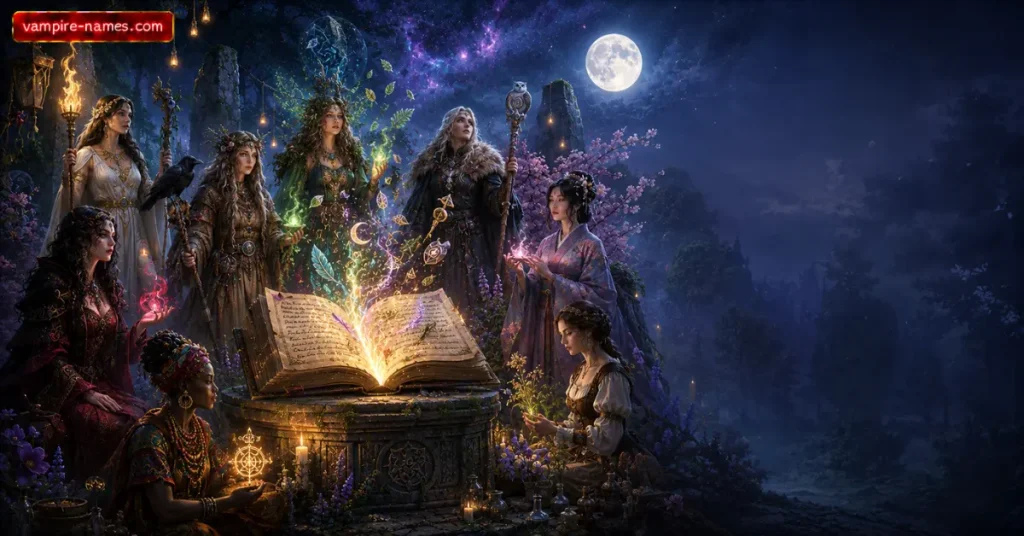
A witch’s name is never just a label. It’s a history, a claim, and a warning. It says something about the culture that produced it, the tradition it comes from, and the specific type of power it represents. Hecate is not the same kind of name as Baba Yaga, which is not the same kind of name as Marie Laveau, which is not the same kind of name as Maleficent. Each of those names is a completely different kind of witch and if you blur them together into a generic ‘witch name’, you lose everything that makes each one powerful.
The tradition of female magical naming is thousands of years old and exists in every culture on earth. West African Vodou loa, Japanese yamauba, Norse völur, Slavic baba-figures, Celtic morrigan-types, Greek sorceresses, Roman magical practitioners each tradition has its own naming conventions, its own phonetics, its own specific relationship between the name and the power it represents. The best witch names you’ll ever find draw from one of these specific traditions rather than from generic ‘dark’ vocabulary.
You now have 700+ evil witch names female across 27 categories, the full historical context of the witch trials, five construction methods, the poison plant tradition, the Vodou tradition, eight cultural magical naming systems, and FAQ answers that actually go deep. Whether you’re naming a novel’s most complex character, choosing a DnD sorceress, looking for a gothic baby name, or honouring the real women who were called witches throughout history the right name is in here. Use it with intention.
“A witch chooses her name the way she chooses her power carefully, and with full knowledge of what it costs.”