he Ultimate Guide to Spiritual, Badass & Fantasy Monk Names
D&D | WoW | BG3 | Buddhist | Taoist | Medieval | Shadow | Funny
| 700+Monk Names | 25+Categories | With MeaningsAll Key Names | Every TraditionCovered |
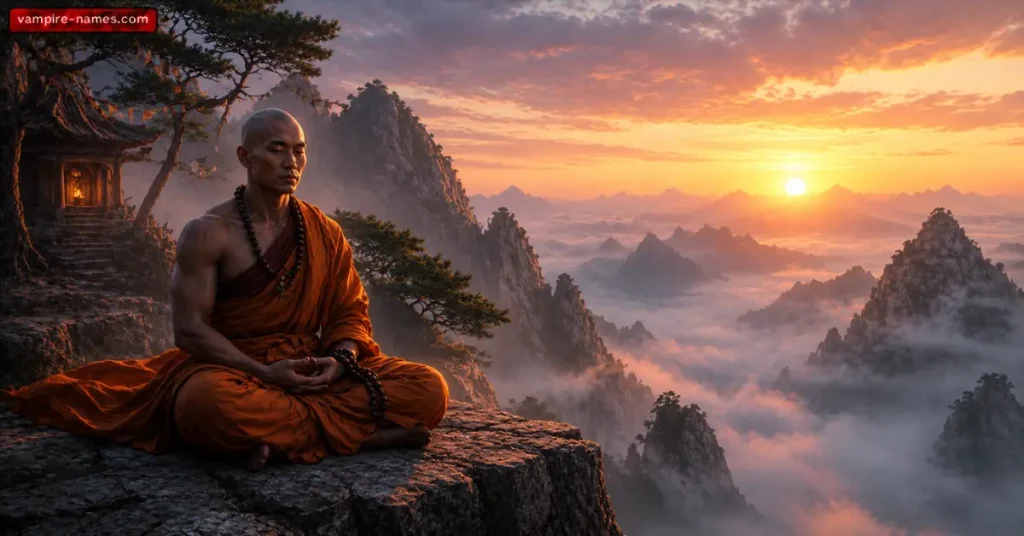
700+ Monk Names: The Ultimate Guide to Spiritual, Badass & Fantasy Monk Names
A monk’s name is a paradox. It should carry stillness and violence simultaneously. The patience of a decade of training and the explosive speed of a nerve strike. The humility of a bowed head and the confidence of someone who has never lost a fight they couldn’t avoid. That’s the monk archetype and it’s one of the most demanding names to get right.
This guide gives you 700+ monk names across every tradition you could need: D&D monk names by subclass, WoW monk names by race, BG3 monk names, Buddhist monk names from Zen and Theravada and Tibetan traditions, Taoist monk names, medieval Christian monk names, Sanskrit and Hindu monk names, shadow monk names, combat monk names, funny monk names that actually work, and one-word monk names that hit harder than most full names.
Every major name includes meaning and context. Because a monk name without roots is just noise and monks, more than almost any character type, should have names that mean something. Their whole identity is built around meaning. Their names should be too.
There’s also a section you won’t find in any competitor: how real monks actually get their Vampire Names . The history of monastic naming across Buddhist, Christian, Hindu, and Taoist traditions is genuinely fascinating, and understanding it will help you name your monk character with depth that readers and players will feel even if they can’t articulate why.
How Real Monks Get Their Names — The History of Monastic Naming
Real monastic naming is one of the most deliberate naming practices in human history. In almost every tradition, a monk doesn’t keep their birth name when they enter religious life. The new name signals a new identity — the old self has died, and what emerges from the monastery gate is someone defined by practice, not by family.
In Zen Buddhism, a monk receives a dharma name (homyo or kaimyo) from their teacher. This name is chosen to reflect the student’s spiritual character, their challenges, or the qualities they’re meant to cultivate. A student who struggles with anger might receive a name meaning ‘peaceful water.’ A student with natural stillness might receive a name meaning ‘clear mirror.’ The name is both description and aspiration.
In Tibetan Buddhism, the tradition is similar but often more elaborate. The name may include the teacher’s name, the monastery’s name, or a description of the student’s spiritual path. ‘Tenzin’ — the name the Dalai Lama gives to thousands of his disciples — means ‘holder of the Buddha-dharma.’ It encodes the responsibility of the student in two syllables.
Christian monasticism has its own tradition. When a monk or nun takes vows, they typically choose or receive a new name — usually the name of a saint whose virtues they wish to embody. Brother Thomas, Sister Clare, Father Augustine. The name is both a role model and a prayer. The historical tradition of Benedictine monks, Franciscans, Dominicans, and Cistercians each developed their own naming culture.
Taoist monks often receive names that reflect the natural world — mountains, water, clouds, bamboo — combined with concepts of virtue, emptiness, or flow. The name ‘Qingfeng’ (clear wind) or ‘Yunhe’ (cloud river) is both aesthetically beautiful and philosophically loaded. This is the naming tradition that most directly influenced what we think of as ‘monk names’ in fantasy settings.
Famous Real Monks Who Made Their Names Legendary
| Name | Meaning / Notes |
| Bodhidharma | Indian monk who brought Buddhism to China in the 5th century — founded Chan (Zen) Buddhism; name means ‘awakening-dharma’ |
| Xuanzang | Tang Dynasty Chinese monk who traveled to India for scriptures — the inspiration for ‘Journey to the West’ |
| Milarepa | Tibetan Buddhist master of the 11th century — former murderer who became one of Tibet’s greatest saints |
| Thomas Aquinas | Dominican friar (1225-1274) — ‘the dumb ox’ whose theological work shaped Western Christianity |
| Rumi | 13th century Sufi mystic — ‘Jalal ad-Din Rumi’ means ‘glory of faith, the Roman’ |
| Hildegard of Bingen | Benedictine abbess (1098-1179) — composer, healer, prophet, and one of the most powerful women of the Middle Ages |
| Nichiren | Japanese Buddhist monk (1222-1282) — ‘sun lotus’; founded his own school; never backed down |
| Dogen | Japanese Zen founder (1200-1253) — ‘way origin’; brought Soto Zen from China to Japan |
| Nagarjuna | Indian Buddhist philosopher (c. 150-250 CE) — ‘serpent-noble’; founded Madhyamaka philosophy |
| Ikkyu | Eccentric Japanese Zen monk (1394-1481) — drank, visited brothels, wrote poetry; still a master |
What Makes a Great Monk Name?
Monk names operate differently from warrior names or wizard names. A warrior name should sound powerful. A wizard name should sound arcane. A monk name should sound… still. And then, underneath that stillness, something sharp.
The best monk names are deceptively simple. ‘Kai.’ ‘Ren.’ ‘Storm.’ ‘Vex.’ One or two syllables, clean consonants, open vowels. The monk’s name should be easy to say under pressure because the monk is easy to underestimate — right up until the moment they aren’t. A four-syllable monk name with heavy consonant clusters tends to feel wrong, like a hammer trying to be a needle.
Cultural roots matter more for monk names than for almost any other character type. A monk with a Japanese name inhabits a different tradition than a monk with a Sanskrit name, a Tibetan name, or a medieval Latin name. Each tradition carries different assumptions about what the monk values, how they fight, what they’re trying to achieve. Choose the tradition first, then the name within it.
For D&D specifically, subclass matters. A Way of the Open Hand monk practices the most traditional martial arts — their name should be clean, East Asian-influenced, traditional. A Way of Shadow monk is an assassin in monk’s robes — their name should be darker, more elusive. A Way of the Four Elements monk should have a name with elemental resonance. A Drunken Master should probably have a name that sounds like it could belong to either a sage or a barfly.
Best Monk Names
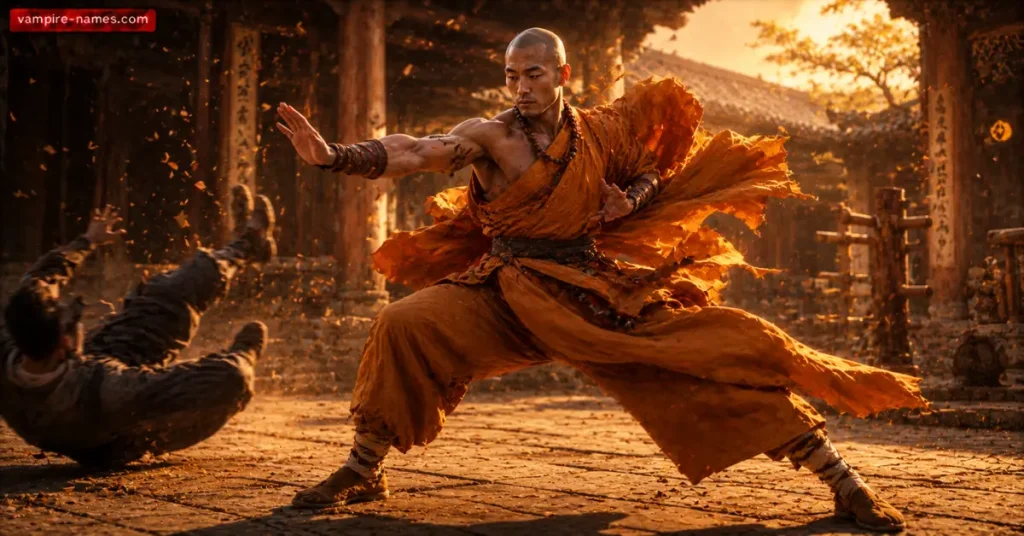
The flagship names versatile, strong, culturally grounded. These work across D&D, WoW, BG3, fantasy fiction, and any setting where the monk archetype needs a name that carries genuine weight.
Best Monk Names with Meanings
| Name | Meaning / Notes |
| Kai | Japanese/Hawaiian: ‘sea’ or ‘shell’ — the vast, deep, apparently calm monk |
| Ren | Japanese: ‘lotus’ or ‘love’ — the lotus grows in mud but emerges clean; the monk’s path |
| Theron | Greek: ‘hunter’ — the combat monk; hunting is discipline made physical |
| Vex | Latin root: ‘to trouble’ — the shadow monk; troubles enemies without being seen |
| Aldric | Old German: ‘noble ruler’ — the monastic master; leads without claiming authority |
| Jin | Chinese/Japanese: ‘gold’ or ‘benevolent, swift’ —ble monk of speed and generosity |
| Kael | Invented/Gaelic-feel: hard K opening — the combat monk who hits before thinking |
| Sora | Japanese: ‘sky’ — the monk without limits; the open hand reaching upward |
| Dusk | Old English: ‘growing dark’ — the shadow monk; operates in the time between day and dark |
| Roran | Invented: R-heavy name with growling quality — the monk whose techniques feel like weather |
| Makoto | Japanese: ‘sincerity, truth’ — Kyudo’s central virtue; the monk who means everything |
| Zephyr | Greek: ‘west wind’ — the speed monk; arrives before the sound of his footsteps |
| Calix | Greek: ‘chalice/cup’ — the monk who contains something larger than themselves |
| Oryn | Invented: short, clean, cross-cultural — works in any setting |
| Tempest | Latin: ‘storm’ — the Four Elements monk; weather as a fighting philosophy |
More Best Monk Names — Quick Reference
| Ash | Blaze | Crest | Dawn |
| Echo | Flint | Gale | Haze |
| Iron | Jade | Kite | Lark |
| Mist | Nova | Onyx | Pine |
| Quill | Reed | Stone | Tide |
| Umbra | Vapor | Wind | Zen |
Male Monk Names
Male monk names draw from every tradition that has produced great monastic warriors and scholars. These balance the warrior’s directness with the contemplative’s depth.
Male Monk Names with Meanings
| Name | Meaning / Notes |
| Aldric | Old German: ‘noble ruler’ — the master who leads the dojo without claiming the title |
| Bowen | Welsh: ‘son of Owen’ (young warrior) — the monk in training who will surpass his master |
| Conan | Irish: ‘little wolf’ or ‘warrior’ — the fierce monk; small but devastating |
| Daichi | Japanese: ‘great land’ or ‘great wisdom’ — the grounded monk; immovable |
| Edric | Old English: ‘rich ruler’ — the monastic administrator; runs the monastery |
| Fuji | Japanese: ‘wisteria’ or Mount Fuji — the monk as mountain; enduring and high |
| Gareth | Welsh: ‘gentle’ — the monk who hasn’t needed to fight in years; therefore the most dangerous |
| Hiro | Japanese: ‘broad, widespread’ — the monk whose influence reaches far |
| Isamu | Japanese: ‘brave, courageous’ — the combat monk who chose bravery as a discipline |
| Jin | Chinese/Japanese: ‘benevolent, swift’ — the monk who helps faster than he fights |
| Kaito | Japanese: ‘sea and sky’ or ‘soaring’ — the monk who moves between realms |
| Leif | Old Norse: ‘heir’ — the monk who carries the school’s tradition forward |
| Makoto | Japanese: ‘sincerity, truth’ — the monk whose word is iron |
| Naoki | Japanese: ‘honest tree’ — rooted in virtue; the monastery’s reliable pillar |
| Osamu | Japanese: ‘discipline, study’ — literally named for what monks do |
| Phelan | Irish: ‘wolf’ — the combat monk who moves like a predator |
| Ren | Japanese: ‘lotus’ — grows through difficulty; emerges pure |
| Shin | Japanese: ‘true, genuine’ — the monk whose techniques are orthodox and devastating |
| Takumi | Japanese: ‘artisan, skilled’ — the monk as craftsman; combat as art |
| Ulric | Old German: ‘wolf power’ — the combat elder; retired but not diminished |
| Vance | Old French: ‘marshland’ — the monk who is hard to pin down |
| Wren | Old English: tiny bird — the monk everyone underestimates |
| Xander | Greek: ‘defender of men’ — the protective monk; fights for others, not himself |
| Yato | Japanese: ‘night’ — the shadow monk from anime tradition |
| Zenko | Japanese: ‘good deed’ — the monk who manifests goodness in action |
More Male Monk Names — Quick Grid
| Akira | Botan | Chikara | Daisuke |
| Enji | Gorou | Haruki | Idris |
| Jasper | Ken | Lothar | Masaru |
| Nobu | Orion | Pierce | Rylan |
| Soren | Taro | Umi | Valor |
| Wystan | Yorick | Zarek | Zenji |
Female Monk Names
Female monk names carry a specific tradition — from Hildegard of Bingen to the Shaolin nuns to the Buddhist bhikkhuni order. These cute island names balance spiritual authority with combat competence, because the best female monk characters embody both without conflict.
Female Monk Names with Meanings
| Name | Meaning / Notes |
| Akane | Japanese: ‘deep red, madder’ — the passionate, intense female monk |
| Brynn | Welsh: ‘hill’ — grounded, steady, the monastery’s foundation |
| Caelia | Latin: ‘of the heavens’ — the monk who has transcended earthly concerns |
| Dara | Irish/Hebrew: ‘oak tree’ or ‘pearl of wisdom’ — the monk-scholar |
| Elowen | Cornish: ‘elm tree’ — Celtic, rare, deeply connected to natural elements |
| Faye | Old English/French: ‘fairy’ — the elusive monk; impossible to hit |
| Gwyneth | Welsh: ‘blessed’ — the monastic teacher; chosen for a purpose |
| Hana | Japanese: ‘flower’ — beauty and precision; the strike that blooms on impact |
| Izumi | Japanese: ‘spring, fountain’ — the source; the monk others draw from |
| Juna | Multiple origins: ‘moon’ — the lunar monk; tidal, cyclical, patient |
| Kira | Persian/Irish: ‘ruler’ or ‘dark’ — the female master who commands absolutely |
| Lyra | Greek: ‘lyre’ — the Ongaku (music) monk; sound as a weapon |
| Mira | Sanskrit/Slavic: ‘ocean’ or ‘peace’ — the deep monk; unreadable |
| Nao | Japanese: ‘honest, direct’ — no hidden techniques; devastatingly straightforward |
| Orla | Irish: ‘golden princess’ — the noble monk who gave up everything and gained more |
| Petra | Greek: ‘rock’ — the unmovable monk; the one who cannot be toppled |
| Quinn | Irish: ‘wisdom, reason’ — the monk who wins by understanding |
| Rin | Japanese: ‘dignified, cold’ — the emotionally controlled combat monk |
| Selene | Greek: moon goddess — the lunar-aligned monk; silver and precise |
| Thyra | Old Norse: ‘Thor’s battle’ — the battle monk; divine force in human form |
| Una | Irish/Latin: ‘one’ — singular; there is no substitute |
| Vesper | Latin: ‘evening star’ — the monk who is most dangerous at dusk |
| Wren | Old English: tiny bird with outsized power — the small monk who leads |
| Yuki | Japanese: ‘snow’ or ‘happiness’ — the winter monk; serene and cold |
| Zara | Arabic: ‘brilliant’ — the monk who illuminates everything she touches |
More Female Monk Names — Quick Grid
| Aella | Chiyo | Emiko | Fumiko |
| Ginko | Hibiki | Ichika | Junko |
| Kanna | Liria | Miyu | Nana |
| Otome | Ran | Sakura | Tsukiko |
| Urara | Vivara | Waka | Yua |
D&D Monk Names by Subclass (5e)
D&D monk subclasses have very different identities, and names should reflect that. Here are names organized by the most common 5e monk subclasses, with explanations of why each fits.
Way of the Open Hand (Traditional Martial Arts)
The Open Hand is the most traditional monk subclass. Names should be clean, East Asian-influenced, and suggest mastery of body and mind.
| Name | Meaning / Notes |
| Makoto | Japanese: ‘sincerity, truth’ — the Open Hand’s core virtue; pure technique |
| Jin | Chinese/Japanese: ‘benevolent, swift’ — the open hand that helps before it strikes |
| Ren | Japanese: ‘lotus’ — the classic Open Hand monk name; grows through difficulty |
| Takumi | Japanese: ‘artisan’ — combat as craft; the Open Hand perfectionist |
| Hana | Japanese (female): ‘flower’ — the strike that blooms |
| Sora | Japanese: ‘sky’ — the limitless Open Hand monk |
| Kai | Japanese/Hawaiian: ‘sea’ — the Open Hand master; deep and calm |
| Shin | Japanese: ‘true’ — the orthodox technique practitioner |
Way of Shadow (Assassin Monk)
Shadow monks are ninja-adjacent assassins. Names should be short, elusive, slightly threatening.
| Name | Meaning / Notes |
| Vex | Latin: ‘to trouble’ — the shadow monk; troubles enemies without being seen |
| Dusk | Old English: ‘growing dark’ — the twilight monk; operates in transitions |
| Ghost | Old English: ‘spirit’ — the shadow monk who isn’t there when you look |
| Kuro | Japanese: ‘black’ — the dark monk; darkness is home |
| Yoru | Japanese: ‘night’ — the night-monk; the darkness itself |
| Shade | Old English: ‘shadow’ — the shadow of a person; the assassin’s presence |
| Cipher | Arabic: ‘zero, nothing’ — the shadow monk who is nothing until they strike |
| Nox | Latin: ‘night’ — the shadow monk of classical elegance |
Way of the Four Elements
Four Elements monks bend elemental forces. Names should carry elemental resonance.
| Name | Meaning / Notes |
| Tempest | Latin: ‘storm’ — the quintessential Four Elements monk name |
| Ember | Old English: ‘low burning fire’ — the fire-aligned monk |
| Gale | Old English: ‘wind’ —ail monk; the wind technique monk |
| Stone | Old English: ‘rock’ — the earth-aligned monk; immovable |
| Tide | Old English: ‘water’ — the water-aligned monk; flows around obstacles |
| Blaze | Old English: ‘fire’ — the aggressive fire monk |
| Frost | Old English: ‘frost’ — the ice monk; control through cold |
| Zephyr | Greek: ‘west wind’ — the air monk; arrives first |
Way of the Drunken Master
Drunken Master monks are unpredictable, comedic, and devastatingly effective. Names should sound like they could belong to a sage or a barfly.
| Sloshed | Wobble | Tipsee | Barrel |
| Flask | Swig | Stumble | Malt |
| Brine | Cork | Dregs | Fuddle |
| Lagered | Slur | Toddy | Vinegar |
Way of the Astral Self
Astral Self monks manifest their ki as a spectral form. Names should sound cosmic and slightly untethered from the physical world.
| Aether | Astral | Cosmos | Drift |
| Ethereal | Flux | Gravity | Halo |
| Infinite | Jettison | Kinesis | Liminal |
| Manifest | Nebula | Orbit | Prism |
| Quasar | Rift | Stellar | Void |
D&D Monk Names by Race
Race affects how a D&D monk’s name sounds as much as their subclass. Here are name suggestions appropriate to each race commonly played as monks.
Human Monk Names
| Aldric | Brynn | Conan | Dara |
| Edric | Freya | Gareth | Hale |
| Ivar | Jessa | Knox | Lyra |
| Mace | Nora | Oryn | Petra |
Elf Monk Names
| Aelindra | Caladwen | Elareth | Lyriel |
| Nimrodel | Sylindra | Thalindra | Vaelindor |
| Aleryn | Celador | Elenath | Moonweald |
| Silvenmoor | Starleaf | Thornelith | Windweald |
Dwarf Monk Names
| Aldrun | Brondin | Copperhelm | Darkdelve |
| Flinthall | Grimdelve | Hammerholm | Ironpeak |
| Khundrath | Moldenmere | Runemount | Stonecrown |
| Thunderak | Anvilborn | Bronzeholm | Deepvault |
Halfling & Gnome Monk Names
| Bimble | Clover | Dewdrop | Ember |
| Finch | Glow | Hazel | Ivy |
| Juniper | Kettle | Lark | Mossy |
| Nettle | Oak | Pebble | Quill |
BG3 Monk Names (Baldur’s Gate 3)
Baldur’s Gate 3 monk characters inhabit the Forgotten Realms setting, which blends Western medieval fantasy with Asian martial arts traditions. The best BG3 monk names feel grounded in the Faerun setting while reflecting the monk’s specific tradition and origin.
BG3 Monk Names by Race
| Name | Meaning / Notes |
| Shadowheart | Canon BG3 character — dark-themed name that works perfectly for a Shadow monk |
| Kae | Short, cross-cultural — works for any BG3 monk race |
| Thorn | Fits the Forgotten Realms’ gritty aesthetic; also thematically right for a monk |
| Sari | Human female monk — soft but capable; the monk others overlook |
| Zev | Short Hebrew-feel name — ‘wolf’; works for a darker-aligned BG3 monk |
| Irik | Invented: Githyanki-feel name for a Gith monk in BG3 |
| Astarion-adjacent | BG3’s camp invites names with Elven flow for Elf monks |
| Drak | Dragonborn monk — the draconic heritage expressed through force |
| Minthara-feel | Dark Elf aesthetic — aristocratic Elvish for a Drow monk |
| Halsin-adjacent | Wood Elf energy — nature-connected names for a Forest monk |
| Wyll-feel | Human urban monk — short, city-born, slightly roguish |
| Karlach-feel | Tiefling monk — powerful, slightly infernal, surprisingly warm |
More BG3 Monk Names — Quick Grid
| Varis | Tienne | Krel | Mori |
| Jast | Senna | Draven | Calix |
| Riven | Thane | Vael | Nira |
| Oren | Silvar | Tael | Wren |
WoW Monk Names by Race (World of Warcraft)
World of Warcraft monks are tied to the Pandaren tradition and the teachings of Tushui and Huojin philosophy. Race-specific naming conventions matter in WoW because each race has its own phonetic culture.
Pandaren Monk Names
Pandaren names are warm, often nature-connected, occasionally food-themed, and carry a gentle humor alongside genuine wisdom.
| Name | Meaning / Notes |
| Chen | Famous Pandaren brewer and wanderer — the iconic Pandaren monk name |
| Ji | WoW Lore: Ji Firepaw — the Huojin philosophy monk; action-oriented |
| Aysa | WoW Lore: Aysa Cloudsinger — the Tushui monk; contemplative |
| Bao | Chinese: ‘precious, treasure’ — the Pandaren who values what matters |
| Mei | Chinese: ‘beautiful’ or ‘plum’ — the Pandaren female monk name |
| Luo | Chinese surname: the Pandaren family tradition |
| Tong | Chinese: ‘together’ — the Pandaren community monk |
| Ping | Chinese: ‘peaceful’ — the Pandaren who embodies Tushui philosophy |
| Zan | Chinese: ‘praise, admire’ — the Pandaren who finds joy in everything |
| Fei | Chinese: ‘fly, soar’ — the Pandaren who moves like wind |
Human & Night Elf WoW Monk Names
| Marcus | Lyenna | Torvald | Serindra |
| Aldric | Fialanis | Brennan | Sylindra |
| Cade | Elindra | Wystan | Thalindra |
| Godric | Aerindel | Piers | Lyriel |
Draenei & Gnome WoW Monk Names
| Vedra | Tinkwhistle | Naraxi | Cogsworth |
| Velen-ko | Sprocket | Akama-ko | Fizzgig |
| Shaylen | Nubscrew | Maraad-ko | Gizmatic |
| Ishanah | Buzzcog | Telryn | Wrenchkit |
Japanese Monk Names
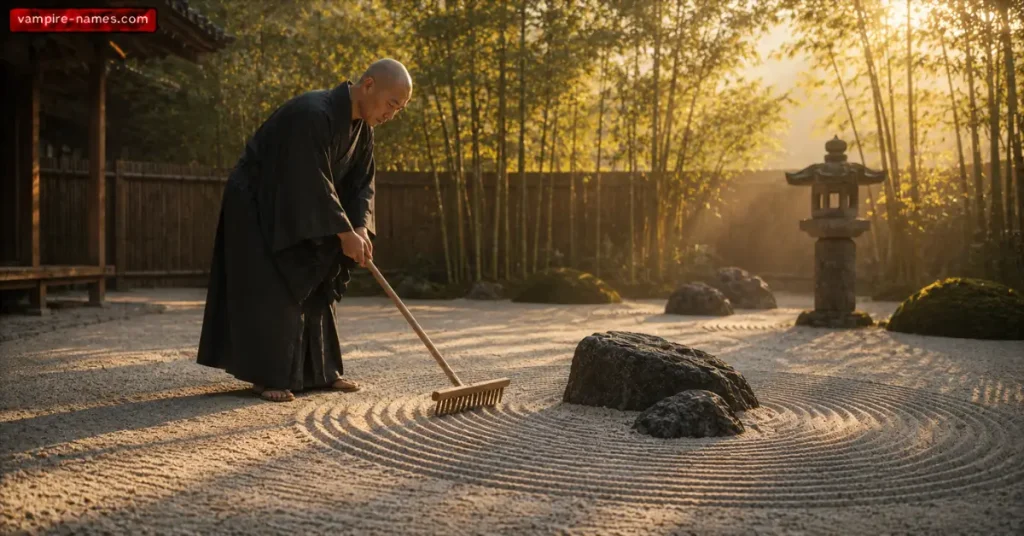
Japanese monastic naming draws from Buddhism, Shinto traditions, and the samurai culture that intersected with Zen Buddhism for centuries. These Tiefling Names are appropriate for historically-grounded Japanese settings, feudal Japan-inspired fantasy, and any monk character from that tradition.
| Name | Meaning / Notes |
| Ikkyu | Historical (1394-1481): the eccentric Zen master — means ‘one pause’; lived against convention |
| Dogen | Historical (1200-1253): founder of Soto Zen in Japan — means ‘way origin’ |
| Musashi | Historical: Miyamoto Musashi the swordsman — place name that became synonymous with mastery |
| Nichiren | Historical (1222-1282): ‘sun lotus’ — the monk who never compromised |
| Kukai | Historical (774-835): founded Shingon Buddhism in Japan — means ‘sea of emptiness’ |
| Saigyo | Historical (1118-1190): the wandering Buddhist poet-monk |
| Ryokan | Historical (1758-1831): the gentle Zen monk who played with children and wrote poetry |
| Hakuin | Historical (1686-1769): revived Japanese Rinzai Zen; famous for koans |
| Takuan | Historical (1573-1645): the Zen monk who taught swordsmanship through Zen principles |
| Yuki | Japanese: ‘snow’ or ‘happiness’ — the winter monk |
| Akira | Japanese: ‘bright, clear’ — the clear-minded monk |
| Haruki | Japanese: ‘spring radiance’ — the renewing monk |
| Makoto | Japanese: ‘sincerity, truth’ — the truthful monk |
| Nori | Japanese: ‘law, precedent’ — the rule-keeper monk |
| Zenji | Japanese: ‘Zen monk’ as a personal name — the monk named for the practice itself |
Buddhist Monk Names (Zen, Theravada, Tibetan)
Buddhist monk names across traditions carry specific philosophical weights. Zen names tend to be short and paradoxical. Theravada names are often Pali-based and refer to Buddhist virtues. Tibetan names are often compound and may include the teacher’s name or Buddhist concepts.
Zen Buddhist Monk Names
| Name | Meaning / Notes |
| Mushin | Japanese Zen: ‘no-mind’ — the state of empty, reactive mind; ultimate monk goal |
| Mugen | Japanese: ‘limitless, infinite’ — the Zen monk who has exceeded categories |
| Zazen | Japanese: ‘sitting meditation’ — named for the core practice |
| Kensho | Japanese Zen: ‘seeing one’s nature’ — the moment of enlightenment |
| Satori | Japanese Zen: ‘enlightenment’ — the goal given as a name |
| Koans | Japanese Zen: the paradox-riddles — a monk named for the practice of questioning |
| Sesshin | Japanese Zen: ‘touching the mind’ — the intensive meditation retreat as a name |
| Kinhin | Japanese Zen: ‘walking meditation’ — the moving practice as a name |
Theravada Buddhist Monk Names (Pali)
| Name | Meaning / Notes |
| Ananda | Pali: ‘bliss, joy’ — the Buddha’s personal attendant; one of the greatest names |
| Dhamma | Pali: ‘truth, teaching’ — the monk who embodies the teaching |
| Sila | Pali: ‘virtue, morality’ —ila the monk of perfect conduct |
| Panna | Pali: ‘wisdom’ — the monk of insight |
| Metta | Pali: ‘loving-kindness’ — the monk who loves completely |
| Karuna | Pali: ‘compassion’ — the compassionate monk |
| Upeka | Pali: ‘equanimity’ — the unshakeable monk |
| Saddha | Pali: ‘faith, confidence’ — the monk of deep trust |
Tibetan Buddhist Monk Names
| Name | Meaning / Notes |
| Tenzin | Tibetan: ‘holder of the Buddha-dharma’ — the Dalai Lama gives this to disciples |
| Karma | Sanskrit/Tibetan: ‘action, cause-effect’ — the monk who understands consequence |
| Rinpoche | Tibetan: ‘precious one’ — honorific title used as a character name |
| Milarepa | Historical Tibetan: ‘cotton-clad Mila’ — the saint who transcended murder |
| Dorje | Tibetan: ‘thunderbolt, diamond’ — the indestructible monk |
| Pemba | Tibetan: ‘Saturday’ or ‘Saturn’ — named for their day of birth |
| Sonam | Tibetan: ‘merit, good fortune’ — the monk who has accumulated virtue |
| Jampa | Tibetan: ‘loving-kindness’ — the Maitreya-aligned monk |
Taoist & Chinese Monk Names
Taoist monk names use Chinese vocabulary focused on nature, emptiness, flow, and the Tao itself. They tend to be two-character compounds where each character carries philosophical meaning.
| Name | Meaning / Notes |
| Qingfeng | Chinese: ‘clear wind’ — the wind that moves without effort; pure Taoist movement |
| Yunhe | Chinese: ‘cloud river’ — the Taoist who flows like water through cloud |
| Wuming | Chinese: ‘no name’ — the Tao Te Ching’s nameless principle as a monk name |
| Ziran | Chinese: ‘natural, spontaneous’ — the Taoist virtue of naturalness |
| Kongxin | Chinese: ’empty heart’ — the monk who has made space for the Tao |
| Shenglong | Chinese: ‘divine dragon’ — the Taoist monk of highest power |
| Baihe | Chinese: ‘white crane’ — the crane style master; elegance as combat |
| Hushan | Chinese: ‘tiger mountain’ — the tiger style master; power as combat |
| Qianhe | Chinese: ‘thousand rivers’ — the monk whose techniques are as varied as water |
| Wuwei | Chinese: ‘non-action’ — the Taoist principle of effortless action as a name |
| Xuzhi | Chinese: ’empty wisdom’ — the monk who knows through emptiness |
| Jingxin | Chinese: ‘still heart’ — the emotionally unshakeable monk |
| Lingfeng | Chinese: ‘spiritual wind’ — the monk who moves with spirit |
| Mingde | Chinese: ‘bright virtue’ — the monk whose goodness illuminates |
| Tianzhen | Chinese: ‘heavenly truth’ — the monk who seeks cosmic truth |
Medieval Christian Monk Names
Medieval Christian monks took saints’ names when they entered monastic life. These names carry the weight of centuries of Christian tradition and work perfectly for any medieval fantasy monk, particularly in settings inspired by European history.
| Name | Meaning / Notes |
| Augustine | Latin: ‘venerable’ — Saint Augustine of Hippo; the great theological mind |
| Benedict | Latin: ‘blessed’ — Saint Benedict of Nursia; founder of Western monasticism |
| Thomas | Aramaic: ‘twin’ — Thomas Aquinas; the ‘dumb ox’ who changed everything |
| Francis | Latin: ‘Frenchman’ — Francis of Assisi; the monk who talked to animals |
| Dominic | Latin: ‘of the Lord’ — founder of the Dominican order; the preaching monk |
| Bernard | Old German: ‘bold bear’ — Bernard of Clairvaux; the most influential monk of the 12th century |
| Columba | Latin: ‘dove’ — the Irish monk who founded Iona; brought Christianity to Scotland |
| Dunstan | Old English: ‘dark stone’ — Archbishop and monk; legendary for fighting the devil himself |
| Hildegard | Old German (female): ‘battle stronghold’ — Hildegard of Bingen; visionary and healer |
| Clare | Latin (female): ‘bright, clear’ — Clare of Assisi; founded the Poor Clares |
| Gertrude | Old German (female): ‘spear strength’ — the great medieval mystic |
| Scholastica | Latin (female): ‘scholar’ — Benedict’s twin sister; founded the female Benedictine tradition |
| Bede | Old English: ‘prayer’ — the Venerable Bede; scholar and historian monk |
| Alcuin | Old English: ‘noble friend’ — Charlemagne’s advisor monk; ran the Palace School |
| Anselm | Old German: ‘God’s protection’ — Archbishop of Canterbury; monk-philosopher |
Hindu & Sanskrit Monk Names
Sanskrit monk names carry the oldest monastic naming tradition in the world — the Hindu ashram tradition predates Buddhist monasticism. These names draw from the Sanskrit vocabulary of dharma, yoga, and the various Hindu spiritual paths.
| Name | Meaning / Notes |
| Arjuna | Sanskrit: ‘bright, shining’ — the divine archer-warrior guided by Krishna |
| Ananda | Sanskrit: ‘bliss’ — the ultimate state; also the Buddha’s attendant |
| Dharma | Sanskrit: ‘cosmic order, right action’ — the monk who embodies the law |
| Karma | Sanskrit: ‘action, cause-effect’ — the monk who acts without attachment to results |
| Deva | Sanskrit: ‘divine being’ —ival the monk touched by divinity |
| Shiva | Sanskrit: ‘auspicious’ — the destroyer-god aspect; the combat monk who purges |
| Artha | Sanskrit: ‘purpose, meaning’ — the monk who has found their purpose |
| Moksha | Sanskrit: ‘liberation’ — the monk seeking ultimate freedom |
| Satya | Sanskrit: ‘truth’ — the monk of absolute honesty; dangerous and wise |
| Tapas | Sanskrit: ‘ascetic practice, heat’ — the monk who burns through discipline |
| Veda | Sanskrit: ‘knowledge’ — the monk-scholar; all knowledge as path to liberation |
| Yogi | Sanskrit: ‘one who practices yoga’ — the monk of physical and spiritual discipline |
| Siddhi | Sanskrit: ‘perfection, attainment’ — the monk who has achieved supernatural powers |
| Prema | (female) Sanskrit: ‘love, affection’ — the female monk of loving devotion |
| Shakti | (female) Sanskrit: ‘power, energy’ — the divine feminine force as a female monk |
Badass & Combat Monk Names
Sometimes the monk doesn’t need to be meditative. Sometimes they need to sound like someone who will put you through a wall with their open hand. These names carry fighting energy without losing the monk’s characteristic precision.
| Blade | Crest | Dread | Ember |
| Ferox | Grim | Havoc | Iron |
| Jade | Kaine | Lynx | Mace |
| Nova | Onyx | Pierce | Riven |
| Steel | Thorn | Umbra | Valor |
| Wrath | Xane | Zeal | Zenith |
| Strikefist | Ironpalm | Voidstrike | Swiftblow |
| Galehand | Stonefist | Thunderkick | Deadstrike |
Spiritual & Meditative Monk Names
For monks whose identity is contemplation over combat — the healer, the sage, the wandering philosopher. These names carry stillness, wisdom, and the kind of authority that comes from genuine understanding.
| Name | Meaning / Notes |
| Ananda | Sanskrit/Pali: ‘bliss’ — the monk who has found what they were looking for |
| Metta | Pali: ‘loving-kindness’ — the monk who loves completely |
| Satori | Japanese Zen: ‘enlightenment’ — the goal made name |
| Dharma | Sanskrit: ‘cosmic order’ — the monk who embodies right action |
| Wuwei | Chinese Taoist: ‘non-action’ — the monk who acts through non-action |
| Peace | Old English: ‘tranquility’ —ache the monk who brings stillness |
| Sage | Latin: ‘wise’ — the monk-sage; wisdom as a way of life |
| Solace | Latin: ‘comfort’ — the healing monk; comes to difficult places |
| Serenity | Latin: ‘calm’ — the monk who cannot be disturbed |
| Lotus | Sanskrit: ‘padma’ — the monk who grows through difficulty and emerges clean |
| Echo | Greek: the sound that returns from the mountain; the monk who reflects |
| Reed | Old English: the hollow plant — the monk who has emptied themselves for wisdom |
Shadow & Assassin Monk Names
Shadow monks are the most dangerous kind — because nobody expects the monk to be the assassin. These names should feel slightly wrong, slightly too quiet, slightly too present in the shadows.
| Name | Meaning / Notes |
| Cipher | Arabic: ‘zero, nothing’ — the shadow monk who is nothing until they aren’t |
| Ghost | Old English: ‘spirit’ — the assassin who isn’t there when you look |
| Vex | Latin: ‘to trouble’ — troubles enemies without being seen |
| Dusk | Old English: ‘growing dark’ — the twilight operative |
| Shade | Old English: ‘shadow’ — the presence of darkness in light |
| Nox | Latin: ‘night’ — the shadow monk of classical elegance |
| Wraith | Scottish: ‘ghost, apparition’ — the shadow monk who moves like a ghost |
| Null | Latin: ‘nothing, zero’ — the monk who has negated their presence |
| Vesper | Latin: ‘evening star’ — the monk who works in the last light |
| Kuro | Japanese: ‘black’ — darkness as home and weapon |
| Yomi | Japanese: ‘underworld’ — the shadow monk with death-adjacent skills |
| Obsidian | Latin: ‘volcanic glass’ — black, sharp, volcanic origin; cuts without warning |
Fantasy Monk Names
Fantasy monk names blend real monastic naming traditions with invented phonetics that feel ancient and spiritually charged. These work in any fantasy setting from Forgotten Realms to original worldbuilding.
| Vaelthorn | Keldrath | Grimvael | Solindra |
| Dawnbreaker | Torgan | Ashveil | Vexara |
| Ironmark | Kaelith | Grimthorn | Embervast |
| Nightfall | Stormwall | Grimwarden | Voidwalker |
| Ashmere | Ironbane | Jadestone | Moonveil |
| Rimfire | Skyreach | Tidewind | Windwall |
Funny & Pun Monk Names
The monk character is surprisingly well-suited to comedy — the contrast between serene face and explosive violence is inherently funny. These Pirate Names lean into that comedy, from terrible puns to food-themed absurdity to pop-culture references.
Monk Puns and Wordplay Names
| Monkey Business | Funky Monk | Junk in the Trunk | Drunk Monk |
| Chunk o’Monk | Spunk Monk | Debunk Monk | Monk-ey See |
| Skunk Monk | Bunk Monk | Punk Monk | Funk Monk |
| Clunk Master | Hunk Monk | Trunk Puncher | Monk De Bonk |
Food-Themed Funny Monk Names
| Wonton Yu | Buddha Pest | Dim Sum Dong | Kung Pao Pete |
| Fried Rice | Miso Angry | Dumpling Dan | Noodle Arms |
| Bao Bro | Spring Roll | Fortune Fist | Eggroll Earl |
| Soup Kick | Ramen Randy | Tofu Thomas | Soy Sauce Sam |
Pop Culture Monk Names
| Master Po | Jackie Chan | Bruce Leee | Ip Manwich |
| Kung Fu Panda | Shifu Shuffle | Mr. Miyagi | Pai Mei |
| Liu Kang Ding | Kung Lao Hat | Shang-Chi Chi | Doctor Strange |
Cool One-Word Monk Names
One-word monk names are some of the most powerful in any tradition. The monk who has reduced everything to its essence doesn’t need two words. These hit harder precisely because they say less.
| Ash | Blade | Calm | Dawn |
| Echo | Flux | Gale | Haze |
| Iron | Jade | Kite | Lore |
| Mist | Null | Onyx | Pine |
| Quill | Reed | Storm | Tide |
| Umbra | Void | Wind | Zen |
| Stone | Fire | Frost | Thunder |
| Soul | Peace | Truth | Still |
Monk Titles and Honorifics
Monk titles work as either prefixes or standalone names, and understanding the tradition behind each one helps you use them correctly in any setting.
| Name | Meaning / Notes |
| Sifu | Cantonese: ‘master, teacher’ — the combat arts title; used throughout Chinese martial arts |
| Sensei | Japanese: ‘one who has gone before’ — the Japanese teacher title |
| Roshi | Japanese Zen: ‘old master’ — the senior Zen teacher; deep respect implied |
| Rinpoche | Tibetan: ‘precious one’ — the Tibetan Buddhist teacher honorific |
| Ajahn | Pali via Thai: ‘teacher’ —ach the Theravada Buddhist master title |
| Venerable | Latin: ‘worthy of deep respect’ —erable the Christian monastic honorific |
| Brother | Old English: ‘sibling’ — the monastic community title; implies equality |
| Friar | Old French: ‘brother’ —ance the mendicant monk’s title; wanders rather than stays |
| Abbot | Aramaic: ‘father’ — the head of a monastery; commander and spiritual father |
| Abbess | Aramaic (female): ‘mother’ — the female head of a religious community |
| Acharya | Sanskrit: ‘one who teaches by example’ — the Hindu-Buddhist teacher title |
| Guru | Sanskrit: ‘heavy, weighty’ — the teacher whose presence has gravity |
| Lama | Tibetan: ‘superior one’ — the Tibetan teacher; not the animal |
| Osho | Sanskrit: ‘to throw light’ — used by Rajneesh/Osho movement; also a Japanese Zen title |
| Shihan | Japanese: ‘master instructor’ — the highest martial arts teaching rank |
Unique Monk Names with Meanings
These names stand out because they draw from traditions underrepresented in most monk name guides, or because they combine concepts in genuinely fresh ways.
| Name | Meaning / Notes |
| Mushin | Japanese Zen: ‘no-mind’ — the ultimate monk achievement as a name |
| Wuwei | Chinese Taoist: ‘non-action’ — the Taoist principle of effortless action |
| Siddhi | Sanskrit: ‘perfection, supernatural power’ — the monk who has achieved |
| Kensho | Japanese Zen: ‘seeing one’s nature’ — named for the enlightenment moment |
| Tapas | Sanskrit: ‘ascetic heat’ — the monk who generates power through discipline |
| Zazen | Japanese Zen: ‘seated meditation’ — the practice itself as a name |
| Dorje | Tibetan: ‘thunderbolt, diamond’ — indestructible and strikes lightning |
| Dhamma | Pali: ‘truth, the teaching’ — the monk who embodies the teaching |
| Qingfeng | Chinese: ‘clear wind’ — the Taoist who moves without effort |
| Ikkyu | Japanese: ‘one pause’ — the eccentric Zen master who defied convention |
| Metta | Pali: ‘loving-kindness’ — the radical virtue of universal love |
| Kongxin | Chinese: ’empty heart’ — the monk who has created space for wisdom |
How to Create Your Own Monk Name
Method 1: Choose a Tradition First
The most important decision in monk naming is which tradition your monk comes from. A Zen Buddhist monk, a Shaolin-style wushu monk, a Tibetan lama, a Benedictine friar, a Taoist immortal, and a Hindu yogi have completely different naming conventions. Each tradition has its own vocabulary, its own concepts, its own relationship between name and identity. Pick the tradition before you pick the name. Then explore that tradition’s actual vocabulary for names that carry genuine meaning. ‘Makoto’ (sincerity) works because Japanese Zen cares deeply about sincerity. ‘Dharma’ (cosmic order) works because Hindu and Buddhist traditions care about the law. The tradition tells you which concepts are worth naming for.
Method 2: Use Monastic Virtues as Names
Every monastic tradition has a list of core virtues, and these virtues make excellent names because they encode the monk’s entire identity in a single word. Buddhist virtues: Metta (loving-kindness), Karuna (compassion), Panna (wisdom), Sila (virtue), Saddha (faith). Taoist virtues: Ziran (naturalness), De (virtue), Jing (stillness), Pu (uncarved wood). Christian virtues: Prudence, Justice, Fortitude, Temperance. Sanskrit virtues: Satya (truth), Ahimsa (non-violence), Dharma (right action), Tapas (discipline). Any of these, used as a name, carries its entire tradition behind it.
Method 3: One Word, Maximum Impact
The most powerful monk names are often the shortest. ‘Ash.’ ‘Stone.’ ‘Gale.’ ‘Void.’ ‘Peace.’ One word that contains the monk’s entire fighting philosophy or spiritual orientation. This technique works because monks have typically stripped everything unnecessary from their lives — their name should reflect that discipline. If your monk character has been in training for twenty years, they’ve probably thought deeply about what the essence of their path is. Name them that essence. ‘Storm’ for the Four Elements monk. ‘Still’ for the Open Hand master. ‘Shadow’ for the assassin monk. ‘Null’ for the monk who has achieved no-self.
Method 4: The Contrast Principle
The most interesting monk names contain a contradiction. ‘Gentle Iron’ (gentle but hard). ‘Silent Thunder’ (loud but inaudible). ‘Peaceful Storm’ (calm but devastating). ‘Iron Lotus’ (hard and delicate simultaneously). This works because the monk archetype IS a contradiction — the most dangerous person in the room who is also the most at peace. Evil Names that encode that contradiction are immediately evocative. You don’t need to use both words as a full name — just one side of the contrast that implies the other. ‘Gentle’ implies the violence underneath. ‘Thunder’ implies the silence that precedes it.
Method 5: Use the Dharma Name Tradition
In the actual Buddhist tradition, a dharma name is chosen to reflect what the student needs to cultivate or what their natural spiritual quality is. Apply this to character creation: what quality does your monk most need to develop? If they struggle with anger, their name might be ‘Metta’ (loving-kindness) or ‘Shanti’ (peace) — an aspiration. If they have natural stillness, their name might be ‘Tempest’ or ‘Storm’ — a reminder of their potential for disruption when necessary. The dharma name tradition says: the name is both description and aspiration. The best monk names do both simultaneously.
Frequently Asked Questions About Monk Names
Q: What is a cool monk name?
Cool monk names share a specific quality: they sound still until you think about what they mean. ‘Mushin’ (Japanese Zen: no-mind), ‘Tempest’ (the storm monk), ‘Vex’ (the shadow monk who troubles enemies), ‘Dorje’ (Tibetan: thunderbolt/diamond), ‘Kael’ (hard and precise), ‘Satori’ (enlightenment itself as a name), ‘Zephyr’ (west wind), ‘Makoto’ (sincerity), ‘Jin’ (benevolent and swift). The coolest monk names tend to be short — one or two syllables — and carry a weight that’s disproportionate to their length. ‘Ash’ is three letters and contains entire worlds. That’s the monk’s aesthetic.
Q: What are good D&D monk names?
D&D monk names should match the subclass. Way of the Open Hand: Makoto, Ren, Jin, Hana, Sora — traditional martial arts aesthetics. Way of Shadow: Vex, Dusk, Ghost, Kuro, Cipher — dark and elusive. Way of the Four Elements: Tempest, Ember, Gale, Stone, Tide — elemental names. Drunken Master: Wobble, Flask, Swig, Stumble — comedic and unpredictable. Astral Self: Aether, Flux, Nebula, Void — cosmic and untethered. For any subclass, consider whether your monk retains a birth name or took a monastic name — the story of that choice is often as interesting as the name itself.
Q: What are WoW monk names?
World of Warcraft monks are primarily associated with the Pandaren tradition and Tushui/Huojin philosophy. Pandaren names are warm, nature-connected, and sometimes food-adjacent: Chen, Ji, Aysa, Bao, Mei, Ping, Fei, Zan. For other WoW races: Human monks work with names like Aldric, Brennan, Cade, Marcus. Night Elf monks suit names like Lyenna, Silvar, Fialanis, Thalindra. Draenei monks work with harder, more alien-sounding names. The key for WoW monk naming is fitting the racial phonetic conventions of the Forgotten Realms while reflecting the monk’s martial arts identity.
Q: What is a good name for a female monk?
Female monk names work best when they carry the same quiet precision as male monk names, without defaulting to softness as a default. Strong options: Hana (Japanese: flower), Rin (Japanese: dignified), Thyra (Old Norse: Thor’s battle), Petra (Greek: rock), Quinn (Irish: wisdom), Makoto (Japanese: sincerity — gender-neutral), Metta (Pali: loving-kindness), Clare (Latin: bright — the medieval abbess tradition), Shakti (Sanskrit: power), Selene (Greek: moon). For shadow monks: Ghost, Vesper, Cipher, Null, Shade. For combat monks: Iron, Blade, Gale, Tempest. The female monk is one of fiction’s most powerful archetypes — her name should match that power.
Q: What are Buddhist monk names?
Buddhist monk names vary by tradition. Zen: Mushin (no-mind), Satori (enlightenment), Kensho (seeing one’s nature), Zazen (seated meditation), Makoto (sincerity). Theravada Pali: Ananda (bliss), Dhamma (truth), Sila (virtue), Panna (wisdom), Metta (loving-kindness), Karuna (compassion). Tibetan: Tenzin (holder of dharma), Dorje (thunderbolt), Karma (action), Sonam (merit), Jampa (loving-kindness). Historical real monk names that work beautifully as character names: Dogen (way-origin), Ikkyu (one pause), Milarepa (cotton-clad), Nichiren (sun-lotus), Kukai (sea of emptiness).
Q: What are medieval monk names?
Medieval Christian monks took saints’ names at profession. Most used ones: Augustine (venerable), Benedict (blessed), Thomas (twin — Aquinas), Francis (Frenchman), Dominic (of the Lord), Bernard (bold bear), Bede (prayer), Alcuin (noble friend), Anselm (God’s protection). Female names: Hildegard (battle stronghold), Clare (bright), Gertrude (spear strength), Scholastica (scholar). For a medieval monk character, these names automatically bring centuries of tradition with them. ‘Brother Benedict’ or ‘Father Augustine’ carries a whole monastic world in a few words.
Q: What are funny monk names?
Funny monk names work best when they play on the contrast between monastic serenity and combat violence. Pun-based options: Wonton Yu, Drunk Monk, Funky Monk, Chunk o’Monk, Monk De Bonk, Bunk Monk, Punk Monk. Food-themed: Buddha Pest, Kung Pao Pete, Dim Sum Dong, Miso Angry, Noodle Arms, Fortune Fist. Pop culture: Master Po-tential, Ip Manwich, Liu Kang Ding. The best funny monk names work because they carry a punchline in the name itself — and monks, more than most character types, can deliver a punchline with their fist while maintaining perfect facial serenity.
Q: What are monk titles and honorifics?
Monk titles vary by tradition. Japanese: Sensei (teacher), Roshi (old master), Shihan (master instructor). Chinese/Cantonese: Sifu (master teacher). Tibetan Buddhist: Rinpoche (precious one), Lama (superior one). Theravada Buddhist: Ajahn (teacher). Christian monastic: Brother, Sister, Friar, Abbot, Abbess, Venerable. Sanskrit-based: Guru (weighty teacher), Acharya (teaches by example), Swami (master). For D&D, these titles work as either prefixes (Sensei Kai, Sifu Ren) or as standalone names that a monk has earned and now uses as their only identifier. ‘The Roshi’ — no personal name; the title is enough.
Conclusion
A monk’s name is the shortest possible description of their entire path. In Buddhist tradition, the dharma name is both what they are and what they’re becoming. In the Taoist tradition, the name encodes their relationship with the natural world. In the Christian tradition, the name is a prayer and a model. In D&D, it should tell your fellow players something about your character before you’ve described anything else.
The 700+ names in this guide span every tradition, every subclass, every game, every aesthetic. Use them directly, combine them, let them lead you to something entirely your own. The creation methods at the end are the real toolkit once you understand how real monks get their Archer Names , you can build one that’s genuinely rooted rather than randomly assembled.
One final note: the monk who has truly achieved mastery often doesn’t need a name at all. But until that day, pick one that carries the weight of what you’re practicing. The name should be a challenge as much as an identity. Something worth growing into.
“The monk who needs three words to explain themselves hasn’t meditated enough.”