The Ultimate Fox Spirit Naming Guide
Japanese | Mythology | D&D | Anime | Gothic | Hybrid | Clan Names
| 700+Kitsune Names | 24+Categories | With MeaningsAll Key Names | MythologyFully Covered |
700+ Kitsune Names with Meanings: The Ultimate Fox Spirit Naming Guide
Some creatures from world mythology have a name so precisely right that no translation can improve on it. Kitsune is one of them. The word itself from the Japanese ki (come) + tsune (always) or from older linguistic roots meaning simply ‘fox’ carries a universe of meaning in two syllables. Intelligent. Ancient. Capable of both great compassion and devastating trickery. The kind of entity that could be your greatest ally or your worst mistake, and you won’t know which until it’s already decided.
Kitsune naming is its own art form. It draws from genuine Japanese linguistics, from Buddhist and Shinto traditions, from elemental philosophy, from the mythology of Inari Ōkami (the Shinto deity of foxes, rice, and prosperity), and from centuries of folklore that distinguished between kitsune who served heaven and those who served only themselves. A kitsune’s name should carry that history or at least gesture toward it.
This guide gives you 700+ kitsune names across every category you could need: traditional Japanese female and male names, names by tail count and power level, names for the nine elemental types, dark Nogitsune names, Gothic fox names (a category almost nobody covers properly), fox-human hybrid names, D&D and Pathfinder Vampire Names, anime-inspired names, clan names, nicknames, and usernames. Every major name includes meaning and context, because a name without roots is just noise.
Whether you’re building a D&D or Pathfinder character, writing a story featuring a fox spirit, creating a game character, or just trying to find the perfect name that fits a kitsune’s particular combination of beauty and danger you’re in the right place.
What Is a Kitsune? The Mythology You Need to Know
Before we dive into names, a quick mythology briefing — because kitsune names only make full sense when you understand what a kitsune actually is. This isn’t just flavor text. If you’re naming a kitsune character, knowing the tradition helps you name them appropriately for their power level, alignment, and role.
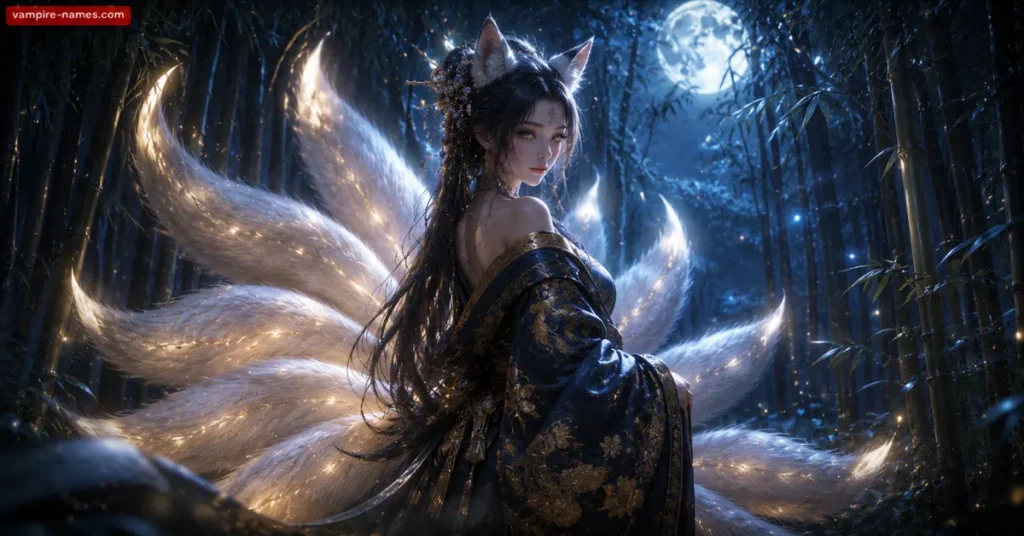
Kitsune are supernatural foxes in Japanese mythology — but they’re not simply magical animals. They’re shapeshifters capable of taking human form, beings of intelligence and longevity who gain power as they age. The older and wiser a kitsune, the more tails they grow: one tail at birth, up to nine tails for the most ancient and powerful. A nine-tailed fox (kyūko or kubô) has existed long enough to see empires rise and fall.
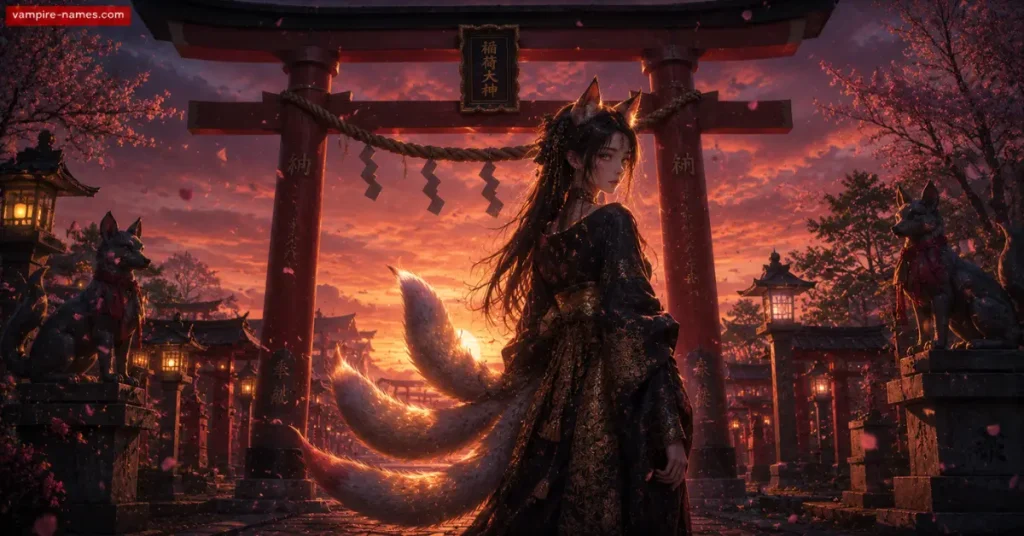
The fundamental split in kitsune mythology is between Zenko — divine foxes who serve Inari Ōkami, act as messengers of the gods, and generally use their powers for good — and Nogitsune (also called wild foxes or mischievous foxes), who answer to no deity and pursue their own goals. The Nogitsune are where the trickster tradition comes from: they possess humans, drain life energy, create illusions, and cause chaos for reasons that range from boredom to revenge to genuine malevolence.
This distinction matters enormously for naming. A Zenko kitsune might carry a name meaning light, blessing, or service. A Nogitsune’s name should feel darker — more ancient, more predatory, touched by something that doesn’t entirely respect human boundaries. The best kitsune names communicate which side of that divide the character occupies, even before you know anything else about them.
Famous Kitsune from Japanese Mythology and History
| Name | Meaning / Notes |
| Tamamo-no-Mae | The most famous kitsune in Japanese legend — a beautiful courtesan revealed to be a nine-tailed fox; killed, her spirit became the Sesshōseki (death stone) |
| Kūgen | From the Otogizōshi tales — a kitsune who falls in love with a monk; perhaps the most sympathetic kitsune in classical literature |
| Abe no Seimei’s mother | According to legend, the great onmyōji Abe no Seimei was the son of a kitsune woman — her name lost, her legacy immense |
| Hakuzōsu | A kitsune from the Tale of Genji tradition — appears as a beautiful woman; the name means ‘white storehouse’ |
| Inari no Kitsune | The divine fox messengers of Inari Ōkami — white foxes who guard Inari shrines across Japan |
| Kiko | From popular folklore — a young kitsune learning her powers; the name means ‘radiant child’ |
| Yaegaki Hime | From the kabuki tradition — a princess revealed to be kitsune-descended; uses fox magic to serve love |
| The Fox Wife | A recurring figure in countless regional tales — always beautiful, always eventually revealed, always departing at the moment of discovery |
The Nine Types of Kitsune — and What They Mean for Naming
Most people know about fire and shadow kitsune from anime. Fewer know that Japanese mythology and later folklore developed a full taxonomy of kitsune types — nine elemental varieties, each associated with different powers, temperaments, and spiritual alignments. These types directly inform what kind of name fits.
| Name | Meaning / Notes |
| Kaze no Kitsune | Wind kitsune — swift, elusive, associated with messages and travel; names should be light and mobile |
| Hi no Kitsune | Fire kitsune — passionate, dangerous, associated with forge and purification; names should burn |
| Mizu no Kitsune | Water kitsune — adaptable, reflective, associated with rivers and rain; names should flow |
| Tsuchi no Kitsune | Earth kitsune — stable, patient, associated with harvest and territory; names should be grounded |
| Kaminari Kitsune | Thunder/lightning kitsune — dramatic, powerful, associated with storms; names should crack and strike |
| Mori no Kitsune | Forest kitsune — hidden, territorial, associated with wild things; names should feel ancient and wooded |
| Yama no Kitsune | Mountain kitsune — solitary, wise, the oldest kinds; names should carry weight and altitude |
| Ongaku Kitsune | Music kitsune — the most dangerous seducers; names should be melodic and irresistible |
| Tengoku Kitsune | Celestial kitsune — the divine type, closest to Inari; names should feel sacred and untouchable |
Kitsune Tail Count — Names by Power Level
A kitsune’s tail count is its most significant marker of age and power. Naming conventions in both mythology and fiction often reflect this — older, more powerful kitsune have Khajiit Names that feel more ancient, more resonant, harder to casually pronounce. Younger kitsune have lighter, shorter names.
One-Tail Kitsune Names (Young, Learning, Curious)
| Kiko | Sora | Hana | Yuki |
| Momo | Nari | Tama | Kuri |
| Hoshi | Riku | Fuwa | Niko |
| Chibi | Pika | Shiro | Kome |
Three-Tail Kitsune Names (Growing Power, First Deceptions)
| Kasumi | Ryoko | Hotaru | Mizuki |
| Asahi | Tsubaki | Koharu | Natsu |
| Kenji | Hiroshi | Takumi | Soren |
| Haruki | Naoki | Akira | Yori |
Five-Tail Kitsune Names (Formidable, Ancient, Respected)
| Akatsuki | Shirogane | Kurohane | Midori |
| Izanami | Kazahana | Tsukiyomi | Raijin |
| Fujiwara | Murasaki | Shiroyuki | Amatsu |
| Ren | Kagekiyo | Himiko | Arashi |
Nine-Tail Kitsune Names (Ancient, Divine or Fallen, Untouchable)
| Name | Meaning / Notes |
| Tamamo | From Tamamo-no-Mae — the most famous nine-tailed fox in Japanese legend |
| Kyūko | Literally ‘nine-tail child’ in Japanese — the name for the nine-tailed form itself |
| Izanagi-Ko | Invoking the primal creator deity — a kitsune old enough to remember creation |
| Sessho | From Sesshōseki (death stone) — the kitsune whose anger became geological |
| Mugen | Japanese: ‘limitless, infinite’ — the nine-tail who has exceeded all previous boundaries |
| Amaterasu-ko | Invoking the sun goddess — for a celestial nine-tail of unquestioned divinity |
| Konton | Japanese: ‘chaos’ — the nine-tail whose power has destabilized their own alignment |
| Yoruichi | Popular in anime — also genuinely beautiful; ‘night one’ in rough translation |
| Hakumei | Japanese: ‘faint light at dawn’ — the nine-tail who arrives at the in-between moment |
| Taiyo-Kage | Japanese compound: ‘sun shadow’ — the nine-tail who contains opposites simultaneously |
How Kitsune Names Work — Japanese Naming Principles
Japanese names don’t work the way English names do. They’re built from kanji — Chinese-derived characters, each carrying meaning — and the same phonetic name can mean completely different things depending on which kanji write it. This is why Japanese naming is both an art and a deliberate act of intention.
Female kitsune names in traditional Japanese tend to use kanji related to natural beauty: hana (flower), yuki (snow), tsuki (moon), hoshi (star), kasumi (mist), akane (red sky at dawn). Male kitsune names often use kanji suggesting strength, action, or elemental force: kaze (wind), arashi (storm), ryuu (dragon), kami (god/spirit), ren (lotus), haruki (spring radiance).
One consistent pattern across both genders: kitsune names in fiction and mythology often carry a suggestion of duality — something beautiful alongside something dangerous, or something natural alongside something supernatural. ‘Shirogane’ (white silver) is beautiful and cold simultaneously. ‘Akatsuki’ (red dawn) is both morning and blood. That duality is intentional. Kitsune are dual creatures. Their Fake Country Names should be too.
For non-Japanese settings (D&D, Western fantasy, original fiction), you can borrow Japanese phonetics without necessarily borrowing real kanji meaning. The sounds work: soft vowels, minimal consonant clusters, words that end cleanly on vowels or soft consonants. ‘Mizaru,’ ‘Korashi,’ ‘Velindra,’ ‘Nyraka’ — these feel kitsune-appropriate even when they aren’t Japanese words.
Best Kitsune Names
The flagship names versatile, strong, appropriate across fiction genres from anime to high fantasy to gothic horror. Every one has been chosen for phonetic beauty and thematic resonance with kitsune mythology.
Best Kitsune Names with Meanings
| Name | Meaning / Notes |
| Akatsuki | Japanese: ‘red dawn’ — the moment between dark and light; perfect for a kitsune who operates there |
| Shirogane | Japanese: ‘white silver’ — beautiful, cold, precious; the aesthetic of a high-power kitsune |
| Kasumi | Japanese: ‘mist’ — the kitsune who is never clearly seen; always slightly obscured |
| Tamamo | From Tamamo-no-Mae — the nine-tailed legend; instantly recognizable to anyone in the tradition |
| Kurohane | Japanese: ‘black feather’ — the fox who moves as silently as falling feathers |
| Mizuki | Japanese: ‘beautiful moon’ — water and moonlight; the classic beautiful kitsune name |
| Kitsunetsuki | The state of fox possession — used as a name for a kitsune who defines that experience |
| Raijin | Japanese god of lightning and thunder — borrowed as a name for a storm kitsune |
| Hotaru | Japanese: ‘firefly’ — small lights in darkness; deceptively fragile-seeming power |
| Yoru | Japanese: ‘night’ — simple, clean, and perfectly kitsune |
| Kaze | Japanese: ‘wind’ — the element most associated with kitsune swiftness |
| Himiko | Historical: the legendary shaman-queen of ancient Japan; mythic weight |
| Murasaki | Japanese: ‘purple’ — from The Tale of Genji; aristocratic, literary, slightly melancholy |
| Arashi | Japanese: ‘storm’ — the kitsune who arrives with weather |
| Tsubaki | Japanese: ‘camellia flower’ — the flower associated with death and beauty simultaneously |
More Best Kitsune Names — Quick Reference
| Akane | Hoshi | Izumi | Kokoro |
| Lumina | Nami | Oboro | Ran |
| Sakura | Tsuki | Umeko | Velindra |
| Wakaba | Xenith | Yomogi | Zaria |
Female Kitsune Names
Female kitsune are by far the more prominent gender in Japanese folklore — the classic image is a beautiful woman who is eventually revealed to have fox ears or a tail, or whose shadow shows a fox’s shape. The names for female kitsune tend to be melodic, beautiful, and carry natural imagery, but the best ones have an edge underneath the beauty.
Female Kitsune Names with Meanings
| Name | Meaning / Notes |
| Akane | Japanese: ‘deep red, madder’ — the red sky at dawn; passionate, intense |
| Aoi | Japanese: ‘blue, hollyhock’ — cool and aristocratic; Heian-era noble name |
| Azusa | Japanese: ‘catalpa tree’ — the tree whose wood makes bows; beauty with weaponry |
| Chihiro | Japanese: ‘thousand fathoms’ — unfathomable depth; Spirited Away’s protagonist |
| Fujiko | Japanese: ‘wisteria child’ — the hanging, beautiful, slightly melancholy flower |
| Ginko | Japanese: ‘silver child’ — silver is the kitsune’s metal; luminous and cold |
| Hanako | Japanese: ‘flower child’ — beautiful surface; don’t mistake it for softness |
| Izumi | Japanese: ‘spring, fountain’ — the source of water; refreshing and inexhaustible |
| Kagura | Japanese: ‘god-entertainment’ — the sacred Shinto dance performed for deities |
| Koharu | Japanese: ‘little spring’ — the second spring of Indian summer; unexpectedly warm |
| Kurumi | Japanese: ‘walnut’ — hard shell, sweet interior; don’t assume the exterior tells the story |
| Midori | Japanese: ‘green’ — nature, growth, the forest’s claiming of everything in time |
| Natsuki | Japanese: ‘summer hope’ or ‘to love’ — warmth with a hint of longing |
| Oboro | Japanese: ‘misty, hazy’ — the moon through clouds; obscured beauty |
| Rin | Japanese: ‘dignified, cold’ — the kitsune who maintains emotional distance |
| Satsuki | Japanese: ‘fifth month, May’ — the azalea month; named for peak beauty |
| Tokiha | Japanese: ‘time feather’ — invented compound; the kitsune who rides time |
| Umeko | Japanese: ‘plum child’ — the plum blooms in winter; beauty that endures cold |
| Wakaba | Japanese: ‘young leaves’ — the tender new growth that conceals incredible resilience |
| Yuki | Japanese: ‘snow’ or ‘happiness’ — dual meaning perfectly reflects kitsune duality |
| Yomogi | Japanese: ‘mugwort’ — medicinal plant; the healer kitsune, useful and slightly bitter |
| Yukiko | Japanese: ‘snow child’ — the ice-touched female kitsune; cold and pristine |
| Zelara | Invented: Japanese-feel phonetics for a Western fantasy context |
| Zaria | Slavic-Japanese hybrid: Slavic dawn goddess name in kitsune phonetics |
Pretty Female Kitsune Names — Quick Grid
| Amaya | Hana | Ichika | Junko |
| Kanna | Liria | Miyu | Nana |
| Otome | Ran | Sakura | Tsukiko |
| Urara | Vivara | Waka | Yua |
| Asahi | Byakko | Chiyo | Emiko |
| Fumiko | Ginza | Hibiki | Isadora |
Male Kitsune Names
Male kitsune appear less frequently in classical Japanese folklore but are common in modern anime and gaming traditions. They tend toward names suggesting elemental power, celestial connection, or ancient authority. These Pirate Names should feel deliberate and weighted — a male kitsune who has chosen to reveal himself has almost certainly planned the encounter in advance.
Male Kitsune Names with Meanings
| Name | Meaning / Notes |
| Arashi | Japanese: ‘storm’ — the kitsune who arrives with weather and changes everything |
| Byakko | Japanese: ‘white tiger’ — one of the four celestial guardians; a kitsune aligned with west |
| Daichi | Japanese: ‘great land’ or ‘great wisdom’ — the grounded, territorial kitsune |
| Fujiwara | Japanese clan name: ‘wisteria plain’ — ancient aristocratic weight; old-blood kitsune |
| Genbu | Japanese: ‘black tortoise’ — the northern celestial guardian; old, patient, enduring |
| Haruki | Japanese: ‘spring radiance’ — the kitsune who heralds renewal; deceivingly warm |
| Izanagi | Japanese mythology: the male creator deity — immense weight for an ancient kitsune |
| Jin | Japanese: ‘benevolent, swift’ — the honorable kitsune; rare, recognizable, trustworthy |
| Kaito | Japanese: ‘sea and sky’ or ‘soaring’ — the kitsune who moves between realms |
| Kuro | Japanese: ‘black’ — simple, clean, direct; the dark-furred male kitsune |
| Makoto | Japanese: ‘sincerity, truth’ — the kitsune who, unusually, means what he says |
| Naoki | Japanese: ‘honest tree’ — the rooted male kitsune; forest-aligned, ancient |
| Onibi | Japanese: ‘demon fire, will-o’-wisp’ — dangerous light; follows you when you shouldn’t follow it |
| Raiden | Japanese: ‘thunder lightning’ — the storm kitsune; raw power, dramatic entrance |
| Seiryu | Japanese: ‘blue dragon’ — the eastern celestial guardian; fast, water-aligned |
| Takeshi | Japanese: ‘warrior, military’ — the fighting kitsune; unusual and therefore memorable |
| Tsukuyomi | Japanese moon god — ruler of the night; perfect for a celestial night-kitsune |
| Ryuu | Japanese: ‘dragon’ — the highest-power comparison; not used lightly |
| Zenko | Japanese: ‘good fox’ — literally names the benevolent alignment; ironic if misused |
| Kazuhiko | Japanese: ‘wind prince’ — the male wind kitsune; swift, light, uncontainable |
More Male Kitsune Names — Quick Grid
| Akio | Bunta | Chikara | Daisuke |
| Enji | Fuji | Gorou | Haru |
| Isamu | Jiro | Ken | Masaru |
| Nobu | Osamu | Ren | Sho |
| Taro | Umi | Yato | Zen |
Japanese Kitsune Names — Traditional and Authentic
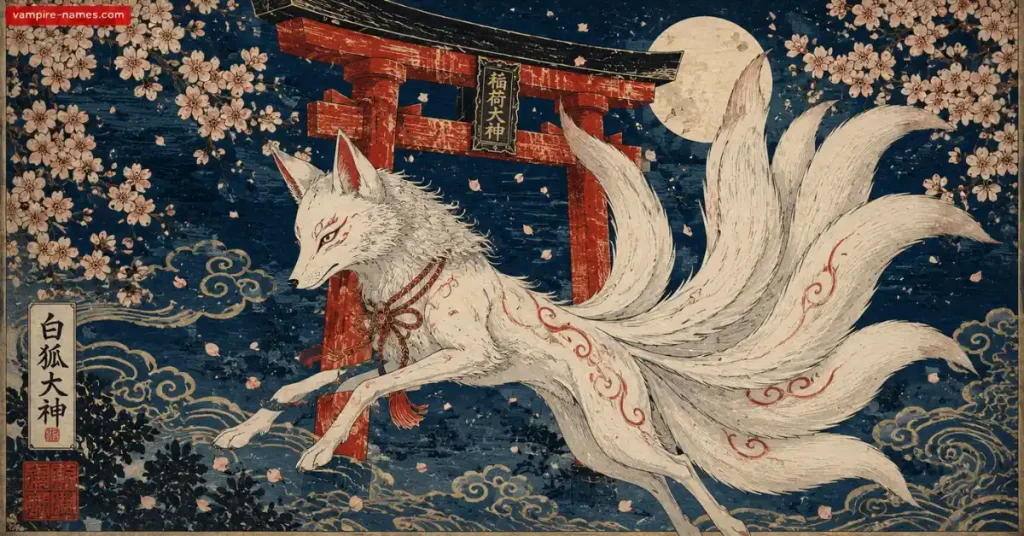
These names are drawn from actual Japanese vocabulary, classical literature, and Shinto religious tradition. They’re appropriate for characters in historically-grounded Japanese settings, classical fantasy inspired by Heian or Edo period Japan, or any context where authenticity matters more than Western familiarity.
| Name | Meaning / Notes |
| Inari | The Shinto deity of foxes, rice, and prosperity — used as a name for a kitsune devoted to divine service |
| Uzume | Shinto: the goddess of dawn and festivity — the joyful, dancing kitsune |
| Amaterasu | Shinto: the sun goddess — an almost sacrilegious name for a kitsune; used only for the most divine |
| Susanoo | Shinto: the storm god — male; chaos and sea; a storm kitsune’s deepest aspiration |
| Benzaiten | Buddhist-Shinto: goddess of music, knowledge, time — the music kitsune’s patron deity |
| Raijin | Shinto: god of thunder — the lightning kitsune’s namesake deity |
| Fūjin | Shinto: god of wind — the wind kitsune archetype deity |
| Izanami | Shinto: the female creator and goddess of death — the kitsune who has seen everything |
| Tsukuyomi | Shinto: moon god banished to the night by Amaterasu — alone, beautiful, lunar |
| Kaguya | From The Tale of the Bamboo Cutter — the celestial princess; used for a heavenly kitsune |
| Murasaki | From The Tale of Genji — the most literary female name in Japanese tradition |
| Sei Shonagon | Historical: the great Heian female writer — sharp, witty, noticing everything; a scholar-kitsune |
| Ono no Komachi | Historical: legendary beauty and poet — used for a kitsune whose power is seduction through art |
| Himiko | Historical: the shaman-queen of ancient Yamatai — real woman, mythologized enormously |
Fox Spirit Names from Chinese and Korean Mythology
The kitsune tradition doesn’t exist in isolation — it’s part of a broader East Asian fox spirit tradition that includes the Chinese huli jing and the Korean kumiho. These aren’t the same creature, and the naming conventions differ meaningfully. Understanding the differences helps you name fox spirit characters from non-Japanese traditions correctly.
Chinese Huli Jing Names
Chinese fox spirits (huli jing) are older in the literary record than Japanese kitsune. They appear in the Classic of Mountains and Seas, predate Buddhist influence, and are perhaps most famously represented by Daji — the concubine whose supernatural manipulation allegedly brought down the Shang dynasty. Chinese fox spirit names often use Chinese phonetics and Taoist/Confucian concepts.
| Name | Meaning / Notes |
| Daji | Historical Chinese: the nine-tailed fox concubine who destroyed a dynasty — the archetype of dark fox power |
| Huli | Chinese: literally ‘fox’ — used as a name for a young or simple fox spirit |
| Baili | Chinese: ‘white fox’ — the color associated with celestial and divine fox spirits in China |
| Mei Ling | Chinese: ‘beautiful jade’ — the classic Chinese beauty name; appropriate for a cultured huli jing |
| Xiao Hu | Chinese: ‘little fox’ — the diminutive; young, playful, not yet dangerous |
| Jiu Wei | Chinese: ‘nine tails’ — the direct name for the nine-tailed fox type |
| Ling Hu | Chinese: ‘clever fox’ — intelligence as primary characteristic |
| Feng | Chinese: ‘phoenix’ — used for a fox spirit of celestial ambition |
| Xuan Hu | Chinese: ‘mysterious fox’ — the unpredictable, inscrutable type |
| Zhen | Chinese: ‘precious, rare’ — the fox spirit who values herself appropriately |
Korean Kumiho Names
Korean fox spirits (kumiho — nine-tailed fox) are notably darker than their Japanese counterparts in traditional folklore. Where kitsune can be benevolent divine messengers, the kumiho is almost always predatory — eating human hearts and livers to transform permanently into human form. Great Warrior Names for kumiho characters should carry more menace.
| Name | Meaning / Notes |
| Miho | Korean: the most common short form; ‘beautiful lake’ or ‘beautiful fox’ — deceptively gentle |
| Soohyun | Korean: ‘pure, excellent’ — ironic for a kumiho; the beautiful lie she tells with her name |
| Jiyeon | Korean: ‘wisdom, affinity’ — the kumiho who studied humans for centuries before hunting them |
| Danbi | Korean: ‘welcome rain’ — the kumiho who appears when something is desperately wanted |
| Haewon | Korean: ‘ocean garden’ — depth and cultivation; something that has tended itself carefully |
| Iseul | Korean: ‘morning dew’ — beautiful, transient, gone before you realize what it meant |
| Nari | Korean: ‘lily’ — the kumiho who uses beauty as her primary weapon |
| Saebyeok | Korean: ‘dawn’ — the moment the night predator must withdraw; her name is her limitation |
| Yeonhee | Korean: ‘beautiful joy’ — names her gift; the joy is real but has a price |
| Cheonsa | Korean: ‘angel’ — the darkest irony for a predatory fox spirit |
Zenko (Benevolent) Kitsune Names
Zenko kitsune serve Inari Ōkami — they act as divine messengers, protect shrines, bring good fortune, and occasionally take human form to help or test mortals. Their names should carry light, warmth, divine connection, and a sense of service without servility. These are powerful beings who choose goodness, which is very different from being harmless.
| Name | Meaning / Notes |
| Inari-ko | Inari’s child — the divine fox who serves the Shinto deity directly |
| Shiroko | Japanese: ‘white child’ — white foxes are Inari’s sacred messengers; divine purity |
| Kinen | Japanese: ‘prayer, memorial’ — the kitsune who answers prayers at Inari shrines |
| Fukuro | Japanese: ‘blessing’ — the fox who delivers fortune |
| Taiyo | Japanese: ‘sun’ — Zenko aligned with solar divinity; life-giving, warm, inevitable |
| Megumi | Japanese: ‘blessing, grace’ — the classic Zenko name; grace freely given |
| Hikari | Japanese: ‘light’ — the divine messenger who carries illumination |
| Kansha | Japanese: ‘gratitude’ — the kitsune who accepts prayers and returns thanks |
| Shiro | Japanese: ‘white’ — the white fox; color of Inari’s sacred messengers |
| Nori | Japanese: ‘law, precedent’ — the divine kitsune who enforces cosmic order |
| Chinami | Japanese: ‘of the earth, ripple’ — divine connection expressed through the natural world |
| Yasuragi | Japanese: ‘peace, tranquility’ — the kitsune who brings calm to troubled places |
Nogitsune (Dark/Trickster) Kitsune Names
Nogitsune are wild foxes who answer to no deity and pursue their own goals — which range from mischief to possession to genuine predation. The Teen Wolf fandom helped spread this term, but the tradition is ancient. A Nogitsune’s name should feel slightly wrong — too beautiful, too musical, with an undertone that something fundamental is off.
Nogitsune Names with Meanings
| Name | Meaning / Notes |
| Konton | Japanese: ‘chaos’ — the Nogitsune whose power is pure disorder |
| Kuroyomi | Japanese compound: ‘black reading’ or ‘dark fate’ — the oracle who tells bad futures |
| Mayoi | Japanese: ‘lost, bewildered’ — causes confusion as a weapon |
| Kakuriyo | Japanese: ‘hidden world’ — the Nogitsune who operates between the visible and invisible |
| Urami | Japanese: ‘grudge, resentment’ — the fox spirit whose trickery comes from old anger |
| Shiranui | Japanese: ‘phosphorescent light at sea’ — the will-o’-wisp that leads travelers to disaster |
| Tatari | Japanese: ‘divine curse, retribution’ — the Nogitsune who punishes the deserving |
| Akuma-ko | Japanese: ‘demon child’ — the fully fallen Nogitsune; no longer pretends |
| Yomi | Japanese: the underworld — the Nogitsune who has visited death and returned changed |
| Majime | Japanese: ‘seriously, earnestly’ — the Nogitsune’s cruelest joke; utterly sincere in their malice |
| Oni-bi | Japanese: ‘demon fire’ — the fire type Nogitsune; burns what it touches |
| Kuroki | Japanese: ‘black tree’ — rooted in darkness; patient and old |
| Akuma | Buraku | Chinkon | Dorobo |
| Enma | Fudo | Gashadokuro | Habaki |
| Ikenie | Jigoku | Kegare | Mononoke |
| Noroi | Obake | Poltergeist | Rachi |
Elemental Kitsune Names
Elemental kitsune names are organized by their affinity — which element the kitsune draws power from. This matters for naming because different elements carry different sonic signatures. Fire names should feel hot and crackling. Water names should flow. Wind names should be light and fast. Earth names should be grounded and slow.
Fire Kitsune Names
| Name | Meaning / Notes |
| Kaen | Japanese: ‘flame’ — simple, direct, perfect |
| Honoo | Japanese: ‘blaze, flame’ — the active burning, not just the presence of fire |
| Moeru | Japanese: ‘to burn’ — the burning itself as an identity |
| Hibana | Japanese: ‘spark’ — the fire kitsune who starts things, not the one who finishes them |
| Akahoshi | Japanese: ‘red star’ — stellar fire; distant, ancient, intensely hot |
| Kagaribi | Japanese: ‘bonfire, beacon fire’ — the fire that guides rather than destroys |
| Pyrael | Invented: ‘pyre’ + Japanese suffix; for a Western fantasy fire kitsune |
| Cinderara | Invented compound: ash + suffix; the fire kitsune after the burning, not during |
Water Kitsune Names
| Mizura | Nagare | Shizuku | Umi |
| Kasane | Nami | Tsuyu | Minato |
| Ryusei | Izumi | Kawa | Shiori |
Wind Kitsune Names
| Kazari | Fujin | Arami | Soyokaze |
| Hayate | Tatsumaki | Kaoru | Kisekai |
| Nagi | Fubuki | Yufuin | Kamikaze |
Lightning & Thunder Kitsune Names
| Raijin | Kaminari | Ikazuchi | Tessen |
| Shinrai | Dengeki | Byakurai | Raiko |
| Arashi | Shiden | Tsurara | Inazuma |
Gothic Fox & Dark Kitsune Names
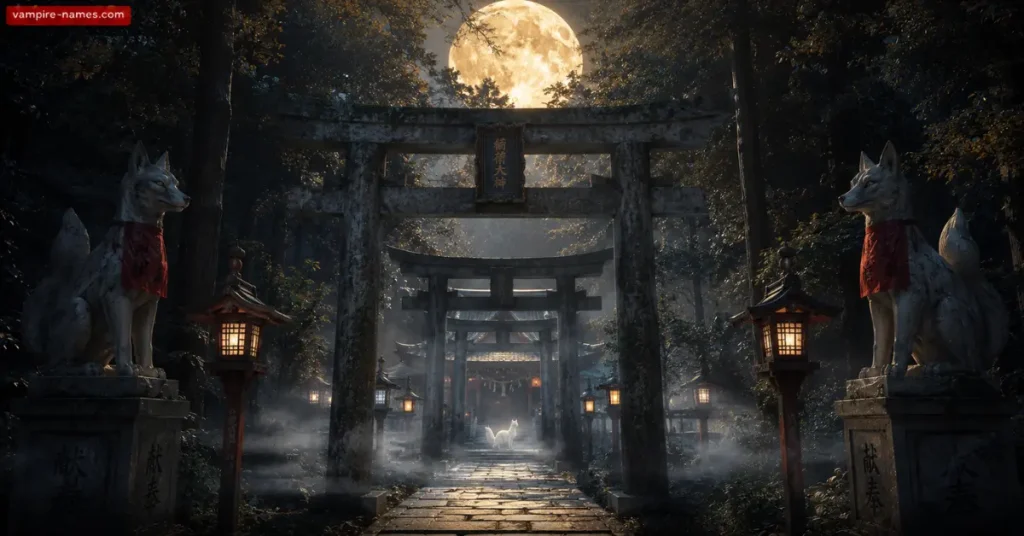
Gothic fox names combine two aesthetics that work together surprisingly well: the Japanese fox spirit tradition and Western Gothic sensibility. These Archer Names lean into darkness, mystery, mortality, and the uncanny. They’re perfect for kitsune characters in Gothic horror settings, dark fantasy, or any story where the fox spirit represents something genuinely threatening.
| Name | Meaning / Notes |
| Morvaine | Gothic invented: dark + ‘vaine’ (vain) — the kitsune who is beautiful and knows it |
| Noctiluca | Latin: ‘night light’ — the bioluminescent glow in dark water; beautiful and deadly |
| Duskara | Gothic compound: dusk + Japanese suffix — the twilight fox who lives in endings |
| Vesperine | Latin: ‘of the evening star’ — the Gothic fox who appears at the day’s death |
| Moriko | Japanese + Gothic: ‘mori’ (forest) + ‘ko’ (child) but in Gothic darkness — the dark forest child |
| Umbrel | Gothic invented: ‘umbra’ (shadow) — the shadow kitsune in Western fantasy clothing |
| Cryptara | Gothic invented: ‘crypt’ + suffix — the kitsune associated with tombs and death places |
| Noctura | Latin: ‘nocturnal’ — the Gothic fox who has embraced the night fully |
| Solanine | Gothic invented: from the poisonous compound in nightshade — beautiful, dangerous, botanical |
| Ravenna | Italian city, but also ‘raven’ in phonetic feel — the Gothic fox associated with death-birds |
| Nightshade | English: the poisonous plant — beautiful and toxic; the kitsune nobody should trust |
| Darkara | Gothic invented: direct darkness + Japanese feel — no pretense of light |
| Velara | Gothic invented: velvety, dark, elegant — the Gothic fox who moves like silk |
| Obsidiana | Gothic invented: from obsidian (volcanic glass) — black, sharp, ancient volcanic origin |
| Eclipsia | Gothic invented: from eclipse — the kitsune who blots out the light |
| Mortisha | Gothic invented: from ‘mort’ (death) — the fox spirit who exists at death’s threshold |
| Ashenara | Blackthorn | Crestfall | Darkhollow |
| Emberveil | Foxbane | Grimvara | Hexara |
| Ironmist | Jadedark | Kuroshiro | Lunara |
| Mistfall | Nyxara | Obsidveil | Phantara |
Fox-Human Hybrid Names
Fox-human hybrid characters occupy a fascinating naming space — they need names that work in the human world where they live (legible, pronounceable, not immediately marking them as supernatural) while still carrying a hint of fox nature. The best hybrid names have a dual quality: they sound like ordinary names until you look closely, then you notice something slightly off.
Names That Would Fit a Fox-Human Hybrid
| Name | Meaning / Notes |
| Amber | Old French/Arabic: the fossilized resin — golden, warm, something ancient preserved inside |
| Fiona | Irish/Scottish: ‘fair, white’ — ordinary enough to pass; the white color of divine foxes |
| Lyra | Greek: the constellation — ordinary name in fantasy; the star-connected creature |
| Cara | Italian/Irish: ‘dear, friend’ — the hybrid who passes as a close companion |
| Vesper | Latin: ‘evening star’ — the twilight hybrid; appears at the in-between time |
| Mira | Sanskrit/Slavic: ‘ocean’ or ‘peace’ — soft enough to pass; depth underneath |
| Sable | Old French: ‘black’ — the dark fox hybrid in human clothing |
| Ember | Old English: ‘low burning fire’ — the fire hybrid; warm until suddenly dangerous |
| Reva | Sanskrit: ‘moving, the star Arcturus’ — always in motion; can’t quite stay still |
| Lumi | Finnish: ‘snow’ — clean, cold, beautiful; the winter fox in human form |
| Kira | Multiple origins: ‘dark’ or ‘ruler’ — the hybrid who adapts meaning to context |
| Zara | Arabic: ‘flower, brilliant’ — the hybrid princess archetype; passes completely |
| Nova | Latin: ‘new’ — the hybrid who presents themselves as perpetually fresh and new |
| Sylvie | Latin: ‘of the forest’ — the forest-fox hybrid; human name with nature etymology |
| Aurora | Latin: ‘dawn’ — the hybrid associated with liminal light; neither day nor night |
| Wren | Old English: the tiny bird — small, quick, underestimated; a perfect hybrid cover |
Kitsune Names for D&D and Pathfinder
D&D and Pathfinder kitsune have their own mechanical and lore contexts that influence naming. Pathfinder 2e established kitsune as a core ancestral option with specific cultural background; D&D kitsune appear primarily in settings inspired by Tashalar, Kara-Tur, or homebrew East Asian fantasy. Names for tabletop kitsune need to work at a table — pronounceable, memorable, distinct from other party members’ names.
D&D Kitsune Names by Class
| Name | Meaning / Notes |
| Mizuki Shadowveil | Rogue — water + shadow compound; the infiltrator who blends completely |
| Arashi Stormcaller | Sorcerer (Storm) — storm + calling; elemental magic as identity |
| Hotaru Glimmerwick | Bard — firefly + glow; the performer who illuminates and distracts |
| Kasumi Dreamweaver | Wizard (Illusion) — mist + weaving; illusion as natural state |
| Raijin Thunderpeak | Paladin (Tempest) — thunder god name; divine lightning warrior |
| Tamamo Foxblood | Warlock (Great Old One) — the legendary fox as patron; ancient power |
| Yoru Nightwhisper | Ranger (Gloom Stalker) — night + whisper; the darkness-aligned fox hunter |
| Kaze Swiftpaw | Monk (Open Hand) — wind + swift; speed as spiritual practice |
| Inari-ko Lightbearer | Cleric (Light) — Inari’s child; divine service as identity |
| Kurohane Shadowmark | Fighter (Arcane Archer) — black feather + shadow; archery meets illusion |
Pathfinder 2e Kitsune Names
| Akifumi | Bijin | Chikako | Daisho |
| Eboshi | Fumio | Genzaemon | Hanbo |
| Ienari | Jakucho | Kichiro | Masahiko |
| Noboru | Osafune | Ryugen | Sanetomo |
| Toshie | Ujimitsu | Yoshifusa | Zaemon |
Kitsune Names in Anime and Pop Culture
Anime has given us some of the most memorable fox spirit characters in modern storytelling. These names are drawn from actual anime featuring kitsune or fox-spirit characters, plus names that have become strongly associated with the aesthetic through gaming and online culture.
| Name | Meaning / Notes |
| Kurama | Yu Yu Hakusho — the nine-tailed silver fox demon; one of anime’s greatest fox characters |
| Tomoe | Kamisama Kiss — the white-haired fox familiar; cold exterior, devoted interior |
| Ahri | League of Legends — the nine-tailed fox mage; the most recognized gaming kitsune |
| Ninetales | Pokémon — the legendary fox pokémon; nine tails, thousand years of legend |
| Shippo | Inuyasha — the young fox demon; tail count starts at zero and grows |
| Ginko | Mushishi — not a kitsune but carries fox-spirit energy; the wandering healer |
| Yoko | Multiple anime: ‘child of the west’ or ‘sunny child’ — classic female anime fox name |
| Ran | Multiple anime: ‘orchid’ or ‘wild’ — short, sharp, works for both types |
| Senko | Sewayaki Kitsune no Senko-san — the 800-year-old fox girl; ancient in small form |
| Nakime | Demon Slayer adjacent: ‘crybaby’ in old Japanese — used in Gothic kitsune contexts |
| Hakumen no Mono | Ushio and Tora — the ancient white fox demon; pure power and ancient malice |
| Youko Kurama | The full name of Yu Yu Hakusho’s fox demon; youth-demon compound meaning |
| Tamamo Cat | Fate series — a chaotic alternate form of Tamamo-no-Mae; playful and terrifying |
| Yahiko | Rurouni Kenshin adjacent: used for fox characters in several games |
Funny and Cute Kitsune Names
Not every kitsune needs to be ancient and terrifying. Some fox spirits are young, playful, or simply living their best nine-tailed life. These names lean into the playful, cute, and comedic sides of kitsune characterization — perfect for lighter campaigns, cozy fantasy, or characters who use the ‘adorable fox’ image to hide what they’re actually doing.
| Foxtrot | Tailwagger | Fluffkins | Sneakypaws |
| Ninetales Jr | Fuzzyface | Trickster | Swishy |
| Pounce | Nibbles | Slyboots | Glittertail |
| Mischief | Blinky | Cheeky | Whiskers |
| Fluffybutt | Pawsome | Sneaky Pete | Foxilocks |
| Tailspin | Scruffles | Foxbert | Furrynova |
Kitsune Clan and Family Names
In settings where kitsune have family or clan structures, last names function differently than personal names. They often reference the clan’s elemental affiliation, their territory, their founding ancestor, or their relationship to Inari. These function as surnames in Japanese order (family name first) or as clan identifiers in Western order.
| Name | Meaning / Notes |
| Kumiho | Korean: nine-tailed fox clan — a name that marks Korean fox heritage |
| Shirohane | Japanese: ‘white feather’ — the white fox clan; Inari-aligned, divine service |
| Kurohane | Japanese: ‘black feather’ — the dark fox clan; independent, Nogitsune-leaning |
| Kazaguruma | Japanese: ‘wind wheel’ — the wind fox clan; fast-moving, migratory |
| Tsukikage | Japanese: ‘moon shadow’ — the lunar fox clan; operates at night |
| Hinata | Japanese: ‘sunny place’ — the solar fox clan; Zenko aligned |
| Fujiwara no Kitsune | Japanese aristocratic clan name + fox — the noble fox family |
| Mizugami | Japanese: ‘water god’ — the water fox clan; river and lake aligned |
| Kageyama | Japanese: ‘shadow mountain’ — the mountain Nogitsune clan |
| Inari no Ke | Japanese: ‘the Inari family’ — the divinely consecrated white fox clan |
| Kitsune-maru | Japanese: ‘fox circle’ — an ancient clan that predates family naming conventions |
| Tamamo no Chi | Japanese: ‘Tamamo’s blood’ — descendants of the legendary nine-tailed fox |
Kitsune Nicknames and Titles
Kitsune nicknames work differently than human ones. They tend to be earned or observed — something other characters call a kitsune based on what they’ve seen. A kitsune’s title often reflects their tail count, their elemental affiliation, or their most notorious deception.
| Name | Meaning / Notes |
| The Fox of Nine Tails | The ultimate kitsune title — announces power level immediately |
| The Silver Fox | For white or silver-furred kitsune; divine alignment implied |
| The Wandering Fox | The kitsune without fixed territory; belongs everywhere and nowhere |
| The Deathstone Fox | Reference to Tamamo-no-Mae’s end; for a legendary fallen kitsune |
| Shrine Fox | The Inari-serving Zenko; divine messenger; respected |
| The Dream Thief | For a Nogitsune who steals memories and dreams |
| Tailless | A kitsune who lost their tails — a terrible nickname, carries shame and mystery |
| The Laughing Fox | The trickster who finds everything genuinely funny, including your suffering |
| Foxfire | For an elemental fire kitsune; the will-o’-wisp association |
| The Honest Fox | The most unsettling kitsune title — nobody knows what to do with one |
| Half-Blood | For a fox-human hybrid; acknowledges both natures |
| The Ancient | For a nine-tail; doesn’t need a name anymore; has outlasted names |
Kitsune Usernames and Gamertags
Kitsune aesthetics are massive in gaming and online communities. These username-format Fantasy Kingdom Names combine kitsune imagery with the conventions of gaming handles — short, memorable, slightly exotic, and available enough to be worth trying.
| xKitsunex | FoxFireNine | SilverTailz | NineTailGod |
| KitsuneQueen | FoxSpiritRPG | TamamoKo | AhriMain |
| NoGitsune | ZenkoFox | KazeNoKitsune | MizukiFox |
| CrimsonTail | GhostFoxVeil | NoctureFox | ShadowKitsune |
| FuryTails | WildFoxMage | HotaruFire | AkatsukiFox |
| DarkFoxRift | TailCountNine | SilentKitsune | MoonFoxDark |
Kitsune Names with Meanings — Complete Reference List
A comprehensive reference of kitsune names drawn from Japanese vocabulary, mythology, and invented fantasy naming. Every entry includes the meaning or origin so you can make an informed choice rather than just picking something that sounds good.
Japanese-Origin Kitsune Names with Meanings
| Name | Meaning / Notes |
| Akatsuki | Red dawn — the liminal moment; between states |
| Amaya | Night rain — the water falling in darkness |
| Arashi | Storm — elemental disruption as identity |
| Asahi | Morning sun — the first light; hopeful and Zenko-aligned |
| Byakuya | White night — the midnight sun; strange and beautiful |
| Fubuki | Blizzard — the ice kitsune; cold wind and snow |
| Fujin | Wind god — divine wind alignment |
| Ginko | Silver child — the silver-furred kitsune |
| Hanabi | Fireworks — brilliant, brief, spectacular |
| Haruka | Distant — the kitsune who always seems far away even when present |
| Hotaru | Firefly — small, bioluminescent, drawn to light and flame |
| Ikazuchi | Thunder — the sound of the storm kitsune arriving |
| Izumi | Spring, fountain — the source; inexhaustible |
| Kagayaki | Brilliance, radiance — the shining kitsune |
| Kasumi | Mist — the obscured, the never-quite-seen |
| Kaze | Wind — the element of speed and elusiveness |
| Kiri | Fog — thicker than mist; the kitsune who obscures completely |
| Koharu | Little spring — Indian summer; unexpected warmth |
| Kurohane | Black feather — the dark-aligned fox |
| Midori | Green — nature and growth |
| Mizuki | Beautiful moon — the classic female kitsune name |
| Murasaki | Purple — aristocratic, literary, melancholy |
| Nagi | Calm, lull — the deceptive stillness before the storm |
| Oboro | Misty, hazy — the moon behind clouds |
| Raijin | Thunder god — divine lightning |
| Sakura | Cherry blossom — beauty and impermanence |
| Shirogane | White silver — beautiful, cold, precious |
| Sora | Sky — limitless, blue, uncontained |
| Tsubaki | Camellia — beauty associated with death |
| Tsukiyomi | Moon reader/moon god — the lunar deity |
| Umi | Ocean — vast, deep, older than memory |
| Yoru | Night — simple and complete |
| Yukionna | Snow woman — the winter spirit, beautiful and lethal |
| Zazen | Meditative sitting — the still kitsune; more dangerous when motionless |
How to Create Your Own Kitsune Name
Method 1: Use Japanese Nature Vocabulary
The most authentic kitsune names use Japanese words for natural phenomena. Open a Japanese-English dictionary and look for words related to weather, seasons, water, fire, sky, and plants. Find one that matches your character’s element and temperament. ‘Arashi’ (storm) took thirty seconds to discover. ‘Shiranui’ (phosphorescent sea light) is more obscure but more beautiful. The key is connecting the word to the character’s nature, not just picking something that sounds nice. If your kitsune is a fire type, search ‘Japanese words for flame and burning.’ The name will emerge from the research.
Method 2: Combine Kanji Meanings
Many Japanese names are kanji compounds — two meaningful characters placed together. You can construct kitsune names the same way even without formal knowledge of kanji. Pick two concepts that define your kitsune and find their Japanese words: ‘silver’ (shirogane) + ‘shadow’ (kage) = Shirokage. ‘Moon’ (tsuki) + ‘mist’ (kasumi) = Tsukikasumi. ‘Storm’ (arashi) + ‘flower’ (hana) = Arashihana. Some of these will be genuine Japanese compound words; others will be invented but sound right. Both work for fictional characters.
Method 3: Borrow from Shinto and Buddhist Traditions
Shinto and Buddhist terminology is rich with names appropriate for kitsune characters — particularly for Zenko (divine) or highly spiritual fox spirits. Deity names (Inari, Raijin, Fujin), sacred concepts (kami, nori, megumi), and religious places (shrine names, sacred mountains) all provide naming material. For a Nogitsune, inverting these — using a sacred name for a dark character — creates interesting tension. A Nogitsune named ‘Hikari’ (light) is more unsettling than one named ‘Akuma’ (demon).
Method 4: Build from the Western Gothic Tradition
Gothic fox names take a different approach: start with Western Gothic vocabulary (shadow, night, dusk, void, ash, bone, frost, crimson) and give it Japanese phonetic texture. ‘Duskara,’ ‘Nightshiro,’ ‘Vesperkaze,’ ‘Umbryori.’ The hybrid approach works because kitsune are themselves hybrid creatures — existing between animal and human, between this world and the spirit world. A name that sits between Western and Japanese naming traditions captures that in-between quality. Add a Japanese suffix (-ko, -ra, -ka, -mi) to a Gothic English word and you often get something that works surprisingly well.
Method 5: Start with the Character’s Story
The most resonant kitsune names usually come from knowing what the character’s story is. A kitsune who burned a village in anger should have a name associated with fire and destruction: ‘Kaen,’ ‘Honoo,’ ‘Hai’ (ash). A kitsune who fell in love with a human and lost them should have something melancholy and beautiful: ‘Tsuyu’ (morning dew), ‘Oboro’ (hazy moon), ‘Koharu’ (the second spring that ends in winter). A kitsune who serves Inari devotedly for a thousand years should have something sacred: ‘Shiro’ (white), ‘Hikari’ (light), ‘Megumi’ (blessing). The story tells you the name. Write a paragraph about who your kitsune is, then highlight the strongest image. That image is probably your name.
Frequently Asked Questions About Kitsune Names
Q: What is a good name for a kitsune?
The best kitsune names combine Japanese phonetic beauty with meaningful roots. For a female kitsune, ‘Kasumi’ (mist), ‘Mizuki’ (beautiful moon), ‘Akatsuki’ (red dawn), or ‘Tsubaki’ (camellia) are classics with genuine depth. For a male kitsune, ‘Arashi’ (storm), ‘Raijin’ (thunder god), ‘Tsukuyomi’ (moon god), or ‘Kaze’ (wind) carry appropriate elemental weight. For any kitsune, the name should hint at their element, their alignment (Zenko or Nogitsune), and their power level. A one-tail gets a shorter, lighter name. A nine-tail gets something that sounds ancient and unpronounceable to ordinary beings.
Q: What are female kitsune names from Japanese tradition?
Traditional Japanese female kitsune names draw from nature, seasons, and classical literature. The most authentic include: Tamamo (from Tamamo-no-Mae), Murasaki (purple, from The Tale of Genji), Hotaru (firefly), Kasumi (mist), Yukionna (snow woman), Oboro (hazy moon), Tsubaki (camellia), Koharu (little spring), Izumi (fountain), and Sakura (cherry blossom). Each carries a specific seasonal or natural meaning, because Japanese female naming traditionally encodes the natural world. For a Nogitsune (dark kitsune), names like Shiranui (phosphorescent sea light), Yomi (underworld), or Tatari (divine curse) push into darker territory.
Q: What are the 13 types of kitsune?
Different sources list different numbers of kitsune types. The most commonly cited nine types are: Kaze (wind), Hi (fire), Mizu (water), Tsuchi (earth), Kaminari (thunder/lightning), Mori (forest), Yama (mountain), Ongaku (music), and Tengoku (celestial/divine). Some traditions add time, sound, river, ocean, and mountain types for thirteen total. The key distinction that matters most for naming isn’t the specific element but the divine alignment: Zenko (divine foxes serving Inari) versus Nogitsune (wild or dark foxes answering to no one).
Q: What is the name of the most powerful kitsune?
In Japanese mythology, Tamamo-no-Mae is the most famous nine-tailed fox — a kitsune who infiltrated the imperial court as a beautiful courtesan and nearly destroyed the emperor before being revealed by the onmyoji Abe no Seimei’s successor. After being killed, her spirit supposedly became the Sesshōseki (death stone), which poisoned everything that touched it for centuries. In modern anime and gaming, Ahri (League of Legends) and Kurama (Yu Yu Hakusho) are perhaps the most recognizable powerful kitsune. Nine tails indicates the maximum power level in the tradition.
Q: What are unique fox names from mythology?
Mythological fox names across cultures include: Tamamo-no-Mae and Kūgen (Japanese kitsune), Daji (Chinese huli jing who destroyed a dynasty), the various unnamed fox-wives of Japanese regional tales, Reynard (the medieval European trickster fox, male), Vulpes (the Latin fox genus name used in heraldry), Fenrir (not a fox, but the Norse wolf-spirit whose energy is similar), and the unnamed white foxes that appear throughout Inari shrine mythology. For gaming, Ahri (League of Legends), Ninetales (Pokémon), and Kurama (Yu Yu Hakusho) have become mythological in their own right.
Q: What are good kitsune names for D&D?
D&D kitsune names work best when they’re pronounceable at a table while still feeling Japanese. Two-part names work well: ‘Mizuki Shadowveil’ (water + shadow; infiltrator), ‘Arashi Stormcaller’ (storm + magic; sorcerer), ‘Kasumi Dreamweaver’ (mist + illusion; wizard), ‘Hotaru Glimmerwick’ (firefly + light; bard). Single names for more mysterious characters: ‘Tamamo,’ ‘Tsukuyomi,’ ‘Raijin,’ ‘Yoru.’ For alignment: Zenko kitsune names should feel warm and light (Hikari, Shiro, Megumi); Nogitsune should feel dark and slightly off (Konton, Tatari, Yomi). Match the name to both the class and the alignment.
Q: What are gothic fox names?
Gothic fox names combine Japanese fox spirit aesthetics with Western Gothic sensibility. Strong options: Noctiluca (night light), Vesperine (of the evening star), Morvaine (dark vanity), Duskara (twilight fox), Umbrel (shadow kitsune), Cryptara (tomb fox), Solanine (nightshade compound), Ravenna (raven association), Nightshade (beautiful and poisonous), Obsidiana (volcanic black glass), Eclipsia (the light-blotting fox), Mortisha (death threshold). The formula: take a Gothic English word or Latin death-adjacent term, add a Japanese phonetic suffix (-ara, -ko, -na, -ra), and you’ll generally get something that sits usefully between both traditions.
Q: How do kitsune choose their names?
In Japanese mythology, kitsune names aren’t formally chosen — they’re given, taken, or accumulated. A young kitsune receives a name from its first human contact or from the Inari shrine it serves. Older kitsune may take names associated with their great deeds or failures (Tamamo-no-Mae took her name from the jewel in her hair). Some acquire human names when taking human form and simply keep them. In fiction and gaming, the naming approach should reflect the kitsune’s history: a name given at birth, a name taken after a significant event, or a title that other beings started using and which stuck. The best kitsune names feel like they were inevitable, not chosen.
Conclusion
Kitsune names are some of the most rewarding to research and choose because the mythology behind them is genuinely rich. This isn’t a tradition of random syllables it’s a thousand years of careful thought about what fox spirits are, what they want, how they relate to humans and to the divine, and what their power costs. Every name in this guide connects to some part of that tradition.
Whether you’re building a nine-tailed sorcerer for your D&D campaign, writing a novel about a fox spirit navigating the modern world, designing a game character who shapeshifts between fox and human form, or simply trying to find a name that captures the precise combination of beauty, intelligence, and danger that defines the kitsune start with the mythology. The mythology tells you the name.
And if nothing in this guide fits perfectly, the creation methods at the end are the real toolkit. Japanese nature vocabulary, kanji compounds, Shinto terminology, Gothic phonetics, and character story use any of them and you’ll find something that feels inevitable rather than chosen. That’s the standard. Not ‘this sounds cool.’ But ‘this could never have been called anything else.’
“A kitsune’s true name is the last secret they keep. Everything else is performance.”