Japanese Male, Female & Historical Names With Real Meanings
Historical • Male & Female • Real Naming Conventions • DnD & Fiction • Verified Meanings
| 335+NAMES & FIGURES | 19CATEGORIES | Real Naming ConventionsSPECIAL FEATURE | Fiction, Games, HistoryBEST FOR |

335+ Japanese Samurai Names: Male, Female & Historical Names With Real Meanings
A quick note before anything else: this page treats samurai naming as what it actually is a real historical practice from a real culture, not a fantasy naming system. Every Vampire Names below is either a genuine historical figure, a real Japanese given name or surname, or a name built from authentic Japanese naming components combined the way real samurai adult names were traditionally constructed. Nothing here is invented pseudo-Japanese. That distinction matters, and we’d rather be precise about it than pad this page with names that just sound vaguely Japanese.
That said, there’s a lot of genuinely useful material here. We’ve pulled together more than 335 names, historical figures, and clan names across 19 categories male names, female names, real samurai clans, verified historical warriors of both genders, and a section most competing lists only touch briefly: an actual explanation of how samurai names worked, because the system is far more interesting than “pick something that sounds cool.”
Here’s the short version of why that system matters: a samurai in feudal Japan didn’t have one fixed name for life. They had a childhood name, an adult name taken at a formal coming-of-age ceremony, sometimes an art name used among peers, and often a final Buddhist name taken in retirement or before death. Oda Nobunaga was Kipposhi as a boy. Tokugawa Ieyasu was Takechiyo. Uesugi Kenshin and Takeda Shingen both took Buddhist names later in life, distinct from the names they’re best remembered by. Knowing this changes how you think about naming a samurai character — a name isn’t just a label, it’s a snapshot of one stage in a life that was expected to include several of them.
Whether you’re naming a historical-fiction character, a D&D or video game samurai, or you’re just curious about how this actually worked, you’ll find real material below rather than a generator’s best guess. And if you want to build a name that’s authentic-feeling but still original, the how-to section near the end walks through exactly how the names on this page were constructed.
Real Samurai Naming Conventions
This is the section most competing lists reduce to a single paragraph. It deserves more than that, because the actual system is both more logical and more interesting than most fantasy naming conventions invented from scratch.
Childhood Names (Yōmyō)
A samurai boy received a childhood name, or yōmyō, at birth — typically softer and more provisional than the adult name that would eventually replace it. These names very often ended in “-maru,” a suffix historically applied to young boys, or referenced birth order directly. Oda Nobunaga’s childhood name was Kipposhi. Tokugawa Ieyasu’s was Takechiyo, incorporating “chiyo,” meaning “a thousand generations,” a common auspicious element in names for young children. Date Masamune was known as Bontenmaru; Ii Naomasa as Toramatsu. Birth-order names were also extremely common and refreshingly literal — “Gorō” simply means “fifth son,” and “Hikotarō” translates roughly to “eldest son boy.” The “Childhood Names” section further down this page lists a dozen genuine historical examples with their notable bearers.
The Genpuku Ceremony and Adult Names
Between roughly ages 14 and 15, a boy underwent genpuku, a formal coming-of-age ceremony that marked his transition into adult status. He received new adult clothing and hairstyle, adult responsibilities, and — critically for our purposes — a new adult name, sometimes called a nanori. This adult name typically consisted of two kanji, producing a four-syllable name with deliberately auspicious meaning. After the tenth century, it became common for a father, lord, or genpuku sponsor to grant one kanji from his own name to the young man as a mark of favor — which is why so many Ashikaga shoguns share the element “Yoshi,” and so many Tokugawa family members share “Ie.” This single practice explains a huge amount of the apparent repetition you’ll notice across historical samurai names once you know to look for it.
The Imina: A Name Too Private to Use
Here’s a detail almost no competing name list mentions: the adult personal name, or imina (literally “taboo name”), was considered genuinely private. Using someone’s imina directly in conversation was disrespectful outside of very intimate or formal contexts. Instead, people commonly referred to each other by title, courtesy name, or other designation entirely. This means a samurai in daily life might rarely have heard their own “real” name spoken aloud by anyone outside their closest family — a genuinely useful and underused detail for fiction, since it means characters addressing each other by given name at all can carry real social weight.
Surnames, Clan Names, and Name Order
Japanese names traditionally place the family or clan name first, given name second — the reverse of most Western naming order. It’s a long-standing myth that only samurai were permitted surnames during the Edo period; in practice, the shogunate simply didn’t formally recognize commoner surnames in official records, while community and commercial records show most commoners had them anyway. What genuinely distinguished samurai was the right to use their surname openly and formally, tied to a documented clan lineage — Minamoto, Taira, Fujiwara, and dozens of others, several of which are covered in the “Samurai Clan Names” section below.
Retirement and Buddhist Names
Many samurai, on retiring or entering the priesthood — a common path, and one that didn’t necessarily mean leaving one’s clan — took a final Buddhist name. Uesugi Kenshin and Takeda Shingen are both widely known today by names that were actually their Buddhist names, adopted later in life, rather than their original adult names. Hattori Hanzō, the famous ninja commander, became a Buddhist monk in his later years under the name Sainen. A name change upon ordination, retirement, or major life shift wasn’t unusual — it was closer to the expected pattern.
A Quick Reference: The Full Naming Progression
| Surname | Meaning / Origin |
|---|---|
| Yōmyō (childhood name) | Given at birth, often ending in “-maru” or encoding birth order; softer and provisional |
| Genpuku | Coming-of-age ceremony, roughly age 14–15, marking the transition to adult status |
| Nanori / imina (adult name) | The formal adult name taken at genpuku, typically two kanji, considered private and rarely spoken by others directly |
| Kanji-sharing tradition | A lord, father, or sponsor often granted one kanji from his own name to the young adult as an honor |
| Clan/surname | Placed before the given Tiefling Names in Japanese order; tied to a documented family lineage |
| Buddhist name | Often taken upon retirement, ordination, or death — many famous samurai are best known by this final name |
Keep this progression in mind while browsing the category lists below. A name pulled from the “Childhood Names” section and one pulled from “Male Names” further down aren’t interchangeable — they represent different life stages, and using them accurately (or deliberately inaccurately, for a specific narrative reason) makes a real difference in how convincing a samurai character’s naming feels.
What Makes a Great Samurai Name?
With the real conventions in mind, here’s what we’d suggest looking for.
1. It respects the correct name order
Surname first, given name second — Tokugawa Ieyasu, not Ieyasu Tokugawa. This is a small detail that a surprising number of Western fiction and games get wrong, and it’s an easy, immediate way to add authenticity.
2. It matches the character’s actual life stage
A child character should carry a yōmyō-style childhood name, not a full adult nanori. A retired or ordained character might carry a Buddhist name instead of the name they were known by in their prime. Matching name to life stage does real, quiet worldbuilding work.
3. The kanji meaning (or approximate meaning) actually fits the character
Real samurai names carried deliberate, auspicious meaning — victory, loyalty, righteousness, long life. Pick a name whose meaning genuinely fits your character’s role or arc, rather than picking purely for sound.
4. It doesn’t borrow too directly from one specific famous figure
Names like Nobunaga or Musashi carry enormous historical weight and instant recognition — using them directly for an original character invites constant comparison. Building a name from the same authentic components (the approach used throughout this page) gets you the same texture without the baggage.
Japanese Samurai Names (Male)
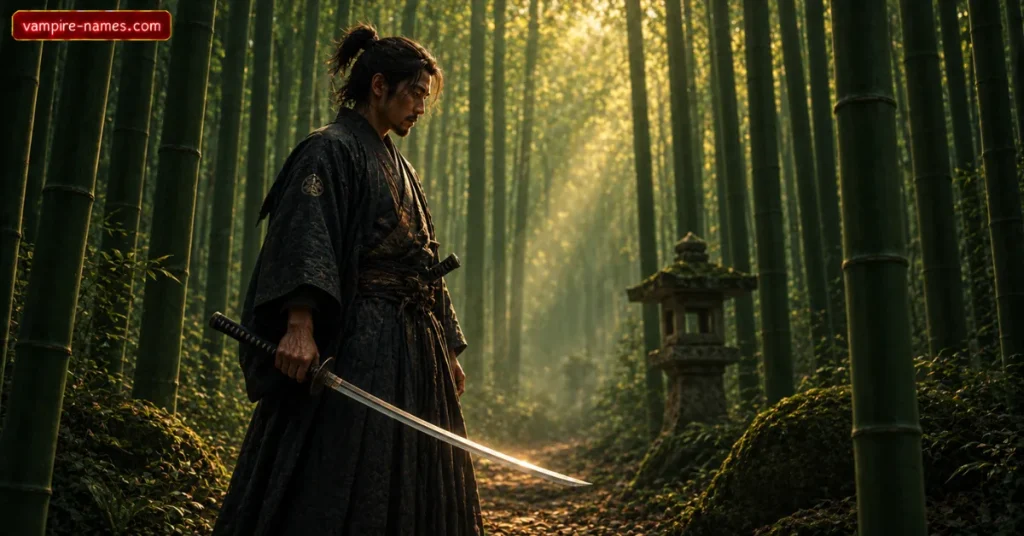
These 90 names are built from genuine Japanese naming components roots like “Nobu” (faith/loyalty), “Masa” (correct/govern), “Taka” (high/noble), “Yoshi” (righteousness), “Katsu” (victory), and “Shige” (abundant) combined in the traditional two-part adult-name pattern described in the naming conventions section above. This is exactly how real historical samurai Outlaw Names were constructed: two meaningful kanji elements joined together. Not every specific combination below is a documented historical record, but every root is authentic, and the construction method mirrors real practice precisely.
| Terutoshi | Toshiteru | Yorisane | Hisatsuna |
| Tomokazu | Kiyomoto | Tsunamitsu | Kazuhisa |
| Yoritsune | Chikasada | Teruyori | Mitsukazu |
| Tomotsuna | Masakage | Hirokuni | Hirotada |
| Kunimasa | Munetoshi | Mitsumasa | Tsunetoshi |
| Nagamasa | Yoshitsune | Sadakuni | Takataka |
| Tadahisa | Masayoshi | Kagesada | Tomoyoshi |
| Yasuyori | Sadanaga | Terumune | Kuniaki |
| Kiyonori | Hisakage | Mitsutsuna | Yoshiyori |
| Shigetoshi | Norimichi | Tsunasada | Mitsumoto |
| Sadanori | Nobuhisa | Sadataka | Yasumasa |
| Nagasada | Yoshimoto | Chikanaga | Muneyori |
| Nagataka | Takayoshi | Masataka | Sanetaka |
| Saneyoshi | Toshishige | Norimasa | Mitsutsune |
| Yasutsune | Kiyosane | Tsunamune | Tomohiro |
| Tadamoto | Shigehisa | Chikashige | Mitsuteru |
| Tomotsune | Nagakazu | Yoshisane | Sanekazu |
| Katsushige | Chikamoto | Toshinaga | Hirotoshi |
| Tadayoshi | Chikamitsu | Muneaki | Kunisada |
| Hirokazu | Tsunakazu | Motokiyo | Motonaga |
| Tomokage | Hiroteru | Masakazu | Tomonobu |
| Terushige | Kunimune | Masatomo | Sanehisa |
| Masahiro | Nagatomo |
If you want a name that leans toward loyalty and service, favor combinations built on “Tada” or “Nobu.” For a name that implies rank or ambition, “Taka” and “Masa” carry that weight most directly. This mirrors how real historical figures were often named to reflect a quality their family hoped they’d embody.
Japanese Samurai Names (Female)
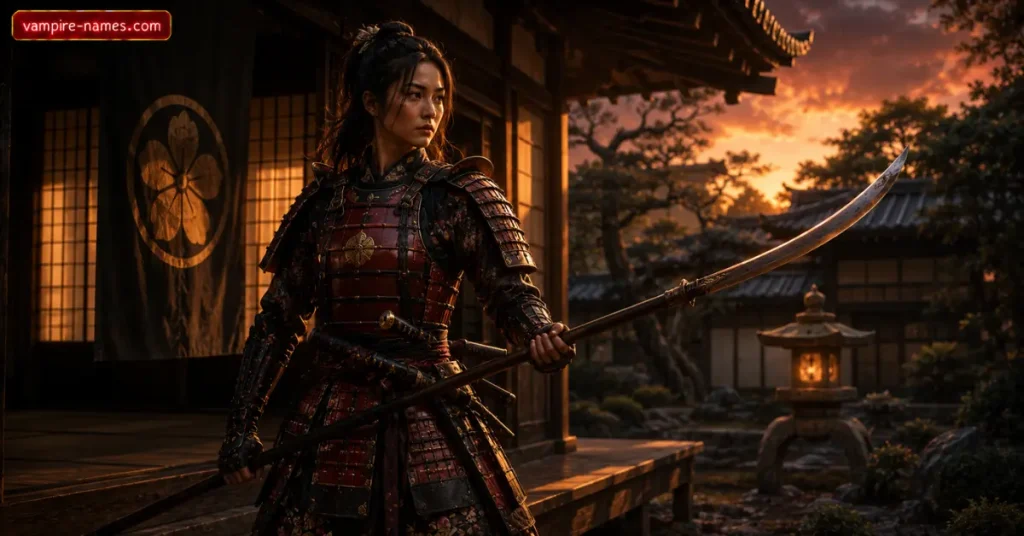
These 69 are genuine, historically-used Japanese female given names, many following the classical “-ko” (child) suffix pattern that dominated female naming from the Heian period through the Edo and Meiji eras names like Yoshiko, Masako, and Sakurako. A number of these were carried by real women of the samurai class, including women documented as onna-bugeisha (female samurai warriors), covered in more depth in the historical section further down this page.
| Sakurako | Umeko | Kikuko | Yoshiko |
| Haruko | Chiyoko | Masako | Nobuko |
| Tomoko | Michiko | Sachiko | Kaoruko |
| Emiko | Reiko | Aiko | Yukiko |
| Hanako | Akiko | Fumiko | Setsuko |
| Toshiko | Kazuko | Shizuko | Hisako |
| Teruko | Sadako | Katsuko | Naoko |
| Ritsuko | Junko | Ayako | Mariko |
| Noriko | Keiko | Kyoko | Yasuko |
| Chieko | Etsuko | Tamiko | Kimiko |
| Sumiko | Wakako | Midoriko | Hinako |
| Sayuriko | Tsuruko | Kameko | Fujiko |
| Matsuko | Momoko | Yoneko | Suzuko |
| Shigeko | Tokiko | Yaeko | Kanako |
| Ranko | Seiko | Takako | Ikuko |
| Chikako | Miyako | Shinko | Ginko |
| Ayame | Botan | Sayuri | Suzume |
| Tsubaki |
Nature and seasonal names — Sakura (cherry blossom), Ume (plum), Kiku (chrysanthemum) — were especially common among court women and carried Buddhist and Shinto symbolic weight tied to impermanence and the turning of seasons. If you want a Great Warrior Names that leans more warrior than court-lady, favor entries built on virtue roots like “Yoshi” or “Tada” rather than the purely floral ones.
Samurai Clan Names
Unlike most of the invented “last name” sections you’d find in a fantasy name list, every entry here is a genuine historical samurai clan or house name from feudal Japan — the real surnames that anchored the political structure of the entire era. These 40 clans include the great warring houses of the Sengoku period alongside older aristocratic lines.
| Minamoto | Taira | Fujiwara | Tokugawa |
| Oda | Toyotomi | Takeda | Uesugi |
| Date | Sanada | Hōjō | Ashikaga |
| Imagawa | Mōri | Shimazu | Chōsokabe |
| Ii | Honda | Sakai | Sakakibara |
| Hattori | Yagyū | Katō | Fukushima |
| Kuroda | Maeda | Ukita | Ōtomo |
| Ryūzōji | Nabeshima | Matsudaira | Asakura |
| Amago | Miyoshi | Akechi | Saitō |
| Isshiki | Otani | Kobayakawa | Shibata |
A few worth knowing for context: Minamoto and Taira were the two great rival clans of the 12th-century Genpei War, a conflict so foundational to samurai history that “Minamoto” and “Taira” descent was claimed by later warrior families for centuries afterward as a mark of legitimacy. Tokugawa, Oda, and Toyotomi are the three unifier clans behind Japan’s eventual reunification in the late 1500s and early 1600s. Using a real clan name for a fictional character instantly signals a specific historical era and political alignment, so it’s worth a quick check that the clan you’ve picked actually fits your story’s timeframe.
Samurai Names With Meaning
Every entry below is a real historical name (or a real naming element) with its verified kanji meaning explained. This is the section to bookmark if you want a name that’s not just historically accurate in structure, but genuinely means something specific and checkable.
| Surname | Meaning / Origin |
|---|---|
| Nobunaga | 信長 — “Nobu” (faith/loyalty) + “naga” (long) — the adult name of Oda Nobunaga |
| Ieyasu | 家康 — “Ie” (house) + “yasu” (peace/ease) — the adult name of Tokugawa Ieyasu |
| Masamune | 政宗 — “Masa” (govern/correct) + “mune” (principle) — the adult name of Date Masamune |
| Kenshin | 謙信 — “Ken” (modest) + “shin” (faith/truth) — the Buddhist name taken by Uesugi Kenshin after ordination |
| Shingen | 信玄 — “Shin” (faith) + “gen” (mystery/profundity) — the Buddhist name taken by Takeda Shingen |
| Musashi | 武蔵 — the name of the historical province, adopted as Miyamoto Musashi’s name; “take/bu” carries connotations of “martial” |
| Yoshitsune | 義経 — “Yoshi” (righteousness) + “tsune” (usual/constant) — the name of Minamoto no Yoshitsune |
| Takeshi | 武 — “warrior” or “fierce,” among the most direct martial given names still used today |
| Kiyomasa | 清正 — “Kiyo” (pure) + “masa” (correct) — the name of general Katō Kiyomasa |
| Tadakatsu | 忠勝 — “Tada” (loyalty) + “katsu” (victory) — the name of Honda Tadakatsu |
| Yukimura | 幸村 — “Yuki” (fortune/happiness) + “mura” (village) — the popular name for Sanada Nobushige |
| Hanzō | 半蔵 — a common given name element meaning roughly “half-storehouse,” historically associated with Hattori Hanzō |
| Sadamune | 貞宗 — “Sada” (chastity/decide) + “mune” (principle) — also the name of a famous swordsmith lineage |
| Naomasa | 直政 — “Nao” (honest/straight) + “masa” (correct) — the name of Ii Naomasa, one of the “Four Guardians” of the Tokugawa |
| Gozen | 御前 — not a given name but an honorific meaning “lady” or “one before the lord,” attached to female warriors like Tomoe Gozen |
| Sakurako | 桜子 — “Sakura” (cherry blossom) + “ko” (child) — a classical female name tied to spring and impermanence |
| Yoshiko | 良子 or 芳子 — “Yoshi” (good/fragrant) + “ko” (child) — one of the most common traditional female name patterns |
| Masako | 雅子 or 正子 — “Masa” (elegant/correct) + “ko” (child) — historically used across both noble and warrior-class families |
| Take (as a root) | 武 — “martial” or “warrior,” the same root behind Takeshi, Musashi, and Bushido (武士道, “way of the warrior”) |
| Bushidō | 武士道 — not a name but the samurai code itself: “bu” (martial), “shi” (warrior), “dō” (way/path) |
Famous Historical Samurai (Male)

These are real historical figures, not name-list entries — worth knowing both as direct references and as genuine background research if you’re writing anything set in or inspired by feudal Japan.
| Surname | Meaning / Origin |
|---|---|
| Miyamoto Musashi | c. 1584–1645. Master swordsman and ronin famous for his undefeated dueling record and the two-sword Niten Ichi-ryū style; author of The Book of Five Rings |
| Oda Nobunaga | 1534–1582. Warlord who began the unification of Japan; one of the “Three Great Unifiers” |
| Toyotomi Hideyoshi | 1537–1598. Rose from peasant foot soldier to unifier of Japan; the second of the “Three Great Unifiers” |
| Tokugawa Ieyasu | 1543–1616. Founder of the Tokugawa shogunate after victory at the Battle of Sekigahara in 1600; the third “Great Unifier” |
| Takeda Shingen | 1521–1573. Daimyo of Kai province known as the “Tiger of Kai,” famed for his rivalry with Uesugi Kenshin |
| Uesugi Kenshin | 1530–1578. Daimyo of Echigo known as the “Dragon of Echigo,” a devotee of the war deity Bishamonten |
| Date Masamune | 1567–1636. One-eyed daimyo of the Tōhoku region, founder of Sendai, known as the “One-Eyed Dragon” |
| Honda Tadakatsu | 1548–1610. Retainer of Tokugawa Ieyasu said to have fought in over 55 battles without ever suffering a serious wound |
| Hattori Hanzō | 1542–1596. Samurai and ninja commander who served Tokugawa Ieyasu, later becoming a Buddhist monk under the name Sainen |
| Sanada Yukimura | 1567–1615. Led the “Sanada-maru” defense of Osaka Castle and a famous last charge at the Summer Siege of Osaka |
| Minamoto no Yoshitsune | 1159–1189. Celebrated general of the Genpei War, a central figure in Japanese legend and literature |
| Katō Kiyomasa | 1562–1611. Daimyo and general under Toyotomi Hideyoshi, known for castle design and campaigns in Korea |
Oda Nobunaga, Toyotomi Hideyoshi, and Tokugawa Ieyasu are collectively remembered as the “Three Great Unifiers” for their roles in ending the chaotic Sengoku period and reunifying Japan under a single stable government — a sequence of three very different leadership styles worth reading further into if your project draws on this era at all.
Famous Historical Female Samurai (Onna-Bugeisha)
Female samurai — onna-bugeisha, literally “woman warrior” — are underrepresented in most popular retellings of samurai history, but they were a real and documented part of the bushi class. In 2017, the Japanese government officially recognized five female samurai as important cultural assets: Tomoe Gozen, Nakano Takeko, Hōjō Masako, Yamakawa Takeko, and Nakano Shige. Here are five of the most historically significant.
| Surname | Meaning / Origin |
|---|---|
| Tomoe Gozen | c. late 1100s. Renowned onna-bugeisha of the Genpei War who fought for Minamoto no Yoshinaka; described in the Heike Monogatari as a warrior “worth a thousand” |
| Hangaku Gozen | fl. 1201. Commander skilled with bow and naginata who led roughly 3,000 warriors defending Torisaka fort during the Kennin Rebellion |
| Nakano Takeko | 1847–1868. Commander of the Aizu domain’s Jōshitai (Women’s Army) during the Boshin War, highly trained in naginata combat |
| Empress Jingū | traditionally 169–269 (historicity debated). Legendary early ruler credited as one of Japan’s first women to lead troops in battle |
| Hōjō Masako | 1156–1225. Powerful political figure and widow of shogun Minamoto no Yoritomo, later called the “nun shogun” |
Note the title “Gozen” attached to several of these names — it’s an honorific meaning roughly “lady” or “one before the lord,” not part of the birth name itself, historically applied specifically to notable female warriors. If you’re naming a female samurai character and want a title rather than just a given Kitsune Names , “Gozen” is a real, accurate choice.
Gender-Neutral Japanese Names
These 25 are genuinely gender-neutral names in real, contemporary and historical Japanese usage — not names arbitrarily declared unisex, but ones that function that way in actual practice. Useful for a character whose gender you want to leave ambiguous, or simply as flexible options.
| Akira | Kaoru | Yuu | Makoto |
| Hikaru | Sora | Ren | Shion |
| Rei | Izumi | Tsukasa | Kei |
| Jun | Sae | Mizuki | Asahi |
| Riku | Wataru | Hinata | Yoshi |
| Ao | Haru | Kanata | Nagi |
| Sui |
Several of these — Akira, Makoto, and Rei among them — have long histories of use for both boys and girls in Japan, rather than being modern gender-neutral inventions, which makes them a solid choice if you want a name that reads as genuinely traditional rather than deliberately ambiguous.
Childhood Names (Yōmyō)
As covered in the naming conventions section above, these are genuine historical childhood names — the names a samurai carried before their genpuku ceremony, each with its notable historical bearer identified.
| Surname | Meaning / Origin |
|---|---|
| Kipposhi | Childhood name of Oda Nobunaga before genpuku |
| Takechiyo | Childhood name of Tokugawa Ieyasu; “chiyo” means “a thousand generations” |
| Bontenmaru | Childhood name of Date Masamune |
| Umatsu | Childhood name of Uesugi Kagekatsu |
| Toramatsu | Childhood name of Ii Naomasa |
| Saruyashamaru | Childhood name of Azai Nagamasa |
| Shōjumaru | Childhood name of Kuroda Nagamasa |
| Benmaru | Childhood name of Sanada Nobushige (Yukimura) |
| Torashiro | Literally “tiger fourth son” — a common birth-order-based childhood name |
| Hikotarō | Literally “eldest son boy” — a common childhood name pattern |
| Gorō | Literally “fifth son” — childhood names frequently encoded birth order this way |
| Bennosuke | A common childhood-name suffix pattern used across several samurai families |
Use one of these directly for a young or child character in a story set in feudal Japan, and pair it with an adult name from the male or female sections above for the same character to use once they come of age — a small but effective way to show a character maturing over the course of a longer story.
Samurai Names for Games & Fiction
For original characters in games, D&D-adjacent settings, or historical fiction, here are 20 full names pairing real clan surnames with authentic given-name components, constructed in genuine Japanese name order (surname first). These are original combinations, not existing historical records, built the respectful way — real components, real structure, invented specific pairing.
| Akiyama Nobutaka | Akiyama Masakage | Hosokawa Masakage | Hosokawa Takahiro |
| Shibata Takahiro | Shibata Yoshinao | Niwa Yoshinao | Niwa Kiyotsugu |
| Mizuno Kiyotsugu | Mizuno Munemasa | Toda Munemasa | Toda Teruhisa |
| Ogasawara Teruhisa | Ogasawara Katsuyori | Ando Katsuyori | Ando Nobutaka |
| Kikkawa Nobutaka | Kikkawa Masakage | Kobayakawa Masakage | Kobayakawa Takahiro |
A brief note on anime and pop culture: rather than listing specific characters from existing, copyrighted anime or games, we’d encourage building an original name the same way — real clan name, real given-name components, correct name order — rather than reusing an existing character’s name directly. It respects both the source material and the culture the names are drawn from.
A–Z Samurai Names
Need one fast, sorted alphabetically? A quick honesty note first: authentic Japanese names don’t naturally begin with every letter of the Latin alphabet — Japanese phonology has no native L, Q, V, or X sounds, and P rarely starts a native name. Rather than padding this list with fabricated entries to force a false A-to-Z completeness, we’ve listed genuine examples only for the letters Japanese naming actually covers.
| Akechi Mitsuhide | Asakura Yoshikage | Bontenmaru | Bennosuke |
| Chōsokabe Motochika | Chiyoko | Date Masamune | Date Tadamune |
| Ii Naomasa | Etsuko | Fukushima Masanori | Fujiwara Nobutaka |
| Gorō | Ginko | Hattori Hanzō | Honda Tadakatsu |
| Ii Naotaka | Isshiki Yoshimichi | Jōkō | Junko |
| Katō Kiyomasa | Kuroda Nagamasa | Minamoto no Yoshitsune | Miyamoto Musashi |
| Nabeshima Naoshige | Nobuko | Oda Nobunaga | Ōtomo Sōrin |
| Ryūzōji Takanobu | Reiko | Sanada Yukimura | Sakakibara Yasumasa |
| Tokugawa Ieyasu | Takeda Shingen | Uesugi Kenshin | Ukita Hideie |
| Wataru Chikamasa | Watanabe no Tsuna | Yagyū Munenori | Yoshiko |
| Zensuke | Zenko |
If your project genuinely needs a name for every letter regardless, the honest option is to romanize loosely — some names transliterate with a “V” or “L” sound in certain non-standard romanization systems — but we’d suggest treating that as a last resort rather than a first choice, since it moves away from how these names are actually written and spoken in Japanese.
Samurai Titles and Honorifics
Beyond given names, surnames, and clan names, real samurai society used a layer of titles and honorifics that carried as much social information as the name itself — another detail most competing name lists skip entirely.
-dono and -sama
“-dono” was a respectful title roughly equivalent to “lord” or “master,” commonly attached to a samurai’s name in formal address, especially toward someone of roughly equal or slightly lower status treated with courtesy. “-sama” carried even greater deference, typically reserved for addressing someone of clearly higher rank, such as a daimyo or shogun.
Gozen
As covered in the historical female samurai section above, “Gozen” was an honorific applied specifically to notable women, often translated as “lady” or, more literally, “one before the lord.” It’s attached to several of history’s most famous female warriors — Tomoe Gozen, Hangaku Gozen — and functions as a title rather than part of the birth name itself.
-no-kami and Provincial Titles
Many samurai held titles referencing a specific province or role, structured as “[Province]-no-kami,” roughly meaning “governor of [Province].” These titles were sometimes purely honorary by the time they were granted, disconnected from any actual administrative authority over the named province, but they carried real prestige and were used constantly in formal address — often more often than the samurai’s actual given ninja names , circling back to the imina privacy convention covered earlier.
Posthumous Names
Beyond the Buddhist names taken in life covered earlier, many samurai and nobles received an entirely separate posthumous name (okurina) after death, used specifically in religious and memorial contexts. This is a distinct practice from the retirement Buddhist name, adding yet another layer to how many different names a single historical figure might accumulate across a lifetime and afterward.
How to Build a Respectful, Authentic-Feeling Samurai Name
If you want to build your own name beyond what’s listed above, here’s the method used throughout this page.
Method 1: Start From Real Naming Components, Not Invented Sounds
Use genuine kanji-reading roots — Nobu, Masa, Taka, Yoshi, Katsu, Shige, and similar — rather than inventing syllables that merely sound Japanese. A quick search on the meaning of any component you’re considering takes thirty seconds and avoids accidentally landing on something meaningless or unintentionally comic.
Method 2: Respect the Two-Kanji Adult Name Structure
Traditional adult names combined exactly two meaningful elements into a four-syllable name. Sticking to that structure — rather than stacking three or four components together — keeps a constructed name feeling authentic rather than like an obviously generated string.
Method 3: Match the Name to the Correct Life Stage
Decide whether you’re naming a child (yōmyō, often “-maru” ending), an adult (the two-kanji nanori structure), or a retired/ordained figure (a Buddhist name) — and build accordingly, per the conventions section earlier in this page.
Method 4: Keep Surname-First Order
Family or clan name first, given name second. This single correction does more for authenticity than almost any other single choice, and it’s the detail most Western fiction and games get wrong most often.
Method 5: Check the Meaning Reads as Auspicious, Not Accidental
Real samurai names were chosen for positive, deliberate meaning — victory, loyalty, long life, righteousness. If you’re combining components yourself, make sure the resulting combined meaning still reads as intentional and positive, not as an awkward or unintentionally negative pairing.
Tips for Choosing the Perfect Samurai Name
A few closing thoughts.
Consider the era your story is set in
A name and clan appropriate to the 12th-century Genpei War era won’t necessarily fit a story set in the 1860s Boshin War, three centuries later. If historical grounding matters for your project, a quick check on which era a given clan or name style belongs to is worth the extra few minutes.
Don’t borrow a legendary name directly unless you mean the comparison
Naming an original character “Musashi” or “Nobunaga” invites the audience to measure them against genuinely famous historical figures. That can work as a deliberate choice, but it’s worth being intentional about rather than accidental.
Use real titles and honorifics where appropriate
Terms like “Gozen” (lady, applied to female warriors) or referring to a retired figure by their Buddhist name rather than their birth name add a layer of real historical texture that a purely invented naming system can’t replicate.
Frequently Asked Questions
Q: What are good samurai names?
A: Good samurai names typically combine two authentic Japanese naming elements with positive, deliberate meaning — qualities like loyalty (Nobu), righteousness (Yoshi), or victory (Katsu) — following the real two-kanji adult-name structure described earlier on this page. Real historical examples like Nobunaga, Masamune, or Kiyomasa show this pattern directly, and the “Japanese Samurai Names (Male)” section above has 90 more built the same authentic way.
Q: What are good samurai names for males specifically?
A: Strong male samurai names tend to favor roots implying martial virtue or loyalty — Take/Takeshi (warrior), Tada (loyalty), Katsu (victory), or Masa (correct/govern). The “Japanese Samurai Names (Male)” section above has 90 names built from these and other authentic components, following the traditional two-kanji naming pattern.
Q: What are Japanese samurai names, and how are they different from generic fantasy names?
A: Japanese samurai names are drawn from a real historical naming system with documented structure — childhood names, formal adult names taken at a coming-of-age ceremony called genpuku, and sometimes later Buddhist names — rather than being invented for atmosphere the way most fantasy names are. The “Real Samurai Naming Conventions” section above covers this system in full detail, since understanding it makes any samurai name choice considerably more accurate.
Q: What are good samurai last names?
A: Real samurai clan and surname examples include Minamoto, Taira, Tokugawa, Oda, Takeda, Uesugi, Date, and Sanada, among many others — genuine historical houses rather than invented surnames. The “Samurai Clan Names” section above lists 40 authentic clan names with brief historical context.
Q: Were there female samurai?
A: Yes. Female samurai, called onna-bugeisha (“woman warrior”), were a real and documented part of the bushi class throughout Japanese history. Tomoe Gozen and Nakano Takeko are among the most historically significant, and in 2017 the Japanese government officially recognized five female samurai — including these two — as important cultural assets. The “Famous Historical Female Samurai” section above covers five verified figures in more depth.
Q: What did samurai names actually mean?
A: Samurai adult names were built from two kanji chosen for auspicious meaning — qualities like loyalty, victory, righteousness, or long life. Oda Nobunaga’s name combines “faith/loyalty” and “long”; Date Masamune’s combines “govern/correct” and “principle.” The “Samurai Names With Meaning” table above explains the verified meaning behind 20 real historical names and naming elements.
Q: Can samurai names be used for D&D or video game characters?
A: Yes, and building one respectfully is straightforward: use real Japanese naming components (rather than invented pseudo-Japanese sounds), follow the traditional two-kanji structure, and keep surname-first name order. The “Samurai Names for Games & Fiction” section above has 20 examples built exactly this way, along with a full method for building more in the how-to section further down.
Q: Did samurai really change their names throughout their lives?
A: Yes — this was standard practice, not an exception. A samurai typically had a childhood name, received a new adult name at the genpuku coming-of-age ceremony, and often took a final Buddhist name upon retirement, ordination, or major life change. Oda Nobunaga was born Kipposhi; Uesugi Kenshin and Takeda Shingen are both best known today by names taken later in life. The “Real Samurai Naming Conventions” section above covers this progression in full.
Q: Is it disrespectful to use real samurai names for fictional characters?
A: Using real historical figures’ full names directly for an unrelated fictional character can invite unwanted comparison, but building original names from genuine Japanese naming components — the approach used throughout this page — is a widely accepted and respectful practice, provided the components and structure are accurate rather than invented sounds dressed up to seem Japanese.
Q: How many names are on this list?
A: This page includes more than 335 genuine names, historical figures, and clan names across 19 categories — real male and female Japanese names, authentic samurai clans, verified historical warriors of both genders, gender-neutral names, and real historical childhood names — plus a full breakdown of actual samurai naming conventions and a names-with-meaning table.
Conclusion
If you take one thing from this page, let it be this: a samurai’s name was never meant to be fixed. It changed with the seasons of a life a soft childhood name, a formal adult name taken in a real ceremony, sometimes a Buddhist name at the end of it all. That’s a genuinely richer naming system than most invented fantasy equivalents, and it’s sitting right there in the real historical record, verifiable and specific.
We’d rather hand you 335 names you can trust than 800 that sound plausible but mean nothing. If you’re building a character set in or inspired by feudal Japan, start with the naming conventions section near the top of this page, decide what life stage your character is at, and build from there. The result will feel more grounded than picking from any generic list, ours included.
“A name, like a sword, was earned again at every stage of a life.”