The Ultimate Guide for Writers & Worldbuilders
Ghost Towns | Halloween | Wild West | Haunted | D&D | Real History
| 700+Town Names | 24+Categories | Real Ghost TownHistory Explained | Halloween &Wild West Covered |
700+ Spooky & Scary Town Names: The Ultimate Guide for Writers & Worldbuilders
There’s a reason so many horror stories begin with a car pulling into a town whose name alone makes you want to keep driving. ‘Blackwater.’ ‘Hollow Creek.’ ‘Silent Pines.’ Before a single resident opens their door, before a single strange sound comes from the woods, the Vampire Names has already told you something is wrong here — or at least, something was, once, and never quite left.
This guide gives you 700+ spooky and scary town names across every category a horror writer, D&D dungeon master, video game designer, or Halloween event planner could need: ghost towns, Halloween-specific names, Wild West abandoned settlements, mining and industrial disaster towns, coastal villages with dark secrets, and scary city names distinct from small-town horror. Every major section includes real context, because the best fictional town names are built on genuine linguistic and historical patterns — not just random scary-sounding syllables.
We start with the actual history of American ghost towns — why real places got abandoned, and what that history teaches us about building a fictional town that feels genuinely haunted rather than just labeled ‘spooky.’ Understanding the real pattern makes every invented name in this guide, and every name you build afterward, land harder.
The Real History of Ghost Towns — Why America’s Abandoned Places Got Their Names
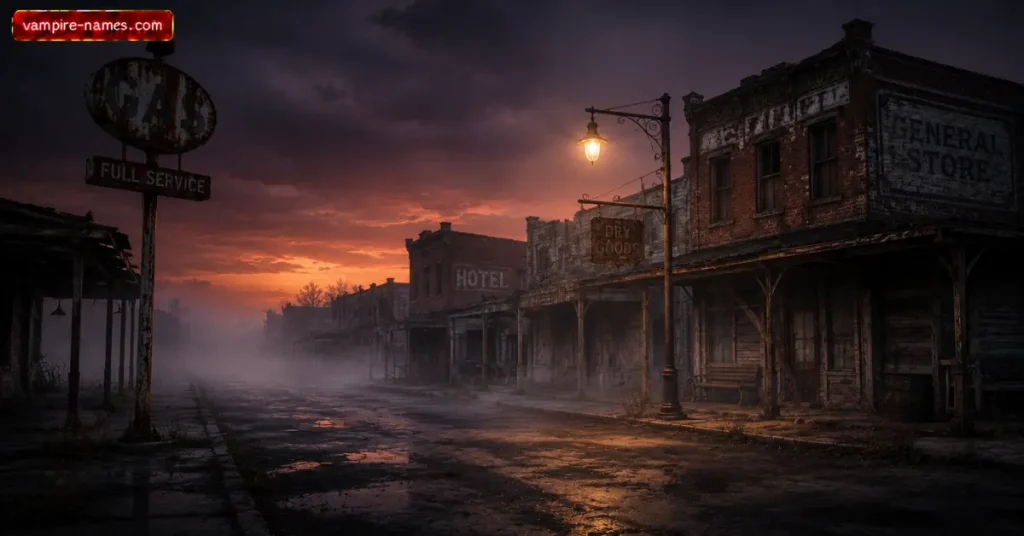
Real ghost towns weren’t named to sound scary. They were named optimistically, by people who believed the settlement would last — and the horror comes entirely from what happened after. Understanding this pattern is the single most useful thing a fiction writer can learn about ghost town naming: the dread isn’t in the name itself, it’s in the gap between what the name promised and what the town became.
Bodie, California was named for prospector W.S. Bodey, who died in a blizzard the winter after discovering gold there in 1859 — the town that bears his misspelled name never got to hear him say it correctly. At its peak in the 1880s it had roughly 10,000 residents, a reputation for lawlessness so severe that a child who was told her family was moving there reportedly prayed ‘Goodbye God, we are going to Bodie.’ By the 1940s it was empty, preserved now in a deliberate state of ‘arrested decay’ by the California State Parks system.
Centralia, Pennsylvania became famous for an entirely different reason: an underground coal seam fire, ignited in 1962 (likely from a trash fire that spread into the mine’s coal veins), has burned continuously ever since — it’s projected to keep burning for another 250 years. The town’s population dropped from over 1,000 to effectively zero as the ground literally became too hot and unstable to live on; it partly inspired the video game and film Silent Hill.
Kennecott, Alaska was a copper-mining boomtown built almost overnight in 1911 by the Kennecott Copper Corporation, abandoned within decades once the most accessible copper ore was exhausted — the classic extraction-town pattern: a company builds a town around a resource, then leaves the moment the resource stops being profitable, taking the reason for the town’s existence with it.
This is the actual pattern behind nearly every real ghost town: a resource boom (gold, silver, copper, coal, railroad access) draws a population, the resource or the economic reason disappears (the vein runs out, the railroad reroutes, a disaster strikes), and the population leaves faster than it arrived, sometimes within a single generation. Fictional ghost towns that mirror this real economic logic — rather than just being ‘cursed’ with no explanation — read as far more convincing.
Famous Real Ghost Towns and Why Their Names Endure
| Town Name | Meaning / Notes |
| Bodie, CA | Named for prospector W.S. Bodey, who died before seeing his own town thrive — the misspelling itself became part of the legend |
| Centralia, PA | A conventional, optimistic town name rendered ironic by an underground coal fire burning since 1962 |
| Kennecott, AK | Named for the Kennicott Glacier (itself misspelled in the copper company’s name) — a resource-boom town abandoned when the ore ran out |
| Rhyolite, NV | Named for the volcanic rock found in the area — boomed with gold in 1905, was nearly empty again by 1920 |
| Bannack, MT | Named for the Bannock Native American tribe — Montana’s first territorial capital, now entirely uninhabited |
| Terlingua, TX | Possibly Spanish ‘three tongues/languages’ — a former mercury-mining boomtown in the Big Bend desert |
| Thurmond, WV | Named for founder Captain William Dabney Thurmond — a coal-and-railroad town with a population that fell to single digits |
| Pripyat, Ukraine | Named for the Pripyat River — evacuated after the 1986 Chernobyl disaster, the most famous modern ghost town in the world |
The Phonosemantics of Scary Place Names — Why Certain Names Feel Haunted
Understanding the actual sound patterns behind effective scary town names will make every name you choose or invent land better.
Compound names built from a natural feature plus a dark or ambiguous modifier are the single most reliable formula in horror fiction: Blackwater, Hollow Creek, Silent Pines, Ashfall, Deadwood Crossing. The natural-feature half (water, creek, pines, hollow) grounds the name in something real and geographic; the dark modifier (black, silent, dead, ash) does the emotional work. This formula appears constantly in real horror fiction precisely because it’s so effective.
Names that use religious or moral vocabulary ironically — Redemption, Mercy Hill, Saint’s Hollow, Providence — create dread through contrast: a name promising salvation attached to a place that clearly offers none. This works especially well for cult-adjacent or religious-settlement horror stories, where the gap between the town’s founding ideals and its present reality is the entire point.
Short, single-syllable or two-syllable names with hard consonant endings (Dis, Grimm, Ashford, Blackrock) read as immediately ominous, while longer, more melodic names (Willowmere, Ravenshollow, Hallowbrook) read as more atmospheric and slow-building — dread through beauty rather than dread through bluntness. Choose based on whether your story needs an instant gut-punch or a creeping unease.
Finally, names that reference absence or silence directly — Silent Pines, Lost Creek, Forgotten Ridge, Last Light — work because they tell the reader something is missing before any plot confirms it. The town’s name is already grieving something, and the story’s job is to reveal what.
Scary Town Name Generator Formula
A repeatable step-by-step formula for building your own convincing scary town name.
Step 1: Choose a Real Geographic Feature
Creek, hollow, ridge, point, cove, bay, ford, mere, hill, vale, wood, marsh. Grounding your druid names in real geography vocabulary makes it feel like an actual place rather than a purely invented horror label.
Step 2: Add a Dark or Ambiguous Modifier
Black, grey, hollow, silent, lost, ash, widow, crow, raven, mourning, forsaken, dead, cold, bleak, dust. Combine this with your geographic feature: Black + Water = Blackwater. Silent + Pines = Silent Pines. Forsaken + Ridge = Forsaken Ridge.
Step 3: Consider the Town’s Real Economic Reason for Existing
What resource or purpose originally brought people here — mining, fishing, farming, religion, a railroad stop? This context (even if never fully explained in the story) will subtly shape which modifier feels right. A mining town suits Ash, Cinder, Coal, or Iron. A fishing village suits Widow, Drift, Salt, or Tide. A religious settlement suits Mercy, Saint, Hallow, or Covenant.
Step 4: Test for the Optimism-Gap
Does the name sound like something its founders would have genuinely believed in? The best fictional ghost town names, like real ones, should sound hopeful or at least neutral on their own — the horror comes from the reader knowing (or discovering) what happened after.
Best Spooky Town Names
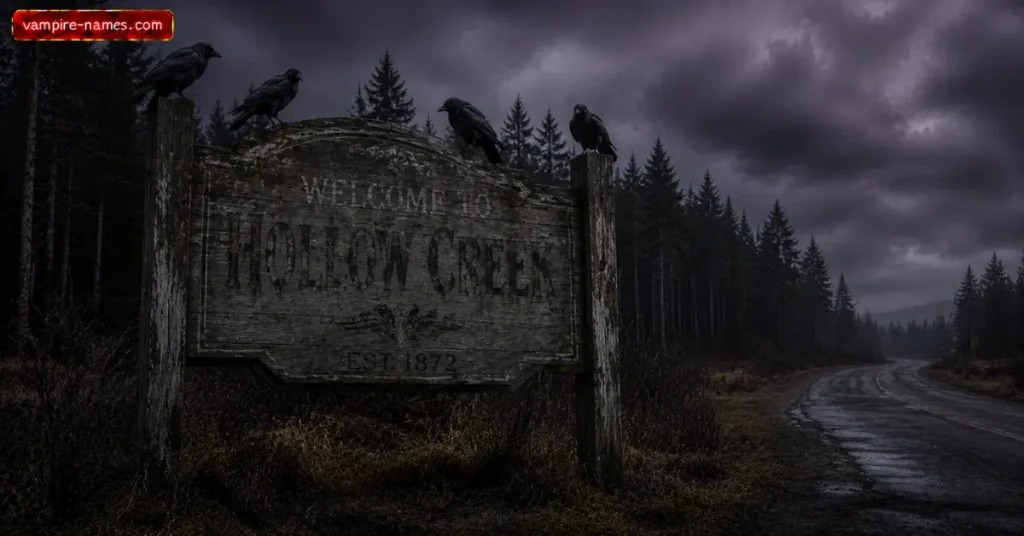
The flagship names versatile, atmospheric, and effective across horror fiction, D&D campaigns, and Halloween events. Each has been chosen for phonetic power and genuine geographic or historical grounding.
Best Spooky Town Names with Notes
| Town Name | Meaning / Notes |
| Blackwater | The single most common horror-town compound — dark water suggests both geography and hidden danger |
| Hollow Creek | Hollow (empty, echoing) + creek (real geographic feature) — the formula at its cleanest |
| Ashfall | Suggests both volcanic disaster and the aftermath of fire — works for post-catastrophe settings |
| Ravenshollow | Bird-of-ill-omen + hollow — combines two horror conventions into one flowing compound Tiefling Names |
| Widow’s Reach | Implies a fishing or coastal town where the sea has taken more husbands than it’s given back |
| Mourning Vale | Directly names grief as the town’s defining quality — unsubtle but effective |
| Deadwood Crossing | Real Old West vocabulary (‘deadwood’ is dead standing timber) + a transit point — feels historically grounded |
| Silent Pines | Absence-of-sound framing — dread through what’s missing rather than what’s present |
| Duskfall | The moment between day and night as a place-name — permanently caught at twilight |
| Grey Mercy | Ironic religious naming — a virtue word drained of its color and meaning |
| Last Light | Suggests a town at the very edge of something — geographic or metaphysical |
| Nocturne | Latin/Italian: ‘of the night’ — elegant and musical, atmospheric dread rather than blunt |
| Coalridge | Mining-town vocabulary — grounds the name in real industrial history |
| Crowmere | Crow (omen bird) + mere (lake) — compact, two-syllable dread |
| Old Mercy | ‘Old’ implies the town’s virtue has faded or curdled with age |
More Best Spooky Town Names — Quick Reference
| Briar Falls | Cinder Creek | Duskhaven | Elderwick |
| Fogmere | Graveldon | Hallowbrook | Ironhollow |
| Jasperfall | Killick Cove | Lostwater | Marrowgate |
| Nightshade Hollow | Owlcreek | Pyrewood | Quietfall |
| Ravensbrook | Stonemourne | Thornwatch | Underhollow |
| Vesperton | Wraithmoor | Ashendale | Bleakford |
Creepy Town Names for Your Book
Creepy town names for fiction should be usable across an entire manuscript — easy to type repeatedly, unambiguous in pronunciation, and atmospheric without being so elaborate they distract from the plot.
| Ashbury | Blackthorn | Crestfallow | Driftbend |
| Elmshade | Fenwood | Grimstead | Hollowmere |
| Ironbrook | Junipermourn | Kestrel Hollow | Larkspur Grim |
| Millrend | Nightfall Creek | Ottermourn | Pinehollow |
| Quillstone | Ravensworth | Somberfield | Thistledown Grave |
| Underbrook | Vesperfield | Wychwood | Yewmoor |
Scary Town Names for a Story
Scary town names for active horror narratives — these lean slightly harder and more immediate than atmospheric ‘creepy’ names, better suited to stories with a faster pace or more direct threat.
| Deadbolt | Gravemarsh | Skullridge | Bonewick |
| Rotfield | Direstead | Malmoor | Vilehollow |
| Wretchmoor | Fangwood | Graspmere | Hexbury |
| Screamhollow | Grimfen | Slaughterford | Coldgrave |
| Torchill | Wailmoor | Fleshmarket | Nightmare Junction |
| Gallowmere | Blightfen | Cursewick | Deathford |
Halloween Town Names
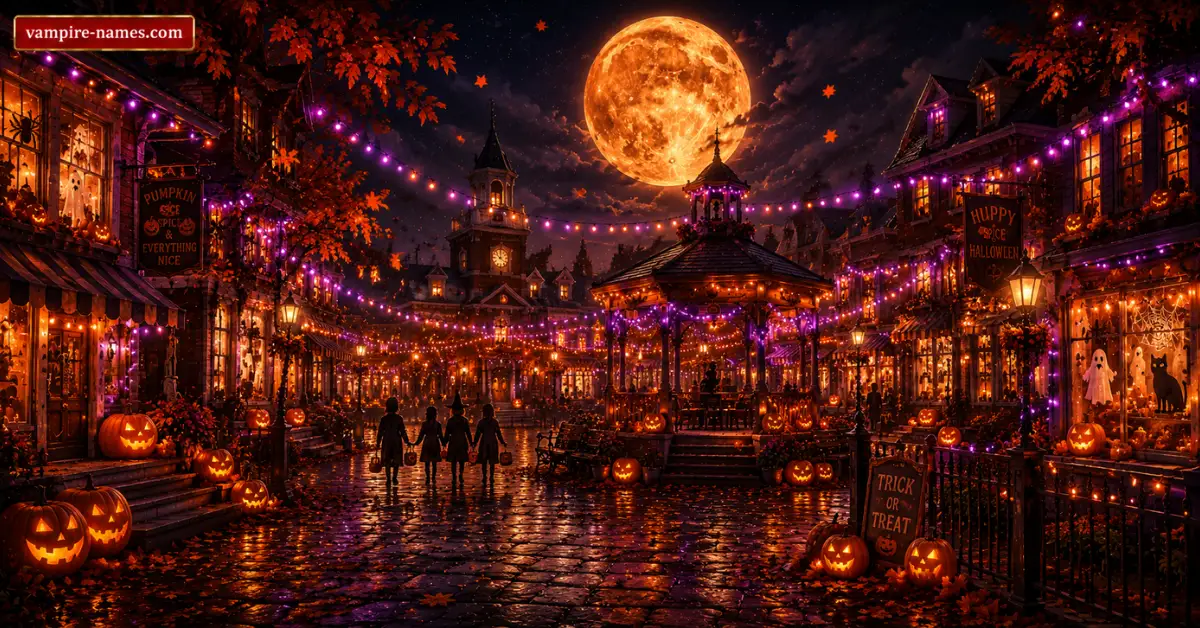
Halloween town names occupy a specific tonal space distinct from pure horror they need to feel fun-scary rather than genuinely disturbing, appropriate for family Halloween events, seasonal branding, or cozy-spooky fiction in the Hocus Pocus / Practical Magic tradition.
| Town Name | Meaning / Notes |
| Pumpkin Hollow | Directly seasonal and warm — the archetypal fun-Halloween town name |
| Autumn Falls | Seasonal beauty with just enough ‘falls’ ambiguity to hint at something more |
| Cobweb Corners | Playful and visual — Halloween decoration vocabulary turned into a place Pirate Names |
| Witch’s Hollow | Direct and iconic — works for cozy witch fiction as much as trick-or-treat branding |
| Candlelight Cove | Warm, atmospheric, seasonal without being frightening |
| Moonlit Meadows | Gentle spooky-adjacent naming — works for children’s Halloween content |
| Sleepy Hollow | The genre-defining reference (Washington Irving, 1820) — still the gold standard of fun-spooky town names |
| Jack-o-Junction | Explicitly seasonal pun — works well for event branding and seasonal marketing |
| Cauldron Creek | Gourdville | Spiderweb Springs | Trickster Hollow |
| Candy Corn Corners | Full Moon Falls | Broomstick Bend | Ghostlight Grove |
| Costume Cove | Frostwitch Fields | Scarecrow Springs | Bat Wing Bluff |
Ghost Town Names (Classic Deserted / Abandoned)
Classic ghost town names work for straightforward abandonment stories — places genuinely empty, without necessarily implying anything supernatural.
| Dustfall | Emptyfield | Forgottonville | Graycross |
| Husktown | Lastchance | Nowhereford | Outpost Zero |
| Quietstead | Restless Flats | Silentbury | Vacantridge |
| Wanderend | Abandonwick | Barrenfield | Cracked Basin |
| Driedout Draw | Fallowmoor | Gone Creek | Hollowedout |
Mining & Industrial Ghost Town Names
Following the real historical pattern (Bodie, Kennecott, Rhyolite), mining and industrial town names should carry the vocabulary of the specific extraction that built and then killed them.
| Coalveil | Ironvein | Copperfall | Ashpit |
| Cinderworks | Slagheap | Quarryend | Brimstone Hollow |
| Furnacetown | Deepshaft | Blastfurnace Row | Tailings Creek |
| Millstone Ruin | Ore Hollow | Sulphur Springs | Rustbelt Junction |
| Smeltertown | Foundryfall | Gravelpit Ghost | Kilnwatch |
Religious & Cult Town Names
Religious settlement names lean into the vocabulary of faith, redemption, and covenant — made ominous through the implication that whatever the founders believed didn’t save them, or worse, is exactly what doomed the town.
| Redemption | Mercy Hill | Saint’s Hollow | Covenant |
| Pilgrim’s Rest | Providence Falls | Shepherd’s End | Hallowfield |
| White Chapel | Sanctuary Ridge | Deliverance | Gracehollow |
| Zion’s Rest | Testament | Blessing Bend | Faithful Grove |
| Absolution | Chapel Cross | Salvation Fields | Prophecy Point |
Coastal & Fishing Village Names
Coastal horror town names draw on maritime vocabulary — the specific dread of a sea that takes and doesn’t always give back, drowned sailors, and fog that never quite lifts.
| Saltmere | Widow’s Reach | Drift Bay | Low Tide |
| Crow Point | Bracken Cove | Hollow Coast | Northhaven |
| Foghorn Bluff | Driftwood Landing | Barnacle Bend | Tidewrack |
| Shipwreck Shoals | Undertow Bay | Brinehollow | Kelp Point |
| Grayshore | Rimewater | Sailor’s Grave | Fathom’s End |
Mountain & Remote Town Names
Isolated mountain town names carry the specific horror of distance — the nearest help is hours away, the winters are unsurvivable, and no one is coming to check on you.
| Grey Peak | Black Ridge | Hollow Pass | Stonehaven |
| Pine Crest | Frost Hollow | Raven Ridge | White Summit |
| Timber Falls | North Ridge | Isolation Peak | Windswept Hollow |
| Avalanche Bend | Highlonesome | Cragmoor | Snowbound Ridge |
| Thin Air Junction | Cliffside Vale | Remotewood | Backcountry Rest |
Wild West Ghost Town Names
Old West ghost towns follow the real historical pattern of gold-rush optimism turned to dust — boomtown names that promised fortune and delivered abandonment.
| Town Name | Meaning / Notes |
| Fortune’s Folly | Directly names the gold-rush hubris that built and then abandoned so many real Western towns |
| Last Chance Gulch | A real historical mining-camp name pattern — desperate optimism baked into the name itself |
| Dry Gulch | Suggests both literal aridity and the metaphorical dried-up fortune of a played-out claim |
| Buzzard’s Roost | Vulture imagery over a dead or dying settlement — classic Western vocabulary |
| Deadman’s Draw | ‘Draw’ is a real Western geographic term (a dry stream bed) combined with mortality |
| Coffin Gulch | Blunt and effective — the kind of Archer Names a real boomtown might have earned through violence |
| Boothill | Dustbowl Junction | Gunsmoke Gulch | Rattlesnake Flats |
| Tombstone Ridge | Vulture Gulch | Whiskey Hollow | Silver Bust |
| Prospect’s End | Gallows Creek | Cactus Grave | Sunbleached Springs |
Scary City Names
Scary city names need to feel different from small-town horror — the dread of scale, anonymity, and a place too large for anyone to notice you’re missing. This is a distinct register that most competitors don’t separate from small-town naming.
| Blackspire City | Ashport Metropolis | Grimhaven | New Erebus |
| Shadowport | Duskgate City | Coldharbor Heights | Ironveil City |
| Nightspire | Crowcastle | Mournington | Grayhollow Metro |
| Rustwater City | Vantablack Junction | Emberfall City | Hollowgate Metropolis |
Creepy City Names
Creepy city names lean more atmospheric than ‘scary’ city names — unsettling rather than outright threatening, suited to noir-horror or urban fantasy settings.
| Umberfall | Duskhollow City | Wraithport | Somber Heights |
| Pale Harbor | Greywater Metro | Nocturne City | Fadeaway Falls |
| Hushington | Palegate | Echo Districts | Shadowmere City |
| Cindergate | Bleakport | Vantage Noir | Foglight City |
Fantasy & Dark Fantasy Town Names
Fantasy horror town names benefit from feeling like they belong to a specific invented culture with its own consistent naming logic, blending real dread-vocabulary with invented phonetics.
| Vaeloth’s Hollow | Grimwardholt | Nyxfell | Thornveil |
| Duskarath | Malvorn Reach | Ashendel | Korrathmoor |
| Vexholm | Sylvangrave | Umbraveil Town | Krethendale |
| Ravenspire Hollow | Grimtharn | Blightwick | Shadowfen |
Haunted Town Names
Haunted-specifically town names imply an active, ongoing supernatural presence rather than just historical abandonment or dread.
| Wraithwick | Poltergeist Hollow | Hauntsmere | Spectral Fields |
| Restless Grave | Whispervale | Echoing Manor Falls | Phantom’s Rest |
| Shadeborn | Grimwhisper | Soulhollow | Wailingfen |
| Ghostlight Ridge | Yourenamehere Manor | Deadvoice Creek | Weepingwillow Grave |
Mysterious Town Names
Mysterious rather than explicitly scary names work for stories where the horror is ambiguous or slow-building — the town itself isn’t necessarily evil, just deeply, unsettlingly unclear.
| Enigma Falls | Unanswered Creek | Riddlewood | Question Mark Hollow |
| Unresolved | Cryptic Cove | Halfheard | Vaguevale |
| Unseen Springs | Elusive Landing | Puzzlewick | Obscura |
| Nameless Notch | Undetermined | Foggy Answer Ridge | Silentquery |
Famous Real Ghost Towns & What Makes Their Names Work
Beyond the American frontier examples covered earlier, these globally famous abandoned places show how real-world naming logic can inform fiction.
| Town Name | Meaning / Notes |
| Chernobyl / Pripyat, Ukraine | Named for a real river; became globally synonymous with nuclear disaster after 1986; the most recognizable modern ghost town name on Earth |
| Hashima Island, Japan | Nicknamed ‘Battleship Island’ for its silhouette; a former coal-mining island abandoned in 1974 when petroleum replaced coal |
| Craco, Italy | A medieval hill town abandoned after a series of landslides and a 1963 evacuation; its eerie silhouette has appeared in multiple films |
| Kolmanskop, Namibia | A former diamond-mining town now half-swallowed by the Namib Desert’s sand, abandoned by the 1950s |
| Oradour-sur-Glane, France | Deliberately preserved as a ruin after a 1944 wartime massacre — kept exactly as it was as a permanent memorial |
International Creepy Town Names
Non-English naming traditions offer genuinely fresh territory for scary town names, drawing on real linguistic roots from cultures underused in horror fiction.
| Villa Silenzio (Italian: ‘silent town’) | Aldea Perdida (Spanish: ‘lost village’) | Dorf der Toten (German: ‘village of the dead’) | Le Village Oublié (French: ‘forgotten village’) |
| Wioska Cieni (Polish: ‘village of shadows’) | Byen Uten Navn (Norwegian: ‘town without a name’) | Mura No Yami (Japanese: ‘village of darkness’) | Selo Tumana (Slavic: ‘village of fog’) |
Names Inspired by Urban Legends
Names built directly from famous urban legend tropes carry instant genre recognition for horror-savvy readers and players.
| Hookman’s Hollow | Bloody Mary Bend | Vanishing Hitchhiker Road | Slit-Mouth Springs |
| Backseat Ridge | Phantom Passenger Falls | Crybaby Bridge | Resurrection Cemetery Road |
| Screaming Bridge Hollow | Devil’s Backroad |
D&D & Horror Game Town Names
Tabletop and horror-game town names need to work spoken aloud repeatedly across a campaign while carrying enough atmospheric weight to set tone immediately for players.
| Barovia (Ravenloft reference) | Grimmshire | Ashenhollow | Vaelthorn Village |
| Duskwatch | Thornedge | Nightreach | Cursedale |
| Bleakhaven | Wraithfell | Grimspire Village | Sorrowgate |
How to Choose the Perfect Scary Town Name
Tip 1: Ground It in a Real Economic or Historical Reason
The scariest fictional ghost towns mirror real ones: something brought people there (a resource, a religion, a railroad), and something took them away. Even if you never explain this fully in your story, knowing it will shape the name and the atmosphere consistently.
Tip 2: Match the Name’s Tone to Your Story’s Pace
Blunt, hard-consonant names (Deadbolt, Gravemarsh) suit fast-paced horror. Longer, more melodic names (Ravenshollow, Willowmere) suit slow-building atmospheric dread. Choose based on what your story actually needs, not just which Kitsune Names sounds coolest in isolation.
Tip 3: Consider the Optimism-Gap
The best scary town names, like real ghost town names, sound like something the founders genuinely believed in. ‘Providence Falls’ or ‘Fortune’s Folly’ hit harder than an on-the-nose name like ‘Deathtown,’ because the gap between hope and reality is where the dread lives.
Frequently Asked Questions About Scary Town Names
Q: What are good fake town names for horror stories?
Strong fake horror-town names combine a real geographic feature (creek, hollow, ridge, mere, cove) with a dark or ambiguous modifier (black, silent, hollow, ash, widow, mourning): Blackwater, Hollow Creek, Silent Pines, Ashfall, Widow’s Reach. This formula works because it grounds the fictional name in real place-naming logic while still carrying atmospheric dread — it reads as a place that could exist, which makes the horror more effective than an obviously invented, over-the-top name.
Q: What is a ghost town called?
A ghost town is the standard English term for an abandoned settlement, typically one that was once populated and thriving before economic, environmental, or disaster-related factors caused its residents to leave. Related terms include ‘abandoned town,’ ‘deserted settlement,’ and in academic contexts, ‘shrinking city’ (for large urban areas experiencing severe population decline rather than complete abandonment).
Q: What is the most famous ghost town?
Bodie, California is generally considered America’s most famous ghost town — a former gold-mining boomtown that peaked at roughly 10,000 residents in the 1880s before being completely abandoned by the mid-20th century. It’s preserved by California State Parks in a deliberate state of ‘arrested decay.’ Globally, Pripyat, Ukraine (evacuated after the 1986 Chernobyl disaster) is probably the most recognized ghost town in the world due to its association with nuclear catastrophe.
Q: What are Halloween town names?
Halloween town names occupy a specific fun-scary register distinct from genuine horror: Pumpkin Hollow, Sleepy Hollow (the genre-defining reference from Washington Irving’s 1820 story), Witch’s Hollow, Autumn Falls, Cauldron Creek, Candlelight Cove, and Jack-o-Junction. These names should feel warm and seasonal, appropriate for family Halloween events or cozy-spooky fiction, rather than genuinely disturbing.
Q: What are scary city names as opposed to scary small town names?
Scary city names carry a different kind of dread than small-town horror — the horror of scale and anonymity rather than isolation. Effective options include Blackspire City, Grimhaven, Shadowport, Nightspire, and Cindergate. Where small-town horror names lean into geographic features and historical abandonment (Blackwater, Hollow Creek), scary city names lean into architectural and industrial vocabulary (spire, port, gate, haven) suggesting a place too vast for anyone to notice you’re gone.
Q: What are creepy place names based on real history?
Real historical ghost towns offer the best inspiration: Bodie, CA (named for a prospector who died before seeing his town thrive); Centralia, PA (an ordinary town name rendered ironic by an underground coal fire burning since 1962); Kennecott, AK (a copper boomtown abandoned when the ore ran out); and Pripyat, Ukraine (evacuated after the 1986 Chernobyl disaster). The pattern across all of these: an optimistic founding, a resource or reason that disappeared, and a population that left far faster than it arrived.
Q: How do I come up with a scary town name?
Start with a real geographic feature (creek, hollow, ridge, cove, mere), add a dark or ambiguous modifier (black, silent, lost, ash, widow, mourning), and consider what economic or historical reason originally brought people to this place — mining, fishing, farming, religion. The best scary town names sound like something their founders genuinely believed in; the horror comes from the reader knowing (or discovering) what happened after that hope.
Q: What are creepy town names for a book manuscript?
For sustained use across an entire manuscript, choose names that are easy to type repeatedly and unambiguous in pronunciation: Ashbury, Blackthorn, Hollowmere, Ironbrook, Ravensworth, Pinehollow. Avoid names with apostrophes, unusual capitalization, or complex spelling that will slow down both your writing and your reader’s processing every single time the town is mentioned — which, in a novel set there, could be hundreds of times.
Q: What are Wild West ghost town names?
Old West ghost town names follow the real historical gold-rush pattern of hope followed by abandonment: Fortune’s Folly, Last Chance Gulch (following a genuine historical naming convention), Dry Gulch, Buzzard’s Roost, Deadman’s Draw, and Coffin Gulch. These work best when they incorporate real Western geographic vocabulary — gulch, draw, flats, roost — combined with either ironic optimism or blunt mortality references.
Q: What towns have scary names in real life?
Several real American towns have unintentionally ominous names: Blue Ball, Pennsylvania; Sweet Lips, Tennessee; Bacon Level, Alabama; Whynot, Mississippi; and Toad Suck, Arkansas lean comedic rather than scary, but names like Hell, Michigan; Purgatory, various states; Sorrow Island in various maritime records; and the numerous towns named Dismal (Dismal Swamp regions) genuinely carry the dark, ambiguous quality horror writers look for — proof that real place-naming history is often stranger than anything invented.
Conclusion
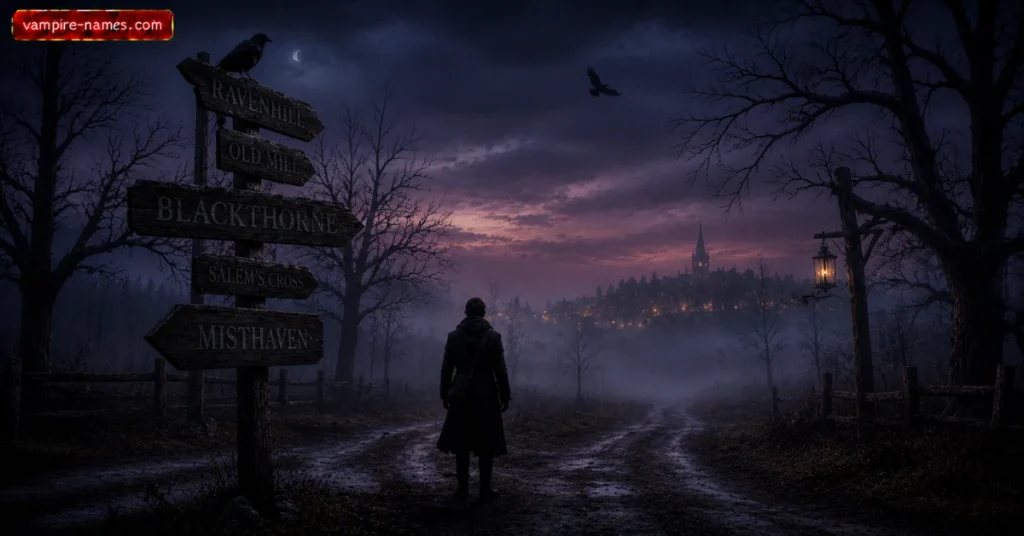
A great scary town name does exactly what a real ghost town’s name does by accident: it promises one thing and delivers another, and the gap between the two is where the story lives. The 700+ names in this guide span every register from cozy Halloween-fun to genuinely unsettling, from real historical grounding to fully invented fantasy phonetics.
Use the generator formula to build something entirely your own. Use the real ghost-town history to ground your fictional town in a believable economic logic. And remember the core principle behind every effective scary place name: the horror isn’t in the name itself, it’s in what the name once meant to the people who chose it, and what happened to make that meaning curdle.
“Every ghost town’s name was once someone’s hope. That’s what makes the silence so loud.”