The Complete Guide to Naming Perfect Societies, Fictional Worlds & Ideological Cities
Harmonious | Technological | Ecological | Spiritual | Dark Utopias | Mythology | Sci-Fi
| 700+Total Names | 25Name Categories | 20+Real Utopian Communities | 8+Philosophy Traditions |
700+ Utopia Names: The Complete Guide to Naming Perfect Societies, Fictional Worlds & Ideological Cities
Thomas More named his perfect island ‘Utopia’ in 1516 and he was making a joke. In Greek, ‘ou-topos’ means ‘no place’ and ‘eu-topos’ means ‘good place’. They sound identical when spoken aloud. More knew exactly what he was doing: the perfect society he described was a good place that was no place, a beautiful impossibility wearing the mask of a reasonable proposal. The name was a warning about the concept it described.
Every utopia name since has been wrestling with that same tension. A Vampire Names that sounds too perfect becomes suspicious. A name that sounds merely pleasant lacks ambition. The best utopia names carry a specific quality of aspiration that stops just short of hubris — they announce a vision without promising delivery. Harmony, Elysium, Arcadia, New Harmony — each one reaching for something that may not be reachable, and knowing it.
This guide takes utopian naming seriously. Real utopian communities exist and their actual names — Brook Farm, Oneida, New Harmony, Arcosanti — are among the most interesting in this tradition. The philosophical lineage from Plato through More through Owen and beyond shapes what utopia names are supposed to do. And the dark utopia tradition — 1984’s Oceania, Brave New World’s World State, Panem in The Hunger Games — produces names that are utopian from one perspective and terrifying from another, which is arguably the most interesting naming tradition of all.
700+ utopia names across 25 categories: harmonious, technological, ecological, spiritual, ancient, fantasy, sci-fi, mystical, cultural, dark/ironic, literary, mythological, one-word, two-word, and five construction methods that actually function as a naming system. Let’s build something better — or at least name it convincingly.
The Etymology of Utopia — Thomas More’s Deliberate Pun & Why It Matters
In 1516, Thomas More published ‘Libellus vere aureus, nec minus salutaris quam festivus, de optimo rei publicae statu deque nova insula Utopia’ — a Latin title meaning ‘A Truly Golden Little Book, No Less Beneficial Than Entertaining, of the Best State of a Republic and of the New Island Utopia’. He named the island in Greek rather than Latin or English, and he named it in two ways simultaneously.
‘Utopia’ sounds like both ‘eu-topia’ (good place, from Greek ‘eu’ meaning good) and ‘ou-topia’ (no place, from Greek ‘ou’ meaning not). Both pronunciations are identical in English. More even included an introductory poem in the book in which the island itself speaks: ‘Utopus my master named me, from no place.’ The pun is the point. More was writing a critique of contemporary English society using the vehicle of a perfect society — but he built into the name itself the acknowledgment that this perfect society cannot exist.
This etymological complexity is enormously useful for naming fictional utopias. The best utopia names carry More’s double meaning: they sound like ‘good’ but hint at ‘impossible’, or they sound achievable but suggest something is being claimed that can’t quite be delivered. This is the naming philosophy this guide is built on.
The Greek roots available for utopia-adjacent naming: ‘eu-‘ (good, well), ‘ou-‘ (not, no), ‘topos’ (place), ‘polis’ (city), ‘arche’ (beginning, rule), ‘logos’ (reason, word), ‘kalos’ (beautiful), ‘agathos’ (good, virtuous), ‘eutopia’ (good place), ‘kallisthenia’ (beauty and strength together), ‘eirene’ (peace), ‘sophia’ (wisdom).
Real Historical Utopian Communities & Their Actual Names
Before building fictional utopias, it’s worth knowing what real people actually named their attempts at perfect communities. These names are fascinating — some are aspirational and beautiful, some are deliberately humble, some are almost accidentally ironic given how they ended.
| Name | Notes / Meaning |
| New Harmony (Indiana, 1825) | Founded by Robert Owen — a Welsh social reformer who believed environment entirely shapes character. He bought an existing Harmonist community. ‘New Harmony’ was inherited from the previous occupants who called their town ‘Harmony’. |
| Brook Farm (Massachusetts, 1841–1847) | Founded by George Ripley — a Transcendentalist commune. ‘Brook Farm’ is deliberately pastoral and simple. Destroyed by fire; the community disbanded after the fire destroyed the main building. |
| Oneida Community (New York, 1848–1881) | Founded by John Humphrey Noyes. Named simply for the county. Practiced ‘complex marriage’ (all adults married to all adults). Eventually became Oneida Limited, the silverware company — an extraordinary practical legacy. |
| Amana Colonies (Iowa, 1855) | Seven villages founded by German Pietist immigrants. ‘Amana’ from the Song of Solomon — ‘to remain true’. One of the most successful communal experiments; transitioned to a corporation in 1932 (still exists as Amana Appliances). |
| Fruitlands (Massachusetts, 1843) | Founded by Bronson Alcott (Louisa May Alcott’s father). A utopian community that lasted seven months and is one of the great failed experiments — no animal products, no artificial lighting, almost no food. |
| Arcosanti (Arizona, 1970–present) | Founded by architect Paolo Soleri — an ‘arcology’ (architecture + ecology). Still under construction. One of the most ambitious ongoing utopian projects. |
| Christiania (Copenhagen, 1971–present) | A freetown/commune in Copenhagen — established by squatters in an abandoned military base. Population around 900. Has its own laws and currency. |
| Auroville (India, 1968–present) | Founded under UNESCO patronage near Pondicherry. Meant to be a universal township. ‘Auro’ from Sri Aurobindo (the spiritual philosopher). Currently about 3,000 residents from 60 nations. |
| The Farm (Tennessee, 1971) | Stephen Gaskin’s hippie commune — named with absolute simplicity. At peak had over 1,500 members. Still exists with about 200. |
| Twin Oaks (Virginia, 1967–present) | An income-sharing community based on Skinner’s ‘Walden Two’. Named for the two oak trees on the property. Still active. |
| Los Angeles’ The Farm Community | One of many communities named ‘The Farm’ — the simplicity of the name is itself a utopian statement. |
| New Llano Colony (Louisiana, 1917) | A socialist colony. ‘Llano’ (Spanish for ‘plain/flat land’) combined with ‘New’ — the standard utopian naming formula. |
| Fordlandia (Brazil, 1928) | Henry Ford’s attempt to build an American-style utopia in the Amazon — for rubber production. A corporate utopia that failed disastrously. |
| Ciudad Evita (Argentina, 1947) | A workers’ housing development named for Eva Perón — a political utopian project. |
The Philosophy Behind Utopian Naming — What Every Name Claims
Every utopia name makes a claim. Understanding the claim being made is the difference between a name that feels profound and one that feels like a motivational poster. There are five main claims that utopia names make, and each produces a different kind of Empire Names.
| Claim Type | Names & Analysis |
| The Harmony Claim | ‘We are at peace with each other and with nature.’ Names: Concordia, Serenity, Eirene, Tranquility, Accord. The risk: sounds passive. The strength: genuinely aspirational without aggression. |
| The Perfection Claim | ‘We have achieved what others merely aspire to.’ Names: Elysium, Arcadia, Eden, Paradise, Utopia itself. The risk: sounds arrogant. The strength: carries millennia of mythological weight. |
| The Justice Claim | ‘Here, everyone receives what they deserve.’ Names: Justicia, Equity, Aequitas, Iustitia, Fair. The risk: legalistic. The strength: honest about the political project. |
| The Knowledge Claim | ‘Here, wisdom and reason govern.’ Names: Sophia, Logos, Athenaeum, Enlightenia, Scientia. The risk: sounds cold or technocratic. The strength: intellectually serious. |
| The Nature Claim | ‘Here, we live in harmony with the natural world.’ Names: Verdana, Eirene, Sylvara, Gaia, Naturalis. The risk: sounds naive. The strength: ecologically resonant and timely. |
| The Transcendence Claim | ‘Here, we have gone beyond ordinary human limitations.’ Names: Elysium, Celestia, Luminar, Ascendant, Beyond. The risk: sounds like a cult. The strength: genuinely aspires to something greater. |
Utopian Names by Governing Ideology
The ideology that governs a utopia shapes its name as much as any aesthetic preference. A technocratic utopia names itself differently from an anarchist collective, which names itself differently from a theocracy. Here are names calibrated to specific governing philosophies.
⚙️ Technocratic Utopia Names
Governed by science, technology, and rational planning. Names tend toward precision, numerical clarity, and a certain cold elegance. The name should feel like it was optimized.
| Axiom | Nexus Prime | Vector City | Algorithm Haven |
| The Construct | The Framework | The Design | The Architecture |
| Optimum | Maximum | Efficient | Optimal |
| Scientia | Techne | Logos City | Rational Prime |
| The Grid | The Network | The System | The Protocol |
| Data Haven | Logic City | Reason Prime | Method City |
| Calculated Bliss | Planned Serenity | Optimized Peace | Efficient Joy |
| Technotopia | Scientopia | Logitopia | Rationaland |
🌿 Ecological / Ecotopia Names
Governed by ecological principles — humanity in harmony with nature, not dominating it. Names draw from natural vocabulary and suggest organic growth rather than planned construction.
| Verdana | Sylvaria | Viridian | Canopy |
| The Green | The Grove | The Forest | The Garden |
| Ecotopia | Naturalis | Gaia’s Rest | Terra Pax |
| Roothold | Barkburgh | Mossmere | Ferngate |
| Leafvale | Bloomhollow | Greenwater | Clearbrook |
| The Rewilded | The Restored | The Renewed | The Returned |
| Biodiversity | Ecosystem | Watershed | Biome |
| Sunlit Canopy | Moonlit Grove | Starlit Meadow | Dawnlit Forest |
🕊️ Anarchist & Consensus Utopia Names
No rulers, no hierarchy — only voluntary cooperation. Ranch Name Generator should feel collective and non-hierarchical: no grand titles, no singular authority suggested.
| The Commons | The Collective | The Community | The Together |
| Free Territory | Open Land | No Masters | Voluntary |
| Mutual Aid | Solidarity | Cooperation | Fellowship |
| Horizontal | Flat Structure | No Peak | No Summit |
| The Conversation | The Agreement | The Consensus | The Accord |
| Everyone’s Place | No One’s Land | All Our Ground | Shared Ground |
| Without Rulers | Beyond Authority | Past Hierarchy | After Power |
| Autogestión | Autarcheia | Autonomia | Self-Governed |
⚖️ Democratic & Republican Utopia Names
Governed by the will of the people, expressed through formal democratic institutions. Names suggest civic virtue, public discourse, and the dignity of collective self-governance.
| Republic Prime | The Agora | Demos City | Civic Haven |
| The Forum | The Assembly | The Senate | The Council |
| Polaris | Politeia | Civitas | Respublica |
| Vote City | Ballot Haven | Election Prime | Mandate Town |
| Common Wealth | Public Good | Shared Flourish | General Will |
| Rousseau’s City | Locke’s Haven | Mill’s Prime | Rawls’ Veil |
| Just Society | Fair Republic | Equal City | Free Town |
| The Constitution | The Charter | The Compact | The Agreement |
✨ Spiritual & Theocratic Utopia Names
Governed by divine authority or spiritual principles. Names carry theological weight and the specific quality of a place that considers itself set apart from ordinary human society.
| New Jerusalem | Heavenly City | City of God | Sacred Ground |
| The Blessed Place | The Holy Ground | The Sanctified | The Consecrated |
| Theopolis | Hieropolis | Sacropolis | Divinopolis |
| Celestia | Firmament | Empyrean | Supernal |
| The Ordained | The Revealed | The Prophesied | The Promised |
| Zion | New Zion | Mount Zion | Zion Prime |
| The Temple City | The Shrine City | The Cathedral City | The Monastery City |
| Blessed Are | Called Apart | Set Aside | Chosen Ground |
Harmonious & Peaceful Utopian Names
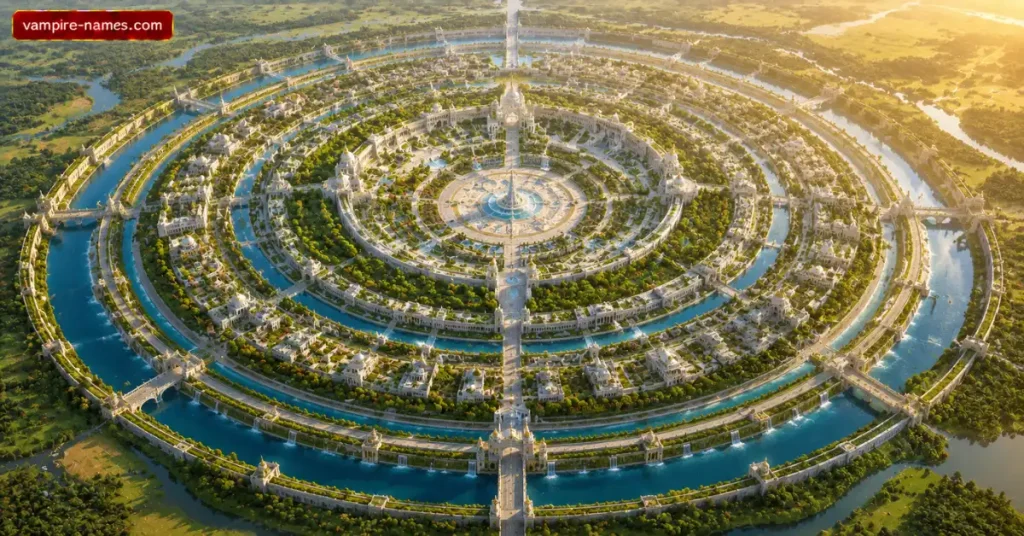
Harmonious utopian names are the most classical tradition they draw from the vocabulary of peace, accord, balance, and the absence of conflict. These are names that sound like they were chosen by people who had genuinely stopped fighting.
| Name | Notes / Meaning |
| Concordia | Latin — ‘concord, harmony’. The goddess of harmony in Roman mythology. One of the purest utopian names available. |
| Eirene | Greek — ‘peace’. The personification of peace in Greek mythology, daughter of Zeus and Themis. |
| Pax | Latin — ‘peace’. Simple, ancient, powerful. The Roman equivalent of Eirene. |
| Harmonia | Greek — ‘harmony’. The goddess of harmony in Greek mythology, daughter of Ares and Aphrodite. |
| Tranquility | English abstract noun — perfect for a peaceful utopia that doesn’t want classical weight. |
| Serenitas | Latin — ‘serenity’. Longer and more formal than Eirene or Pax, but carries specific weight. |
| Ataraxia | Greek — ‘freedom from mental distress’. The Epicurean concept of mental peace. A philosophically precise utopia name. |
| Euthymia | Greek — ‘good spirit, contentment’. Democritus used this word for the highest good. A philosopher’s utopia. |
| Elene | Greek/Old English — ‘torch, bright’. Light as peace — the peaceful place is also the illuminated one. |
| Equanimity | English — mental calmness especially in difficult situations. A mature peace, not naive. |
| Concord | English — from Latin ‘concordia’. The real city of Concord, Massachusetts carries this utopian quality. |
| Stillwater | English compound — the still water as metaphor for peace. Serene and grounded. |
| Clearsky | English compound — unobstructed view, nothing threatening above. |
| Calm Haven | English compound — the harbour where storms don’t reach. |
| Softwind | English compound — the breeze that doesn’t threaten, only refreshes. |
| Gentlemere | English compound — the gentle lake. Calm, reflective, undisturbed. |
| Accord | Balance | Equilibrium | Symmetria |
| Harmonyville | Peacehaven | Serenevale | Calmwater |
| Gentlehollow | Quietmere | Stillair | Softgate |
| Easehollow | Restford | Peacegate | Harmonyholm |
| Concordholm | Tranquilgate | Sereneford | Quietvale |
| Blisshollow | Joygate | Contentford | Satisfiedmere |
| Sufficiency | Enough | Adequate | Complete |
| Whole | Full | Perfect Balance | Just Right |
Technological & Scientific Utopian Names
Technological utopian names draw from the tradition of scientific optimism — the belief that human ingenuity and rational planning can solve any problem and build any good society. Francis Bacon’s ‘New Atlantis’ (1627) was the first great tech-utopia — a society governed by a scientific institution called Solomon’s House. These Tiefling Names carry that tradition.
| New Atlantis | Scientia Prima | Logos Prime | Reason City |
| The Enlightened | The Illuminated | The Informed | The Knowledgeable |
| Technetia | Mechanica | Automatica | Cybernea |
| Silicon Haven | Quantum City | Neural Prime | Algorithm Reach |
| The Calculated | The Optimized | The Efficient | The Streamlined |
| Prometheus City | Hephaestus Haven | Daedalus Prime | Inventor’s Gate |
| Discovery City | Innovation Haven | Breakthrough Prime | Progress Gate |
| Clean Energy | Fusion City | Quantum Haven | Nano Prime |
| Biosynthia | Genomica | Neuroscopia | Cognitivia |
| The Upload | The Singularity | The Transcendence | The Beyond |
| New Atlantis | Bacon’s Dream | Solomon’s House | The Institute |
| Applied Reason | Practical Wisdom | Useful Knowledge | Tested Truth |
| Empirica | Positivia | Rational Haven | Evidence City |
| Penicillin City | Vaccine Haven | Cure Prime | Medicine Gate |
| Clean Water | Safe Food | Shelter Assured | Need Met |
| Post-Scarcity | Abundance City | Plenty Gate | Enough For All |
Ecological & Nature Utopian Names
Ecological utopian names draw from the tradition of ecocentric thought — humanity as part of nature rather than its master. Ernest Callenbach’s ‘Ecotopia’ (1975) named the genre; Ursula K. Le Guin’s Always Coming Home imagined a future California culture built on ecological principles. These names feel grown rather than built.
| Ecotopia | Verdania | Sylvaria | Bioregion |
| The Watershed | The Biome | The Ecosystem | The Web |
| Canopy City | Root Hold | Mycelium | The Network Below |
| Rewilded | Restored | Returned | Reclaimed |
| Thorngate | Briarhollow | Fernmere | Mossgate |
| Oakenseat | Elmhaven | Birchvale | Cedarhollow |
| Clearwater | Cleanair | Richsoil | Deeproot |
| The Meadow | The Prairie | The Grassland | The Plain |
| Tide City | Current Haven | Flow Prime | River Gate |
| Mountain Rest | Valley Peace | Canyon Quiet | Desert Calm |
| Sunpower | Windfall | Rainwater | Earthheat |
| Permaculture | Regenerative | Regenerate | Soil Rich |
| Slow City | Patient Growth | Long View | Deep Time |
| The Patient Earth | The Ancient Soil | The Deep Root | The Long Rain |
| Gaia’s Rest | Terra Prima | Earth Haven | World Garden |
| Biodiversity City | Species Rich Haven | Complex Ecology | Web of Life |
Spiritual & Heavenly Utopian Names
Spiritual utopian names draw from the theological tradition of the perfect afterlife made present — the Kingdom of Heaven brought to earth, the Garden of Eden regained. Augustine’s ‘City of God’, Bunyan’s ‘Celestial City’, the New Jerusalem of Revelation — all describe a perfect spiritual community that becomes a model for earthly attempts. These names carry that weight.
| Name | Notes / Meaning |
| New Jerusalem | From Revelation 21 — the holy city descending from heaven. The most used spiritual utopia name in Western history. |
| City of God | Augustine’s ‘De Civitate Dei’ — the perfect community of those who love God above themselves. |
| Celestial City | Bunyan’s Pilgrim’s Progress — the destination of the pilgrim’s journey. Simple and luminous. |
| The Promised Land | From Exodus — the land flowing with milk and honey. The archetype of the place one journeys toward. |
| Zion | Hebrew — ‘fortress’ or ‘monumental place’. Used throughout Jewish and Christian tradition for the ideal community. |
| Eden Restored | The garden before the fall, returned. What would it mean to undo the original catastrophe? |
| Elysium | Greek — the final resting place of heroic souls. Perfect peace for the worthy dead made available to the living. |
| The Beatific City | Latin ‘beata’ (blessed) + ‘civitas’ (city). A city in a state of complete blessedness. |
| Sanctum | Latin — holy place. Simple, powerful, precise. |
| The Sacred Ground | Not a city but a place — utopia as sanctified territory. |
| Empyrean | Greek — the highest heaven, the sphere of fire, the outermost celestial sphere. The farthest point above. |
| Azurean | Invented — from ‘azure’ (deep sky blue) + ‘-ean’ suffix. The blue-heaven city. |
| Luminar | Latin ‘luminare’ — a light, a heavenly body. The city that gives light. |
| Seraphiel | Invented — ‘seraph’ (highest angel order) + ‘-iel’ (of God, Hebrew suffix). The city of the highest angels. |
| The Radiant | English — what shines outward. A city whose light is its defining quality. |
| Grace Haven | The harbour of divine grace. Religious but not sectarian. |
Ancient & Classical Utopian Names
Ancient utopian names draw from the great classical tradition of ideal societies — Plato’s Kallipolis (beautiful city), the mythological Arcadia, the Elysian Fields, the Islands of the Blessed. These names carry two and a half thousand years of philosophical aspiration.
| Name | Notes / Meaning |
| Kallipolis | Plato’s Republic — ‘kalli’ (beautiful) + ‘polis’ (city). The beautiful city where philosopher-kings rule and justice prevails. |
| Arcadia | A region of Greece idealised as a pastoral paradise. ‘Et in Arcadia ego’ — ‘even in Arcadia, I (death) am present’. |
| The Elysian Fields | Greek mythology — the final home of heroic souls, a place of perfect happiness and beauty. |
| Islands of the Blessed | Greek mythology — Hesiod’s paradise for three-times-virtuous souls. Perfect and inaccessible. |
| The Golden Age | Hesiod — the first and best age of humanity, when humans lived peacefully among gods. |
| Arete | Greek — ‘excellence, virtue’. The goal of classical Greek ethics. A city built on virtue. |
| Eudaimonia | Greek — ‘good spirit’, translated as flourishing or happiness. Aristotle’s highest human good. |
| Phronesis City | Greek — ‘practical wisdom’. A city governed by wise judgment rather than abstract principles. |
| Chronopolis | ‘Time city’ — the city that has always been and always will be. Ancient beyond dating. |
| Plato’s Republic | Sometimes named directly — the idea has become the name. |
| The Polis | Greek — simply ‘the city’. When the city is perfect, it needs no other name. |
| Agathia | Greek ‘agathos’ (good, noble) + ‘-ia’ suffix. The good place, in the moral sense. |
| Sophopolis | Greek ‘sophia’ (wisdom) + ‘polis’. The city of wisdom. Plato would approve. |
| Dikaiia | Greek ‘dikaios’ (just) + ‘-ia’. The just community. What Socrates spent his life arguing for. |
| Aristeia | Greek ‘aristos’ (best) + ‘-ia’. The place where the best prevails. |
| Megalopolis | Greek — ‘great city’. Aristotle actually used this word. Sometimes simple grandeur suffices. |
Fantasy Utopian Names — High Fantasy Perfect Worlds
Fantasy utopian names exist in the tradition of Tolkien’s Valinor (the Undying Lands), Tolkien’s Lothlórien, Le Guin’s Orsinian Tales, and the various ‘perfect kingdoms’ of fantasy literature. They combine the aesthetic richness of high fantasy naming with the philosophical aspiration of utopian thought.
| Valinor | Lothlórien | Rivendell (Imladris) | The Undying Lands |
| Camelot | Avalon | Lyonnesse | Tir na Nog |
| Aelthandris | Silvermere | Goldenvale | Luminara |
| Celesthaven | Astralhaven | Ethereal City | The Shining |
| Evermore | Eternity Gate | Forever Vale | Endless Bloom |
| The Bright Lands | The Golden Plains | The Silver Shore | The Crystal Heights |
| Elysara | Arcadion | Edenara | Paradisia |
| Faerie Court | Fey Realm | The Fair Lands | The Gentle World |
| Lightborne | Dawnborn | Peaceborn | Hopeborn |
| Starfall City | Moonrise Haven | Sunbloom Gate | Dawnbreak Vale |
| The Gentle Kingdom | The Kind Realm | The Wise Domain | The Just Land |
| Alvareth | Caeldrath | Silvindor | Aelindra |
| The First City | The Old Paradise | The Ancient Good | The Remembered Garden |
| Mithril City | Crystal Haven | Diamond Gate | Pearl Vale |
| Bloom Eternal | Spring Endless | Dawn Forever | Light Always |
| Verdant Crown | Emerald Throne | Jade Sovereignty | Peridot Reach |
Sci-Fi Utopian Names — Future Perfect Societies
Science fiction utopian names inherit the optimism of scientific progress and imagine what human civilization could become if we solved our current problems. Gene Roddenberry’s Star Trek universe imagines a Federation of Planets without scarcity — a tech-utopia made real. Iain M. Banks’s Culture is perhaps the most fully realised sci-fi utopia, governed by benevolent AI ‘Minds’. These Werewolf Names carry that tradition.
| The Federation | The Culture | The Commonwealth | The Alliance |
| New Terra | Second Earth | Earth Prime | Earth Restored |
| The Nexus | The Hub | The Core | The Center |
| Utopia Planitia | Elysium Mars | New Olympus | Terraformed Haven |
| The Abundance | The Plenty | The Sufficiency | The Enough |
| Post-Scarcity City | After Want | Beyond Need | Past Lack |
| The Benevolent | The Caring | The Kind | The Helpful |
| Enlightened City | Evolved Haven | Advanced Prime | Developed Gate |
| The Peaceful Stars | The Quiet Void | The Gentle Cosmos | The Kind Universe |
| Solaria | Lunaris | Aeria | Aquatopia |
| The Ring | The Wheel | The Torus | The Station |
| Orbital Paradise | Space Haven | Void Garden | Cosmic Rest |
| The Long Peace | The Permanent Ceasefire | The Final War’s End | The After Violence |
| Designed Well | Built Right | Planned Thoughtfully | Made for People |
| The Uploaded Paradise | Digital Elysium | Virtual Utopia | Simulated Perfect |
| Consciousness City | Mind Haven | Thought Prime | Idea Gate |
Mystical & Enchanted Utopian Names
Mystical utopian names suggest a place touched by forces beyond ordinary human understanding — a city where magic is the infrastructure, where wisdom is the currency, where the boundary between the material and spiritual is thin. They draw from alchemical, hermetic, and esoteric traditions.
| Arcana | The Mysterie | The Hidden City | The Veiled Paradise |
| Hermetica | Alchemica | The Philosophers’ Stone City | Gold from Lead |
| The Transmuted | The Transformed | The Perfected | The Completed |
| Rose Cross | The Rosicrucian City | The Hermetic Garden | The Alchemist’s Dream |
| The Philosopher City | The Wise Ones’ Place | The Illuminated Circle | The Perfect Lodge |
| Sophia’s City | Gnosis Haven | Wisdom Gate | Enlightenment Prime |
| The Inner Sun | The Hidden Moon | The Secret Star | The Invisible Light |
| Astral City | Ethereal Haven | Spiritual Gate | Soul’s Rest |
| The Fourth Dimension | The Other Side | The Beyond | The Through |
| Alchemy City | Transmutation Haven | Perfection Gate | Gold City |
| The Sealed Garden | The Hidden Valley | The Secret Mountain | The Veiled Lake |
| The Perfect Art | The Complete Work | The Great Work | The Magnum Opus |
| Quintessence | The Fifth Element | The Pure | The Distilled |
| The Rose Garden | The Golden Dawn | The Silver Moon | The Crystal Star |
| Inner Sanctum | Secret Chamber | Hidden Room | Known Only to The Worthy |
Cultural & Artistic Utopian Names
Cultural utopian names imagine a perfect society defined by its artistic and intellectual achievement rather than its political or economic structure. William Morris’s ‘News from Nowhere’ (1890) described a future England that had returned to medieval craft traditions. These names carry that tradition — the city as the highest expression of human creativity.
| The Atheneum | The Gallery | The Library | The Museum |
| Museum City | Gallery Haven | Library Prime | Archive Gate |
| The Symposium | The Dialogue | The Conversation | The Discussion |
| Arts City | Craft Haven | Skill Prime | Maker Gate |
| The Renaissance | The Flourishing | The Blooming | The Peak |
| Mozart City | Shakespeare Haven | Michelangelo Gate | Da Vinci Prime |
| The Beautiful | The Sublime | The Picturesque | The Aesthetic |
| Harmony of Arts | Unity of Beauty | Integration of Culture | Synthesis of Wisdom |
| The Golden Ratio City | The Perfect Form Haven | The Ideal Beauty Gate | The Platonic Prime |
| Kalophilia | Philokalia | Aesthetica | Beautopolis |
| The Great Story | The Perfect Song | The Masterwork | The Complete Art |
| Living Art City | Walking Museum Haven | Breathing Gallery Gate | Moving Theatre Prime |
| The Craftsperson’s City | The Artist’s Haven | The Writer’s Gate | The Musician’s Prime |
| Education City | Learning Haven | Knowledge Gate | Wisdom Prime |
| The Well-Read | The Fully Taught | The Deeply Knowing | The Broadly Wise |
| A Place of Art | For Beauty’s Sake | In Service of Music | Toward the True |
The Dark Utopia — Dystopias That Think They’re Utopias
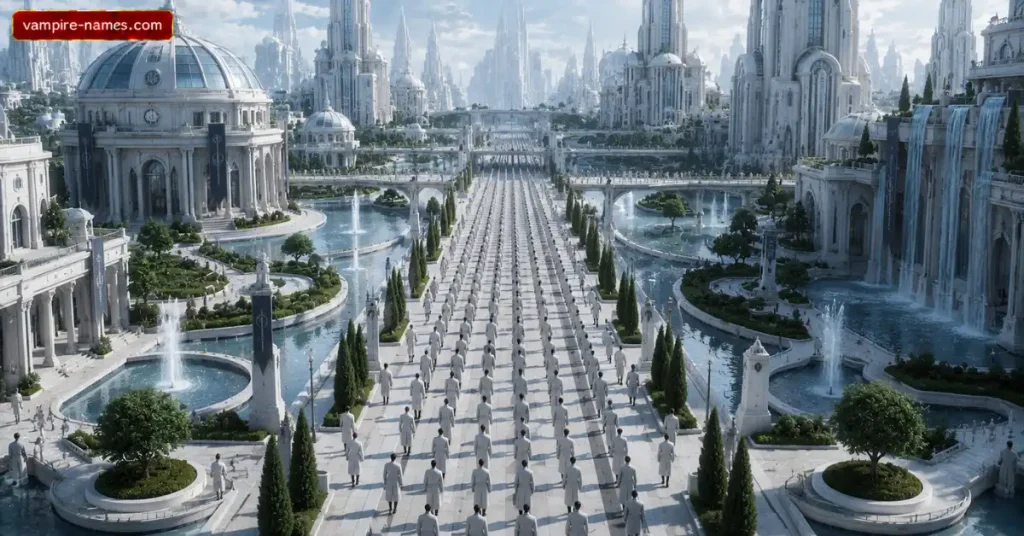
📸 IMAGE: A gleaming perfect city from above — immaculate white towers, green parks, blue waterways — but the people below are all identically dressed, moving in perfect synchronized patterns, no individual variation visible | Alt: Dark utopia names — perfect city where everyone moves identically, individuality absent
The most interesting utopian names in literature are the ones worn by dystopias. Orwell’s ‘Oceania’ sounds like an ocean empire — vast, cool, liquid. ‘Panem’ (The Hunger Games) is Latin for ‘bread’ — from ‘panem et circenses’ (bread and circuses), the Roman formula for keeping the population compliant. ‘The World State’ in Brave New World doesn’t even pretend to be more than it is — a state that controls the world.
These names work because they sound either genuinely utopian or deliberately neutral — they conceal the horror until you know the story. This is the most sophisticated utopian naming tradition available.
| Name | Notes / Meaning |
| Oceania | Orwell’s 1984 — sounds like a placid ocean empire. Contains Airstrip One (formerly Britain). Run by Big Brother. |
| Panem | The Hunger Games — Latin ‘panem’ (bread). From ‘bread and circuses’. A Capitol that feeds itself on its districts. |
| The World State | Huxley’s Brave New World — no pretension; just the statement of control. ‘Our Ford’ is the deity. |
| Gilead | The Handmaid’s Tale — biblical region name. A theocratic republic built on slavery and reproductive control. |
| Camazotz | Madeleine L’Engle’s A Wrinkle in Time — a planet of perfect conformity and horrible sameness. |
| The Capitol | The Hunger Games — self-evidently the seat of power. The name announces who matters. |
| Alphaville | Jean-Luc Godard’s 1965 film — a futuristic city-state run by a computer called Alpha 60. |
| Metropolis | Fritz Lang’s 1927 film — a two-tiered city where workers live underground while elites live above. |
| The Community | The Giver — a community so controlled it has eliminated choice, memory, and color. |
| Omelas | Ursula K. Le Guin’s ‘The Ones Who Walk Away from Omelas’ — a city of perfect happiness built on one child’s suffering. |
| Brave New World | The title is the name. Shakespeare’s Miranda: ‘O brave new world, that has such people in’t.’ Irony all the way down. |
| Equilibrium | The 2002 film — a state that has eliminated emotion to eliminate war. The name is the ideology. |
| The City | In many dystopian works — ‘the city’ without a name, because naming implies it deserves individual recognition. |
| Zion (dark version) | The Matrix — the last human city, a utopia of survival rather than flourishing. Compare with its biblical use. |
| District One through Twelve | The Hunger Games — not utopia names but the systematic reduction of people to numbers and resource categories. |
| Perfect Society | The name as statement: if you have to say it’s perfect, it probably isn’t. |
Dark utopia name ideas for fiction — names that sound utopian but carry ironic weight:
| Serenity (enforced) | Harmony (mandated) | Peace (imposed) | Order (absolute) |
| The Greater Good | The Common Benefit | The Collective Well | The All’s Sake |
| No Problems Here | Nothing Wrong | Everything Fine | Perfectly Normal |
| The Stable Society | The Predictable City | The Reliable Haven | The Consistent Gate |
| Always Happy | Never Sad | No Tears Allowed | Smile Mandatory |
| The Corrected | The Adjusted | The Normalized | The Standardized |
| Progress City | Forward Haven | Onward Gate | Advance Prime |
| The Ministry of Love | The Department of Peace | The Bureau of Joy | The Office of Bliss |
Famous Utopias from Literature & Philosophy — With Analysis
These are the named utopias that built the tradition — understanding them helps build better fictional ones.
| Name | Notes / Meaning |
| Utopia (Thomas More, 1516) | The original. An island republic with religious tolerance, public ownership, and no private property. More executed for refusing to support Henry VIII’s divorce. |
| The City of the Sun (Campanella, 1602) | A theocratic utopia on a mountain, divided into seven concentric rings. Ruled by a priest called ‘Hoh’ (metaphysic). Written from prison. |
| New Atlantis (Francis Bacon, 1626) | A technological utopia with a research institution called Solomon’s House. The founding text of scientific optimism. |
| Christianopolis (Andreae, 1619) | A Christian utopia with scientific institutions. Influenced Bacon. A city shaped like a square with a central temple. |
| Erewhon (Samuel Butler, 1872) | ‘Nowhere’ nearly anagrammed. A society where illness is a crime and crime is treated as illness. |
| News from Nowhere (William Morris, 1890) | A socialist utopia set in a future England that has reverted to medieval craft traditions and abolished money. |
| Looking Backward (Edward Bellamy, 1888) | A man wakes in 2000 to find a socialist utopia. One of the most influential utopian novels ever written — over 160 Bellamy Clubs formed in response. |
| A Modern Utopia (H.G. Wells, 1905) | A utopia governed by a voluntary order of samurai-like administrators. Wells was obsessed with utopia — this is the most structured attempt. |
| Herland (Charlotte Perkins Gilman, 1915) | An all-female utopia discovered by three male explorers. Cooperative, peaceful, rational. The men struggle to understand it. |
| Island (Aldous Huxley, 1962) | Huxley’s positive utopia — written as a counterpart to Brave New World. The island of Pala. Destroyed at the end of the novel. |
| The Dispossessed (Ursula K. Le Guin, 1974) | An anarchist moon colony called Anarres. ‘An ambiguous utopia’ in the subtitle. One of the most honest utopian texts. |
| Always Coming Home (Ursula K. Le Guin, 1985) | A future California culture called the Kesh. Ecologically based, complex, not paradise — something better than paradise. |
| Pacific Edge (Kim Stanley Robinson, 1990) | The third of Robinson’s Three Californias — a genuine green utopia. Part of a trilogy that includes a dystopia and a present. |
| The Ministry for the Future (Robinson, 2020) | A near-future in which climate crisis is gradually solved through international cooperation. Named for its fictional organisation. |
Famous Utopias from Film & TV
| Name | Notes / Meaning |
| Wakanda (Black Panther) | A technologically advanced African nation that chose isolation. Its utopia is specifically African and specifically chosen — not imposed. |
| The Federation (Star Trek) | Gene Roddenberry’s post-scarcity democracy — no money, no poverty, exploration as the primary human activity. |
| Zootopia | Disney’s failed animal utopia — ‘anyone can be anything’ turns out to be more complicated than the slogan suggests. |
| Tomorrowland | The 2015 film — a utopian dimension accessible to optimists. Named for the Disneyland area. |
| The Good Place | NBC series — a comedy about the afterlife that became a philosophy course. The Good Place is a utopia that turns out to be a torture. |
| Themyscira (Wonder Woman) | The Amazonian island — a utopia of warrior women. Beautiful, isolated, specifically gendered. |
| Shangri-La (Lost Horizon) | James Hilton’s novel and Frank Capra’s film — a Tibetan valley of perfect peace and longevity. |
| The Village (The Prisoner) | Patrick McGoohan’s TV series — a utopia-as-prison. Everything provided; freedom is the thing withheld. |
| The Culture (Iain M. Banks) | Not filmed but enormously influential — a post-scarcity interstellar civilization run by benevolent AI. |
| Logan’s Run | A utopia where everyone is executed at 30. Perfect comfort with a fatal flaw that benefits those in power. |
| The Giver | A community that has eliminated pain, difference, and memory. The cost: human experience itself. |
| Westworld (Season 1’s Dolores’ dream) | The ideal world Dolores imagines has to be fought for and may not be achievable. |
| Avatar’s Pandora | A utopia for the Na’vi — but specifically threatened by human technology and exploitation. |
| WALL-E’s Axiom | A humanity-as-utopia that has become a dystopia through comfort and passivity. |
| Everything Everywhere All at Once’s Everywhere | Every possible version of the world contains a utopia and a dystopia simultaneously. |
Unique & Rare Utopian Names
These names push beyond the standard utopian vocabulary toward something more unexpected — abstract nouns, unexpected combinations, philosophical concepts turned into place names.
| Sufficiency | Enough | Adequate | Complete |
| The Necessary | The Required | The Meeting of Need | The Filled |
| Flourish | Thrive | Bloom | Grow |
| The Possible | The Achievable | The Reachable | The Within Grasp |
| Becoming | Developing | Evolving | Improving |
| The Patient | The Long View | The Deep Time | The Slow Good |
| The Conversation | The Dialogue | The Understanding | The Agreement |
| The Generous | The Abundant | The Giving | The Freely Shared |
| The Unafraid | The Secure | The Safe | The Trusted |
| The Known | The Understood | The Heard | The Seen |
| The Cared-For | The Tended | The Looked-After | The Valued |
| Particularity | Specificity | This Exact Place | Here and Nowhere Else |
| The Finite | The Limited | The Bounded | The Enough-Sized |
| The Ordinary | The Everyday | The Regular | The Usual Made Good |
| The Repaired | The Healed | The Fixed | The Mended |
| The Returned | The Restored | The Renewed | The Rebuilt |
Modern Utopian Names — 21st Century Perfect Society
Modern utopian names need to address 21st-century problems specifically: climate change, digital technology, economic inequality, political polarisation. They can’t pretend these problems don’t exist — the most honest modern utopian names acknowledge what was overcome to get there.
| Post-Carbon City | Zero Emission Haven | Net Zero Gate | Clean Air Prime |
| After Inequality | Post-Scarcity Haven | Beyond Want Gate | Past Poverty Prime |
| The Repaired City | The Fixed Haven | The Solved Gate | The Answered Prime |
| Digital Democracy | Tech for All | Access Assured | Connected Equally |
| The Healed Earth | The Fixed Climate | The Saved Atmosphere | The Cooled World |
| Universal Basic City | Guaranteed Floor Haven | Minimum Secured Gate | Floor Assured |
| The Listened-To | The Heard Voice | The Counted | The Included |
| Mental Health City | Cared-For Haven | Supported Gate | Helped Prime |
| The Short Week | Four Days Work Haven | Leisure Rich Gate | Time Wealthy Prime |
| The Horizontal City | Flat Structure Haven | No Boss Gate | Self-Governed Prime |
| Local Food City | Short Chain Haven | Seasonal Gate | Regional Prime |
| Slow City | Careful Haven | Patient Gate | Unhurried Prime |
| The Repaired Democracy | Functional Republic Haven | Working System Gate | Honest Prime |
| Universal Health | Guaranteed Care Haven | Free at Point Gate | No Bill Prime |
| Education Free | Knowledge Accessible Haven | Learning Open Gate | Wisdom Common |
| The Long Term | The Patient Plan Haven | The Deep Investment Gate | The Future Thought |
Utopian Names from World Mythology
Every culture has its mythological paradise — the place of perfect happiness that humans glimpse but cannot inhabit. These femboy name carry the accumulated longing of their cultures.
| Name | Notes / Meaning |
| Shangri-La | Tibetan/fictional — James Hilton’s 1933 novel Lost Horizon. A hidden Himalayan valley of perfect peace and longevity. The name entered common usage as a synonym for paradise. |
| Avalon | Celtic — the mythical island where King Arthur was taken to heal. ‘Abal’ in Old Irish means apple. The Apple Isle. |
| El Dorado | Spanish — ‘the gilded one’. A legendary city of gold sought by Spanish conquistadors. A utopia of wealth. |
| Prester John’s Kingdom | Medieval European legend — a Christian kingdom of perfect justice and plenty somewhere in Asia or Africa. |
| Tir na Nog | Irish — ‘Land of the Young’. A Celtic paradise of eternal youth, beauty, and happiness. |
| Annwn | Welsh — the Celtic Otherworld. A realm of abundance, music, and timelessness. |
| Lyonnesse | Arthurian — a drowned kingdom of perfect civilization beneath the sea off Cornwall. |
| Valhalla | Norse — the hall of the slain, where warriors feast forever. A warrior’s utopia. |
| Gimlé | Norse — the hall that will exist after Ragnarök, where the righteous will dwell. A post-apocalyptic paradise. |
| Sukhavati | Sanskrit — ‘land of bliss’. The Pure Land of Amitabha Buddha — a paradise where enlightenment is easily attained. |
| Shambhala | Tibetan Buddhist — a hidden kingdom of peace and wisdom. Also spelled ‘Shangri-La’ in Western usage. |
| Takamagahara | Japanese — the Plain of High Heaven, home of the Shinto deities. The divine utopia. |
| Elysium | Greek — the final resting place of heroic and virtuous souls. Perfect happiness for the deserving. |
| Islands of the Blessed | Greek — where three-times-virtuous souls go. Beyond even Elysium. |
| Garden of Eden | Hebrew — the original paradise before the fall. The utopia that was lost. |
| Land of Cockaigne | Medieval European — a land of endless food, sleep, and pleasure. A peasant’s dream of relief from scarcity. |
One-Word Powerful Utopian Names
Single-word utopian names carry the most weight when they work. They need to be immediately meaningful, phonetically pleasant, and carry the full weight of a utopian aspiration in a single utterance.
| Harmony | Accord | Concordia | Serenity |
| Tranquility | Equanimity | Ataraxia | Eudaimonia |
| Elysium | Arcadia | Paradise | Eden |
| Pax | Eirene | Shalom | Salam |
| Flourish | Thrive | Bloom | Grow |
| Sufficiency | Abundance | Plenty | Enough |
| Justice | Equity | Aequitas | Dikaiosyne |
| Sophia | Logos | Phronesis | Nous |
| Verdana | Sylvaria | Viridian | Canopy |
| Luminar | Radiance | Aurelius | Solaris |
| Celestia | Empyrean | Firmament | Azurean |
| Becoming | Flourishing | Improving | Perfecting |
| Utopia | Eutopia | Nusquama | Nowhere Good |
| Kallipolis | Politeia | Eudaimonia | Arete |
| Perfection | Completion | Wholeness | Fullness |
| Peace | Rest | Ease | Comfort |
Two-Word Utopian Names — The Most Effective Format
Two-word utopian names are the most versatile format — they carry both a modifier and a structural noun, which means they can communicate ideology (what kind of place), aesthetic (what it feels like), and scale (what size of entity) simultaneously.
| Eternal Harmony | Perfect Balance | Complete Peace | True Accord |
| Golden Age | Silver Dawn | Crystal Morning | Diamond Light |
| Green Haven | Blue Serenity | White Peace | Clear Sky |
| New Jerusalem | New Harmony | New Eden | New Beginning |
| The Republic | The Community | The Commons | The Collective |
| Bright Future | Clean Tomorrow | Clear Horizon | Open Sky |
| Deep Root | Strong Foundation | Solid Ground | True Base |
| Free City | Open City | Fair City | Just City |
| Wise Council | Good Governance | Fair Law | Just Rule |
| Shared Abundance | Common Wealth | Public Good | Everyone’s Flourish |
| Patient Growth | Slow Progress | Deep Change | Long View |
| Healed World | Fixed Earth | Restored Land | Repaired Home |
| Small Enough | Large Enough | Sized Right | Proportionate Good |
| The Sufficient | The Adequate | The Meeting | The Fulfilled |
| After War | Past Conflict | Beyond Violence | Through Peace |
| All Welcome | None Excluded | Everyone Included | No One Left |
How to Build Your Own Utopia Name — 5 Methods (The Real Generator System)
These five methods function as a genuine naming system — not a random generator, but a principled approach that produces names with internal logic and philosophical coherence.
Method 1 — The Greek Root Method
Choose the core value your utopia embodies and find its Greek root. Greek roots produce names that feel ancient, philosophical, and slightly elevated — appropriate for a society that considers itself the culmination of human aspiration. ‘Eu-‘ (good) + any noun: Eutopia, Eudaimonia, Eutaxia (good order). ‘Sophia’ (wisdom) compounds: Sophopolis, Sophocracy, Sophia’s City. ‘Kalos’ (beautiful) + ‘agathos’ (good) = Kalokagathia — the classical Greek ideal of combined beauty and goodness. ‘Eirene’ (peace), ‘Arete’ (virtue), ‘Dikaiosyne’ (justice), ‘Philia’ (love/friendship). Choose the concept, find the Greek, build the name.
Method 2 — The Claimed Value Method
Identify the primary claim your utopia makes (see the earlier section on what utopia names claim) and name it after that claim. Harmony Claim: Concordia, Accord, Eirene, Pax. Perfection Claim: Elysium, Arcadia, Eden, Kallipolis. Justice Claim: Justicia, Aequitas, The Fair City, Equitable. Knowledge Claim: Sophia, Logos, Athenaeum, Scientia. Nature Claim: Verdana, Sylvaria, Gaia, Canopy. Transcendence Claim: Empyrean, Celestia, Luminar, Ascendant. The name announces the ideology before any constitution is written.
Method 3 — The Historical Real Community Method
Research the actual names of historical utopian communities and borrow their naming logic. ‘New Harmony’ uses the New + existing-name formula. ‘Brook Farm’ uses a pastoral physical description. ‘Oneida’ uses a local geographic name. ‘Auroville’ uses its founding philosopher’s name (‘Auro’ from Sri Aurobindo). ‘The Farm’ uses absolute simplicity. Each of these naming strategies can be applied to your fictional community: New [aspiration], [pastoral description], [local geography], [founder’s name or root], or pure simple description.
Method 4 — The Irony Method (for Dark Utopias)
Choose a name that sounds genuinely utopian while carrying within it the seeds of its own critique. ‘Serenity’ is genuinely beautiful — but enforced serenity is horror. ‘Order’ sounds stable — but total order is oppression. ‘The Common Good’ sounds generous — but who decides what’s common and good? The ironic utopia name works by applying the analysis of what the governing ideology would call itself to the reality of what it produces. A surveillance state calls itself ‘The Transparent City’. A conformist society calls itself ‘The Harmony’. A consumption-controlling regime calls itself ‘The Sufficient’. The name is always the lie the system tells itself.
Method 5 — The Problem-First Method
Start with the specific problem your utopia has solved and name it for that solution. If your utopia has solved climate change: Post-Carbon City, After Emissions, The Cooled World, Clean Air Forever. If it has solved inequality: After Scarcity, Beyond Want, The Floor Assured, Universal Basic City. If it has solved violence: The Long Peace, After War, The Permanent Ceasefire, Beyond Violence. This method is particularly effective for contemporary fiction because it anchors the utopia in recognisable present-day problems — readers immediately understand what was overcome to get there, which makes the utopia both plausible and aspirational.
Frequently Asked Questions
Q: What is a good name for a utopia?
A: The best utopia names match the ideology and aesthetic of the society they describe. For a harmonious utopia: Concordia, Eirene, Accord, Serenity, Pax. For a technological utopia: Nexus Prime, Axiom, Scientia, The Enlightened. For an ecological utopia: Verdana, Ecotopia, The Watershed, Canopy. For a spiritual utopia: New Jerusalem, Celestia, Elysium, The Radiant. For a fantasy utopia: Kallipolis, Sylvaria, Luminara, Aelthandris. For a dark utopia: Serenity (enforced), Perfect Order, The Common Good (ironic), Stability Forever. The single most important rule: the name should announce what the society claims to be, not just what it looks like.
Q: What is the Greek word for utopia?
A: Thomas More coined ‘Utopia’ in 1516 as a deliberate Greek pun. It simultaneously reads as ‘eu-topia’ (good place, from Greek ‘eu’ meaning good) and ‘ou-topia’ (no place, from Greek ‘ou’ meaning not/no). Both sound identical when spoken aloud in English. The pun was intentional — More was simultaneously describing a good society and acknowledging its impossibility. The Greek for ‘good place’ specifically would be ‘eutopia’. The Greek for ‘no place’ would be ‘outopia’. More’s genius was making them the same word.
Q: What are some famous utopias in literature?
A: The most influential literary utopias include: Thomas More’s Utopia (1516 — the original); Plato’s Kallipolis from The Republic (360 BCE — philosopher-kings ruling a just city); Francis Bacon’s New Atlantis (1626 — a scientific utopia); Tommaso Campanella’s City of the Sun (1602 — a theocratic utopia); Edward Bellamy’s Looking Backward (1888 — a socialist utopia in 2000); Charlotte Perkins Gilman’s Herland (1915 — an all-female utopia); Aldous Huxley’s Island (1962 — a positive response to Brave New World); Ursula K. Le Guin’s The Dispossessed (1974 — an anarchist utopia); and Kim Stanley Robinson’s Pacific Edge (1990 — a green utopia).
Q: What are names for a utopian society that feel realistic?
A: Realistic utopian society names tend to be either modest and descriptive (The Commons, The Community, The Collective, The Farm, New Harmony) or philosophically grounded Greek/Latin roots (Concordia, Eirene, Eudaimonia, Pax, Aequitas). Historical real community names are the most realistic: Brook Farm, Oneida, Amana, Twin Oaks — these work because they’re actually real and their modesty is itself a utopian statement. Avoid names that sound too explicitly utopian (‘Perfect Harmony City’) — real utopian communities rarely announced their ambitions that directly.
Q: What is the difference between a utopia and a dystopia name?
A: Grammatically and aesthetically, sometimes nothing — which is the point. The most effective dystopian fiction uses names that sound utopian: Oceania (Orwell), Panem (from ‘bread’, in The Hunger Games), Gilead (biblical peaceful region, in The Handmaid’s Tale). The dystopian name often sounds more aspirational than the utopian one, because the dystopia is spending more energy on its own propaganda. A genuine utopia might call itself ‘The Farm’ or ‘The Commons’. A dystopia calls itself ‘The Greater Good’ or ‘The Perfect Society’. The grandiosity of the name is sometimes the tell.
Q: What are utopian city names for worldbuilding?
A: For worldbuilding, utopian city names should match your world’s cultural language and phonetic conventions. For a pseudo-European world: Latin roots work best (Concordia, Pax, Serenitas, Justicia). For a pseudo-Greek world: Greek philosophical concepts (Kallipolis, Eudaimopolis, Sophopolis, Dikaiia). For a fantasy world: invented names with internal consistency (Aelthandris, Silvermere, Luminara, Sylvaria). For a sci-fi world: technological vocabulary (Nexus Prime, Axiom, The Grid, The Network). The key is that the name should feel like it was named by the people who live there, not by an outsider describing what they see.
Q: What are good names for utopian societies based on ideology?
A: Technocratic utopia: Axiom, The Optimized, Scientia, Nexus Prime, The Calculated. Ecological utopia: Verdana, Ecotopia, The Watershed, Canopy, The Rewilded. Anarchist utopia: The Commons, The Collective, Mutual Aid, Autogestión, No Masters. Democratic utopia: The Agora, The Forum, Politeia, Demos City, The Republic. Theocratic utopia: New Jerusalem, Celestia, The Ordained, Zion, The Sacred Ground. Socialist utopia: The Commons, Common Wealth, Public Good, Shared Abundance, After Scarcity. The name should be what the ideology would call itself if it were at its best.
Q: What are famous real-world utopia names?
A: Real historical utopian community names include: New Harmony (Robert Owen’s socialist community, Indiana, 1825), Brook Farm (Transcendentalist commune, Massachusetts, 1841), Oneida (John Humphrey Noyes’s complex marriage community, New York, 1848 — became Oneida silverware), Amana Colonies (German Pietist communities, Iowa, 1855 — became Amana appliances), Arcosanti (Paolo Soleri’s arcology, Arizona, 1970 — still under construction), Auroville (UNESCO-affiliated universal township, India, 1968 — still active), Christiania (Freetown, Copenhagen, 1971 — still active), The Farm (Stephen Gaskin’s hippie commune, Tennessee, 1971 — still active), and Twin Oaks (based on Skinner’s Walden Two, Virginia, 1967 — still active).
Conclusion
Thomas More’s pun has never been more relevant. We live in an era when the gap between what human civilization could be and what it currently is feels unusually visible and the question of whether a better society is a ‘good place’ or ‘no place’ is not abstract. The utopian tradition in naming is a tradition of hope that refuses to be naive about its own impossibility.
The best utopia names carry that tension. They sound like something worth building toward while acknowledging that the building itself is the point, not the arrival. ‘New Harmony’ suggests that harmony was lost and can be recovered, not that it has been perfectly achieved. ‘The Commons’ suggests a shared project, not a finished one. ‘Arcosanti’ suggests architecture and ecology in conversation, not a solved equation. The names that work are the ones that carry the aspiration without the arrogance.
You now have 700+ utopia names across 25 categories, the full etymological history of the word ‘utopia’ itself, eight governing ideology naming systems, profiles of twenty real utopian communities, literary analysis of the dark utopia tradition, mythological paradises from twelve cultures, and five construction methods that function as a genuine naming system. Whether you’re building a fictional society for a novel, a DnD campaign, a game world, or just thinking about what better might look like the name is where it starts. Choose one that earns it.
“A utopia named honestly is either the good place or no place. The best ones are both at once.”