Dark Elf Male, Female & Last Names With Real Naming Conventions
Fantasy • DnD & BG3 • Male, Female & Last Names • Half-Drow • Naming Conventions
| 776+DROW NAMES | 23CATEGORIES | Naming ConventionsSPECIAL FEATURE | DnD, BG3, FictionBEST FOR |

800+ Drow Names: Dark Elf Male, Female & Last Names With Real Naming Conventions
Drow naming is one of the few fantasy naming systems that actually has rules behind it not just a vibe, but a genuine internal logic that’s been built up across decades of tabletop lore, novels, and video games. Most fantasy races get names that just need to “sound right.” Drow names need to sound like they came from a specific kind of society: matriarchal, house-based, obsessed with status, and constantly one insult away from open violence. Get that context wrong and even a great-sounding name feels off.
That’s the gap this page is built to close. We pulled together more than 776 drow names across 23 categories male, female, last names, half-drow, evil, pretty, cool, surface-aligned, and more but we’re leading with something almost no competing list actually delivers: a real, detailed breakdown of drow naming conventions. Not a one-line summary. An actual explanation of how given names, house Vampire Names, and surface names work differently, and why that difference matters if you want a name that feels genuinely earned rather than randomly generated.
Quick context before we get into it: drow society, across most of the fiction that’s shaped the archetype, is built around matriarchal houses noble bloodlines led by a matron mother, locked in constant, often lethal competition with rival houses. That single fact shapes almost everything about how drow names work. A given name marks the individual. A house name marks political standing, alliances, and inherited enemies. Losing house standing, in a lot of drow fiction, can mean losing the right to use the house name at all which is exactly the kind of detail that makes a name choice actually mean something in a story, rather than just sounding cool.
Whether you’re rolling a drow for a D&D or Baldur’s Gate 3 character, writing a dark elf antagonist for a novel, or building out an entire Underdark house for a campaign setting, you’ll find what you need below. And if you want to build a name completely from scratch once you understand the system, the how-to section near the end walks through exactly that.
Drow Naming Conventions Explained
This is the section most drow name lists skip, or handle in a single paragraph. It shouldn’t be skipped, because understanding the actual structure makes every other section on this page considerably more useful.
The Two-Part Structure: Given Name Plus House Name
Most drow naming conventions in popular fiction follow a two-part structure: a given name, chosen or bestowed early in life, and a house name, inherited from the matron line. The given name is personal — it belongs to the individual and generally doesn’t change. The house name is political — it belongs to the family, and it can be stripped from a character who’s exiled, disowned, or who publicly disgraces their house. This is different from most human naming conventions, where a surname is mostly just administrative. In drow society, a house name is closer to a rank or a claim than a label.
One of the most recognizable published examples of this structure is the surname “Do’Urden,” from mainstream D&D fiction — the apostrophe-plus-syllable pattern (Do’Urden, Baenre, and similar constructions) is the actual template most drow house names in modern fantasy still follow, whether or not a given work acknowledges the influence directly. You’ll see that same apostrophe-driven rhythm reflected across the “Drow Last Names” section further down this page.
Matron-Line Inheritance
Because drow society in most fiction is matriarchal, house names typically pass down through the mother’s line rather than the father’s — the reverse of most real-world Western naming conventions. A matron mother’s house name is the house name; her children carry it, her daughters compete to eventually inherit her position, and her sons generally serve the house without ever leading it. This matters for naming because it means a drow character’s house name tells you something specific about their mother’s political standing, not their father’s — worth remembering if you’re building out a family tree for a campaign or story.
Surface Names vs. Underdark Names
Drow characters who leave the Underdark and live among surface elves or other surface races sometimes adopt a second name — a “surface name” — deliberately softer and more in line with Seldarine (surface elf) naming conventions, used to blend in or signal a break from their old life. This is where the “Seldarine Drow Names” section on this page comes in: those names are built to sound more like traditional high-elf or wood-elf names, precisely because that’s the effect a surface-adapting drow character is usually going for. A character might introduce themselves with their surface name to strangers while keeping their birth name for those who already know their history — a small detail that can do a lot of narrative work if you use it.
Sound Patterns: What Makes a Name Read as “Drow”
Beyond the structural rules, drow names in most fiction share a consistent phonetic identity: heavy use of sharp consonants (V, X, Z, K), frequent apostrophes marking syllable breaks, and a general avoidance of the softer, rounder sounds common in surface-elf naming. This is a deliberate design choice across the genre — it makes drow names instantly recognizable, and distinct from the more melodic Seldarine names, even before any other context is given. Every category on this page (aside from the surface-adapted section) leans into that sharper phonetic identity on purpose.
A Quick Reference: The Naming Logic at a Glance
| Surname | Meaning / Origin |
|---|---|
| Given name | Personal, chosen early in life, generally permanent regardless of house standing |
| House/last name | Inherited through the matron line, tied to political standing, can be stripped through exile or disgrace |
| Matron mother | The house name is effectively hers — children carry it, sons rarely inherit leadership of it |
| Surface name | A secondary, softer name adopted by drow living among surface races, often Seldarine-influenced |
| Apostrophe marker | Common structural device separating a prefix from a house-name root (as in Do’Urden-style constructions) |
| Renegade/exile naming | Characters cut off from their house sometimes drop the house name entirely, going by given Fantasy Kingdom Names alone |
Keep this table in mind as you scroll through the category lists below — knowing which structural role a name is meant to fill (given name, house name, or surface name) will help you combine entries from different sections into something that actually functions the way real drow names do in the fiction that shaped the archetype.
What Makes a Great Drow Name?
With the conventions above in mind, here’s the checklist we used to build every list on this page.
1. It respects the given-name/house-name split
Don’t just mash two cool-sounding fantasy words together. Decide whether you’re building a given name or a house name first — they serve different narrative purposes and, per the conventions above, they shouldn’t sound interchangeable.
2. It carries the right phonetic identity
Sharp consonants, apostrophe breaks, minimal softness. A name that sounds like it wandered in from a Seldarine or wood-elf list will read as out of place unless you’re deliberately building a surface-adapted character.
3. It implies status without over-explaining it
A longer, more ornate house name implies an old, established bloodline. A shorter, blunter one implies a newer or lower-ranking house — or a character who’s deliberately shed their house name altogether. Let the name’s shape do some of that storytelling.
4. It survives being shouted in a fight
Drow fiction skews toward conflict — house rivalries, ambushes, duels. Test any candidate name by imagining it shouted mid-combat. If it collapses into an unintelligible string of consonants at speed, simplify it.
5. It leaves room for a title or epithet
Drow characters who rise in status often accumulate titles — “Matron,” “Weapons Master,” “Mistress of the Web.” A name with a little rhythmic space around it accommodates a title being added later without feeling crowded.
Drow Male Names
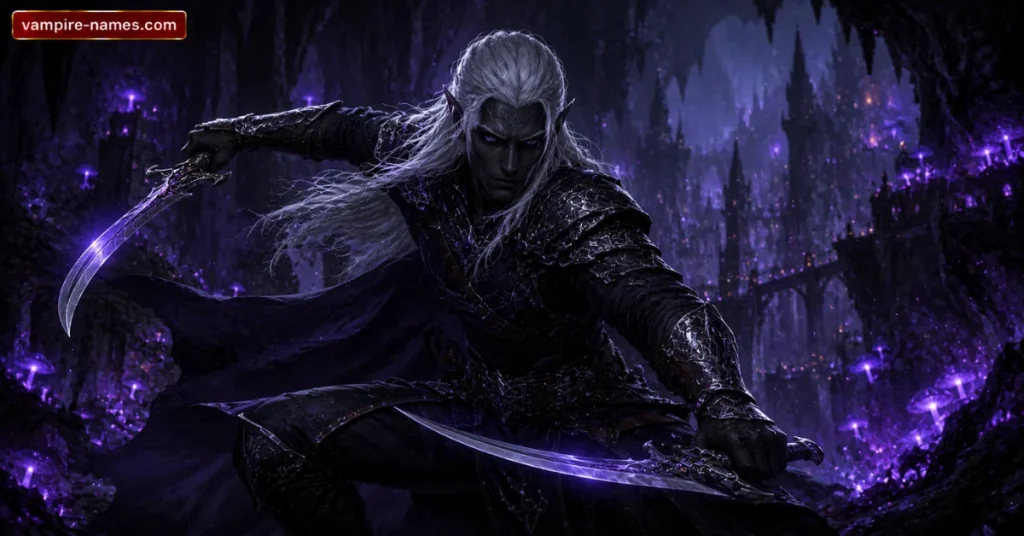
Drow male names in most fiction carry a harder, more clipped phonetic identity than the female names covered next a reflection of the fact that drow society, as commonly depicted, positions men predominantly in warrior, soldier, or support roles rather than positions of house leadership. That doesn’t mean the names need to sound weak; if anything, the opposite they tend to sound direct and unadorned, without the political weight a matron-line name carries. Here are 65 to work with.
| Saelossin | Ilvivax | Drosirion | Draluul |
| Vaelryn | Xarvex | Vorux | Saelvex |
| Dralirion | Vhenux | Ilvaelis | Malvax |
| Vorryn | Vorendor | Quorozar | Ossinethis |
| Dralaelis | Vaeloril | Zaken | Vaelendor |
| Nymyrion | Malvoril | Saelyrion | Vorivax |
| Vorozar | Malvoth | Nymndal | Xaraelis |
| Ossinath | Vhenozar | Rylvex | Kaelendor |
| Vhenoril | Vhenath | Tyzuul | Quorath |
| Malven | Nymozar | Zakoth | Grixossin |
| Karnen | Tyzoril | Xaroth | Xaroril |
| Zakethis | Saelath | Vaelux | Quoroth |
| Drosavon | Zakivax | Ornaelis | Voruul |
| Karnyrion | Ossinryn | Ossinoril | Zakendor |
| Baelendor | Dralyrion | Vorvex | Grixirion |
| Baelndal | Nymen | Kaelath | Vaelndal |
| Ilvavon |
Pirate Names ending in “-oth” or “-ux” read as blunter and more soldier-coded — good for a weapons master or house guard. The longer entries ending in “-yrion” or “-endor” carry more formal weight, better suited to a male character with unusual standing for his gender within the house, such as a favored consort or a rare male priest.
Drow Female Names
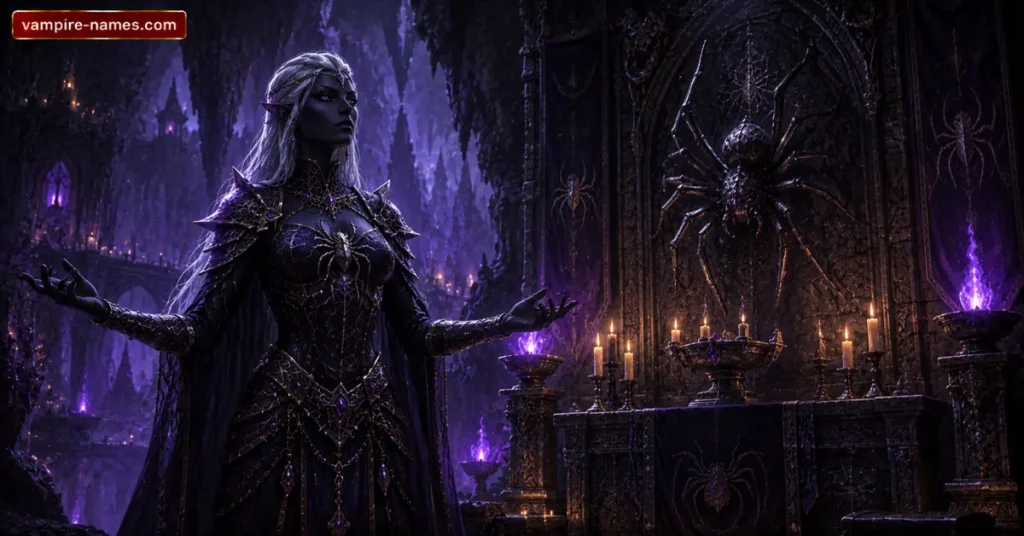
Female drow names generally carry more phonetic range than the male list reflecting a society where women hold house leadership, priestly authority, and the full spectrum of political and martial roles. These 65 lean into softer vowel work without losing any of the sharpness that defines the broader drow naming identity.
| Ilseoth | Thessavel | Kaelasyn | Silade |
| Faeliel | Ryora | Vessynn | Ilseora |
| Silasyn | Zellynn | Thessarah | Ossaith |
| Vessiel | Vessithra | Malysse | Wrenone |
| Silarah | Faelwyn | Myrlanna | Faelithra |
| Quenosse | Ossawyn | Ilseosse | Vessavel |
| Vessysse | Ossaveth | Queninyth | Ryarah |
| Wrenesse | Zellysse | Xaelora | Vaelithra |
| Zellwyn | Zellesse | Ashade | Malesse |
| Ossaanna | Quenysse | Myrlveth | Cyraoth |
| Savanna | Ashwyn | Ryveth | Rywyn |
| Myrlone | Ilseesse | Faelynn | Malveth |
| Kaelivra | Myrlavel | Nymarah | Vessade |
| Savosse | Wreniel | Wrenwyn | Myrlithra |
| Briithra | Silosse | Vessora | Cyraasyn |
| Briinyth | Quenanna | Vaelesse | Faelinyth |
| Thessivra |
If you’re naming a matron mother or high priestess specifically, favor the longer, more layered entries — length and complexity in a drow female name generally signal seniority and accumulated status in most of the fiction that established these conventions. Shorter entries suit a younger daughter still competing for standing within the house.
Drow Last Names
This is the section almost no competing list treats as its own category — most bury house names inside a generic “elf names” list, missing the fact that a drow house name works completely differently from a given name and deserves its own dedicated treatment. These 55 follow the apostrophe-plus-syllable structure covered in the naming conventions section above.
| Do’Urden | Xa’Xarath | Va’Vael | Zi’Ithran |
| Il’Nassar | My’Oth | Or’Ryven | Ke’Kess |
| Ba’Baenre | Ny’Nyloth | Sha’Shael | Rill’Rilvyn |
| Auz’Auzryn | Mez’Mezrath | Vhael’Vhaeril | Quar’Quaren |
| Tel’Telvyn | Rav’Ravos | Sos’Sosryn | Del’Delvax |
| Do’Kess | Xa’Baenre | Va’Nyloth | Zi’Shael |
| Il’Rilvyn | My’Auzryn | Or’Mezrath | Ke’Vhaeril |
| Ba’Quaren | Ny’Telvyn | Sha’Ravos | Rill’Sosryn |
| Auz’Delvax | Mez’Urden | Vhael’Xarath | Quar’Vael |
| Tel’Ithran | Rav’Nassar | Sos’Oth | Del’Ryven |
| Do’Mezrath | Xa’Vhaeril | Va’Quaren | Zi’Telvyn |
| Il’Ravos | My’Sosryn | Or’Delvax | Ke’Urden |
| Ba’Xarath | Ny’Vael | Sha’Ithran | Rill’Nassar |
| Auz’Oth | Mez’Ryven | Vhael’Kess |
Remember the matron-line rule from earlier: whichever of these you assign to a character, it should trace back to a mother’s lineage, not a father’s, if you want the naming to stay consistent with how these conventions actually work in the fiction that shaped them. A character stripped of house standing might go by their given name alone, dropping one of these entirely — which is itself a meaningful character detail worth using if the story calls for it.
Half-Drow Names
Half-drow characters occupy an unusual naming position — often caught between two systems, sometimes carrying a drow given Female Goblin Names with a surface-style surname, or the reverse, depending on which parent raised them and how connected they remained to Underdark politics. These 45 lean toward that in-between phonetic space: softer than full drow names, but not fully Seldarine either.
| Brenith | Wynithe | Lythith | Brenoria |
| Orinoran | Solis | Aeravel | Caelithe |
| Kessavel | Miraelle | Miraare | Serawen |
| Miraithe | Kessith | Orinare | Faelelle |
| Ilyais | Caeloria | Solavel | Ilyaisse |
| Orinwen | Miraander | Faelithe | Ilyaavel |
| Brenora | Brenyss | Kessael | Talander |
| Lythora | Aerora | Orinyss | Wynoran |
| Brenoran | Aeroria | Wynander | Faelisse |
| Miraoran | Ilyayss | Wynare | Lythelle |
| Lythis | Faeloria | Aeryss | Dawnavel |
| Lythavel |
A useful approach for a half-drow character specifically: pair one of these given names with a surname from either the Drow Last Names section (if the character maintains a connection to their drow house) or the Seldarine section further down (if they were raised primarily on the surface). The mismatch between the two naming systems can become a small, effective detail in a backstory — a name that doesn’t fully belong to either world, because the character doesn’t either.
Drow Names With Meaning
Every entry below includes the logic or reference behind the name — some are fully fantasy-coined, a few reference well-known published naming patterns directly, and all are explained so you know exactly what you’re picking and why.
| Surname | Meaning / Origin |
|---|---|
| Vex’ithra | Coined to evoke “vexation” and spite — a name given, in-world, to a child born during a house conflict |
| Do’Urden | A well-known example of drow surname structure from published D&D fiction — the apostrophe-plus-syllable pattern this whole naming system is built on |
| Ilvara | Invented, meant to sound like it carries the weight of an old, once-powerful house name now in decline |
| Nymvessa | “Nym” (root implying secrecy) plus a softened feminine suffix — for a spy or infiltrator-coded character |
| Zaknoth | Blunt, hard-consonant construction — reads as a soldier or enforcer rather than a noble |
| Ossivane | Fantasy-coined, “oss” evoking bone or stillness, paired with “vane” for a quiet, watchful character |
| Xarath | Short and severe — works well as a name a character is simply known by, no house attached |
| Thessivane | A softer, more melodic construction, suited to a priestess or scholar rather than a warrior |
| Malrothis | “Mal” (bad, ill) rooted directly into the name — deliberately ominous, best for an antagonist |
| Faelivara | Lighter phonetics than most of this list, useful for a drow character written more sympathetically |
| Vhaeril | Invented house-name-style construction, evokes an old bloodline through its length and formality |
| Kessivyn | A shorter, punchier name that still carries the characteristic apostrophe-adjacent rhythm of drow naming |
| Ryvossin | Built to sound aristocratic — long, layered, hard to shorten into a casual nickname |
| Draxil | Blunt and consonant-heavy, matches a warrior or weaponmaster archetype well |
| Elunaesse | Softer, moon-adjacent sound (echoing “luna”) — works for a character connected to Seldarine, surface-aligned drow culture |
| Sylranith | Long and formal, suited to a matron mother or high priestess character specifically |
| Ashryn | Shorter and more modern-sounding than most entries here, works well for a half-drow character |
| Corvain | Borrows raven-adjacent phonetics (“corv-“) for a character associated with omens or spycraft |
| Vantivax | Harsh, weapon-like sound — good for a duelist or assassin character |
| Perravyn | A gentler, almost musical name, useful as a contrast pick for a drow character written against type |
| Ravethar | Blunt and formal at once — works well for a house enforcer or duelist with noble standing |
| Auzryn | Coined house-style surname, evokes an old bloodline through unusual, hard-to-place phonetics |
| Mezrath | Short, weighty surname construction — suits a minor or declining house rather than a major power |
| Vhaeril (given name use) | The same root as the house-name entry above, usable as a given name for a character carrying that legacy personally |
| Quaren | Simple, clipped surname — reads as newer or lower-ranking than the longer, more ornate house names |
| Telvyn | Balanced, moderate-length surname, neither aristocratic nor common — a solidly mid-tier house |
| Sosryn | Sharp, quick-to-say surname, well suited to a character who operates alone rather than through house politics |
| Delvax | Hard-edged, functional-sounding surname — fits a mercenary or exile who no longer claims formal house standing |
| Nyloth | A softened, almost melodic surname — one of the gentler-sounding options in the matron-house set |
| Baenre | A well-known example of a matron house name structure from published D&D fiction — flat, powerful, minimal ornamentation |
| Ithran | Mid-weight surname construction, works equally well for a noble or a merchant-class drow family |
| Rilvyn | Softer surname with a musical quality, suited to a house known more for influence than open warfare |
| Kessivane (surname use) | A longer variant on the Kessivyn given name, repurposed as a formal house name for continuity across generations |
| Oth | About as short as a drow surname gets — used by exiled or renegade characters cutting ties with formal house structure |
Evil Drow Names

Drow fiction leans villainous by default in a lot of published settings, but there’s a difference between “drow” as a general aesthetic and a character specifically written to be cruel or antagonistic. These 50 names skew harder and darker on purpose, for exactly that kind of character.
| Vhornux | Zulivax | Skarnux | Vhornosk |
| Ghalerath | Vexoth | Malurn | Baelivax |
| Sinisurn | Ravasholeth | Ravashethis | Karnash |
| Ravashivax | Sinisux | Ghalethis | Draxoleth |
| Xunoth | Baelosk | Vexurn | Xunryn |
| Ghalash | Ravashoz | Draxivax | Xunurn |
| Vhornarion | Vhornasyn | Sinisiss | Thraskoz |
| Skarnarion | Malarion | Ghalasyn | Zulerath |
| Vhornerath | Malosk | Zuloz | Draxryn |
| Ravasherath | Xunasyn | Zulethis | Skarnoleth |
| Skarnoth | Draxosk | Malasyn | Krourn |
| Skarnurn | Ghalarion | Baelabor | Vhornabor |
| Ravashurn | Ravasharion |
Pair these carefully — one strong “evil” word per full name reads as genuinely threatening, while stacking two (“Malothivax the Nethysoth”) tends to undercut itself into parody. The entries ending in “-oth” or “-ux” read as older and more established in cruelty; the ones ending in “-ethis” or “-arion” read as younger and more recently turned toward villainy, useful if your character’s darkness is a recent development rather than a lifelong trait.
Dark & Enigmatic Drow Names
Different from outright “evil” — these 50 aim for mysterious and unreadable rather than openly hostile. Good for a character whose loyalties or intentions the reader or party genuinely can’t pin down for a while.
| Xulirin | Chymyss | Vailirin | Xulveth |
| Hollowmaw | Nyxithar | Umbrauun | Crypyss |
| Ghastuun | Itharshade | Itharesh | Quorgoth |
| Itharyss | Ghastirin | Hollowesh | Obexshade |
| Vormithar | Crypveth | Nyxuun | Vormoon |
| Hollowgoth | Itharaleth | Obexyss | Vormuun |
| Xulwhisper | Xulmind | Ghastoc | Zethaleth |
| Vailwhisper | Umbrawhisper | Hollowmind | Chymmaw |
| Xulmaw | Umbraveth | Chymaleth | Obexoon |
| Itharmaw | Vormmind | Chymesh | Vailshade |
| Vailithar | Obexveth | Umbramind | Shadeuun |
| Vailuun | Hollowwhisper | Crypryth | Xulryth |
| Itharuun | Itharwhisper |
These work especially well for a character whose actual role in the story is deliberately withheld for a while — a spy embedded in a rival house, an informant playing both sides, or a priestess whose true loyalties aren’t revealed until well into the plot. The unreadable, faintly unsettling sound of these names does some of that ambiguity work before a single line of dialogue is spoken.
Fantasy Drow Names
General-purpose, richly fantastical drow names for settings that want maximum otherworldly texture without leaning specifically evil, pretty, or comedic. These 55 work as a flexible default across most drow-adjacent character types.
| Caelithien | Ossionwe | Vaelithien | Caelarion |
| Valwyndra | Aerandriel | Silithor | Aelonwe |
| Quenithor | Ryloranel | Rylthalor | Faelwynne |
| Rylonwe | Quenithien | Valthalor | Wynoranel |
| Thalandriel | Aelarion | Aerithor | Thaloriel |
| Valwynne | Rylavel | Wynonwe | Thalithor |
| Caelethis | Caelarwen | Queninde | Kestavel |
| Vaelethis | Silethis | Valarwen | Ossiwyndra |
| Caelwyndra | Silarion | Ossiavel | Wynoriel |
| Rylwyndra | Thalarwen | Ossithalor | Vaeloranel |
| Vaelandriel | Wynarion | Silarwen | Ithithor |
| Vaelithor | Valethis | Aelariel | Caelariel |
| Rylithor | Rylethis | Aeronwe | Faelinde |
| Silinde | Kestithien | Vaelinde |
If you’re building an entire Underdark house and need several related names quickly, these work well as a starting pool precisely because they don’t lean hard toward any one specific archetype — pull two or three, adjust the endings slightly to feel like variations on a shared family sound, and you’ve got the beginnings of a believable extended house.
Pretty Drow Names
For characters whose defining trait isn’t menace — a noble diplomat, a romantic lead, a character deliberately written against the “evil dark elf” stereotype. These 45 keep the sharp drow phonetic identity while softening the overall effect.
| Faelosse | Ashenora | Valeosse | Faeliss |
| Nyraade | Seraith | Liraelle | Ilyaora |
| Perraelle | Thessaynn | Thessaline | Seliswen |
| Thessaora | Perraosse | Nyraline | Cyraynn |
| Wrenith | Ilyaiss | Seraelle | Wrenisse |
| Nyrawen | Thessaarah | Cyraora | Wrenelle |
| Faelesse | Faelavel | Perraanne | Ondinarah |
| Valeesse | Liraesse | Nyraavel | Ashenade |
| Faelade | Liraiss | Ashenarah | Cyraisse |
| Thessaade | Wrenavel | Ashenline | Valeynn |
| Valeith | Cyraiss | Liraavel | Miraelle |
| Valeelle |
This section tends to get overlooked because “drow” so often gets written as synonymous with “villain,” but a diplomat, a merchant, or a sympathetic point-of-view character benefits enormously from a name that doesn’t announce menace before the character has said a word. Consider one of these for any drow character whose arc is meant to complicate, rather than confirm, the reader’s assumptions about the species.
Cool Drow Names
For characters who need an edge without tipping fully into “villain” territory — rogues, mercenaries, morally grey protagonists. These 50 lean sharp and confident rather than overtly sinister.
| Iltharyz | Ashkaul | Thaxyz | Ilthararax |
| Norlosh | Zarithan | Vexora | Skellul |
| Kelthora | Ylloth | Yllekar | Vraxok |
| Yllul | Kelthyz | Norlekar | Morzoth |
| Draskithan | Skellarax | Zarora | Draskuth |
| Norlok | Yllarion | Morzul | Draskora |
| Iltharurak | Iltharendar | Kelthiss | Grixarion |
| Thaxurak | Vexurak | Norlendar | Ashkaosh |
| Iltharosh | Vexarax | Ashkaarion | Morzuth |
| Yllosh | Draskendar | Ashkaekar | Thaxoth |
| Thaxithan | Morzarax | Vexendar | Krynora |
| Thaxora | Norlurak | Skellonn | Iltharonn |
| Yllora | Yllurak |
These read well as an adopted or earned name too — a character might start a campaign with a plainer given City Name Ideas from the male or female sections and pick up one of these later as a reputation-based alias once they’ve done something notable enough to be known by it across the Underdark.
Seldarine (Surface-Adapted) Drow Names
As covered in the naming conventions section above, drow characters who live among surface elves sometimes adopt names built to fit Seldarine (surface elf) conventions rather than traditional Underdark ones — softer vowels, gentler consonant work, a deliberate move away from the sharper drow phonetic identity. These 40 are built specifically for that adaptation.
| Coreldriel | Ilvarawen | Corelissa | Vaelwyn |
| Ilyness | Aerlon | Aerwen | Threnwyn |
| Aravaeanor | Aeravel | Threnora | Ilvaraess |
| Aerissa | Silissa | Ellyness | Vaelarion |
| Vaelwen | Ilynande | Ilvaraanor | Corelavel |
| Ilynissa | Corelwyn | Silanor | Ilynanor |
| Ellynarion | Aravaeith | Aerwyn | Ellynissa |
| Solanande | Naethdriel | Threndriel | Naethanor |
| Faenande | Corelarion | Solanarion | Vaeldriel |
| Faenwyn | Ilvaradriel | Faeness | Naethavel |
These pair well as a “second name” for a half-drow or surface-dwelling drow character alongside a traditional given name from earlier in this list — exactly the two-name situation described in the conventions section, where a character might use one name among drow and another among surface elves.
DnD & BG3 Drow Names
Built for the specific rhythm tabletop and CRPG settings need — quick to say mid-session, distinct enough to track across a long campaign, and comfortable sitting next to a class or subclass name. These 55 are original constructions, safe to use directly on a character sheet.
| Grixyz | Skathul | Krayz | Grixarax |
| Orvosh | Xarithan | Zaora | Ilthul |
| Vraxora | Pelloth | Pellekar | Thaxok |
| Pellul | Vraxyz | Orvekar | Norloth |
| Uzzithan | Iltharax | Xarora | Uzzuth |
| Orvok | Pellarion | Norlul | Uzzora |
| Grixurak | Grixendar | Vraxiss | Yllarion |
| Kraurak | Zaurak | Orvendar | Skathosh |
| Grixosh | Zaarax | Skatharion | Norluth |
| Pellosh | Uzzendar | Skathekar | Kraoth |
| Kraithan | Norlarax | Zaendar | Vhenora |
| Kraora | Orvurak | Ilthonn | Grixonn |
| Pellora | Pellurak | Xarul | Thaxiss |
| Zaiss | Yllyz | Kraiss |
These were built to read clearly the first time a player hears them in voice-acted dialogue or a DM’s narration, without needing the spelling in front of them to follow what’s being said — a small but genuinely useful constraint for any name that’s going to get spoken out loud dozens of times across a long campaign.
Unique Drow Names
For when the more familiar drow-name shapes above still feel too recognizable. These 45 lean into less conventional syllable combinations while staying within the broader phonetic identity established earlier.
| Rhosivaneon | Ithrenesh | Wyndrethande | Cyrixarch |
| Naerilora | Vaelothith | Fenraelith | Ithrenoth |
| Solvethael | Vaelothiel | Ithrenwyn | Ithrenande |
| Vaelothwyn | Solvethoth | Vaelothesh | Ithrenora |
| Wyndrethwyn | Naerilith | Naerilael | Cyrixith |
| Solvethith | Rhosivaneesh | Naerilon | Ossarawyn |
| Ithreniel | Cyrixoth | Naerilande | Rhosivaneande |
| Vaelotharch | Fenraelarch | Solvetharch | Vaelothande |
| Zephivaxoth | Ilvarinora | Solvethwyn | Wyndrethesh |
| Wyndrethon | Zephivaxiel | Naeriliel | Zephivaxith |
| Solvethon | Ossaraith | Cyrixael | Solvethande |
| Wyndrethys |
If one of these still feels slightly too unfamiliar to fully commit to, try pairing it with a more conventional house name from earlier in this list — the contrast between an unusual given name and a recognizably structured house name often reads as more intentional than an unusual name carried all the way through.
Funny Drow Names
Drow society takes itself extremely seriously in most fiction, which makes it a genuinely rich target for comedy if your table or story wants to lean that way. These 30 poke gently at the tropes — sunlight aversion, constant political drama, general theatrical grimness.
| Sir Trip-in-the-Dark | Squints McUnderdark | Vex the Very Mildly Evil | Ol’ Web-Foot |
| Sir Sunlight-Averse | Baron von Awkward Silence | Grumbles Nightcrawler | Chuggs the Cave Bat Whisperer |
| Sir Pointy-Eared Problems | Dame Perpetually-Judgmental | Squire Can’t-See-in-Bright-Light | Sir Sneezes-at-Sunrise |
| Vex the Mildly Inconvenienced | Lord Cobweb-Collector | Sir Underdark-and-Proud | Nightshade the Overdramatic |
| Dame Eight-Legs-Away | Sir Whisper-Too-Loud | Grumpydark the Bat-Fearing | Sir Stalactite-Bonk |
| Vex’not-Today | Sir Spiderweb-in-My-Hair | Dame Overly-Dramatic-Sigh | Squire Cave-Moss-Allergy |
| Lord Perpetually-Squinting | Sir Tripped-Over-a-Stalagmite | Nightling the Chronically Startled | Vex the Slightly Damp |
| Sir Web-Between-My-Toes | Dame Can’t-Find-My-Cloak |
As with any comedic naming, restraint sells the joke better than repetition — a character introduced once as “Squints McUnderdark” and then treated with complete narrative seriousness for the rest of the story tends to land better than one where the joke gets referenced every single scene.
Short & One-Word Drow Names
For character sheets, usernames, or a character who goes by a single Zombie Names Girl deliberately — common for renegades or exiles who’ve cut ties with a formal house, per the naming conventions covered earlier. These 40 are all short, sharp, single-word options.
| Vor | Zeth | Nix | Rax |
| Vael | Kro | Sael | Duv |
| Yrn | Kas | Wex | Fael |
| Tor | Zin | Bryx | Quel |
| Orn | Kess | Draz | Nym |
| Voth | Sirn | Krael | Ossa |
| Vyn | Thax | Ael | Ysh |
| Kroth | Zorn | Aeth | Voss |
| Ux | Nym | Vail | Ryl |
| Xael | Myrl | Wren | Ilv |
Beyond exiles and renegades, these also suit a character still young enough in their house that they haven’t yet been granted a longer, more formal given name — a common enough detail in matriarchal, status-obsessed societies, where length and ornamentation of a name can be something a character grows into rather than something fixed from birth.
A–Z Drow Names
Need one fast, sorted alphabetically? Here are two fully-formed given-and-house-name pairs per letter, ready to use as-is.
| Aeloth Vhael | Ashryn Do’Nassar | Baelnoth Xarath | Briss Va’Oth |
| Corvain Zi’Ithran | Cyrellith | Draxil My’Kess | Delvara Rilvyn |
| Ezrivax | Elunaesse | Fenrathoth | Faelivara |
| Gorvax Il’Baenre | Griselith | Halveth Ryven | Hesperaesse |
| Ilvarath | Ithrissa | Jorvax | Junavessa |
| Kaelithar | Kessivyn | Loravax | Liorasse |
| Malrothis | Myrlithra | Nymrothis | Nyravessa |
| Ossivax | Orlithe | Pellrothar | Perravyn |
| Quorivax | Quennaesse | Ravethar | Rhosivane |
| Selisrath | Sylranith | Tarnivax | Thessivane |
| Ulrivax | Umbrivane | Vantivax | Vesperaesse |
| Wrenlivax | Wylathra | Xanthivax | Xylaesse |
| Yorivax | Ylvavane | Zephrivax | Zaravane |
Every entry here already pairs a given name with a house name, which makes this the fastest section on the page to pull a complete, ready-to-use full name from if you’re short on time and just need to keep the story or session moving.
How to Create Your Own Drow Name
If nothing above fits exactly, here’s the process behind every list on this page, built around the naming conventions explained earlier.
Method 1: Build the Given Name and House Name Separately
Don’t try to invent one seamless full name in a single pass. Build the given name first, focused on the individual character’s personality and role. Build the house name second, focused on political weight and lineage. Combining two names built with different goals in mind produces a far more convincing result than inventing both halves at once.
Method 2: Use the Apostrophe Structure Deliberately
The apostrophe-plus-syllable pattern common in published drow house names isn’t decoration — it typically marks a specific structural break, often between a shortened prefix and the core house root. Try building your house name as two distinct pieces joined by that break, rather than one continuous invented word.
Method 3: Decide the House’s Status Before Naming It
Per the conventions section above, longer and more ornate house names generally read as older, more established bloodlines, while shorter, blunter ones read as newer or lower-status houses. Decide where your house sits in that hierarchy before choosing the name’s length and complexity.
Method 4: Build a Surface Name as a Deliberate Contrast
If your character has any connection to the surface world, build their surface name using noticeably softer phonetics than their given drow name — pull from the Seldarine section above as a model. The contrast between the two names can carry real narrative weight without needing extra explanation.
Method 5: Say the Full Name Under Pressure
Drow fiction runs on conflict. Say your candidate name the way it would actually get used — shouted across a chamber during a house conflict, hissed as a warning, announced formally at a political gathering. If it doesn’t hold up in at least one of those deliveries, simplify it.
Tips for Choosing the Perfect Drow Name
A few closing thoughts before you commit to one.
Decide the character’s relationship to their house first
A drow character proud of their house, one actively scheming against it, and one who’s been fully exiled from it should all sound different — the first two likely keep a formal house name, the last might go by a given name alone. Settle this before finalizing anything.
Don’t default to “evil” just because the race often is
Plenty of well-written drow characters across fiction are morally complex rather than straightforwardly villainous. If your character isn’t a villain, pull from the Pretty, Cool, or Unique sections rather than automatically reaching for the Evil or Dark lists.
Keep a house name’s status consistent across a campaign or story
If you establish that a house name is old and powerful, don’t casually introduce three other characters with equally ornate house names in the same story — it dilutes the signal. Reserve the longest, most formal-sounding names for houses that are genuinely meant to matter.
Frequently Asked Questions
Q: What are good drow names?
A: Good drow names generally follow the two-part structure covered earlier on this page — a personal given name paired with an inherited house name, usually built around sharp consonants and an apostrophe-marked structural break. Names like Vor’ndal Xa’Baenre or Nymvessa Do’Nassar work because they respect that structure rather than just sounding vaguely dark-fantasy.
Q: What are good drow male names?
A: Drow male names tend to favor blunter, more clipped phonetics than female names, reflecting the predominantly warrior- and support-coded roles men hold in most drow fiction. Names like Vorndal, Zakoth, or Draloth work well — direct, unadorned, without the layered complexity that signals house-leadership status in the female naming conventions. The “Drow Male Names” section above has 65 built specifically in that register.
Q: What are good drow last names?
A: Drow last names — more accurately house names — typically follow an apostrophe-plus-syllable structure, similar to well-known published examples like Do’Urden or Baenre. A strong drow last name should sound like it could plausibly belong to an entire generational bloodline rather than one individual. The “Drow Last Names” section above has 55 built around that matron-house structure, with guidance on how the naming logic actually works.
Q: What are good half-drow names?
A: Half-drow names often sit between two naming systems — a drow given name paired with a softer surname, or the reverse, depending on which side of the character’s heritage was more present growing up. The “Half-Drow Names” section above has 45 built specifically for that in-between phonetic space, along with guidance on pairing them with either drow house names or surface-style surnames.
Q: What are drow naming conventions, exactly?
A: Drow naming conventions, as established across most popular fantasy fiction, generally involve a two-part structure: a personal given name and an inherited house name passed down the matron line rather than the father’s line. House names carry political weight and can be lost through exile or disgrace, while given names are permanent. Drow living among surface races sometimes adopt a second, softer surface name as well. The full “Drow Naming Conventions Explained” section above covers this in much greater depth.
Q: What makes a name sound distinctly “drow” rather than generic elf?
A: Drow names typically lean on sharper consonants (V, X, Z, K), frequent apostrophe breaks marking syllable structure, and a general avoidance of the softer, rounder sounds common in Seldarine or wood-elf naming. This creates a phonetic identity distinct from surface-elf names even before any other context is given, which is why most categories on this page lean into that harder sound on purpose.
Q: Can drow names be used for Baldur’s Gate 3 or D&D characters?
A: Yes — the names on this page are original constructions built to fit the broad drow naming conventions established across mainstream tabletop and CRPG fantasy, and they’re safe to use directly on a character sheet. The “DnD & BG3 Drow Names” section above has 55 names built with tabletop and CRPG pacing specifically in mind.
Q: What is a Seldarine drow name?
A: “Seldarine” refers to surface elf naming and cultural conventions rather than Underdark ones. A Seldarine-style drow name is typically adopted by a drow character living among surface elves, built with softer phonetics to help the character blend in or signal a break from their Underdark past. The “Seldarine (Surface-Adapted) Drow Names” section above has 40 names built specifically for this use case.
Q: Do drow names have real meanings?
A: Most drow names in fantasy fiction are fully invented rather than drawn from a real-world language, though many are built to imply meaning through sound and structure — length and ornamentation implying status, harsher consonants implying aggression, and so on. The “Drow Names With Meaning” table above explains the logic or reference behind 34 specific names, including a few that echo well-known published naming patterns.
Q: How many drow names are on this list?
A: This page includes more than 776 drow names across 23 categories — male, female, last names, half-drow, evil, dark, pretty, cool, surface-adapted, and more — plus a full naming-conventions breakdown, a names-with-meaning table, and an A–Z quick-reference list.
Conclusion
Nearly 800 names is a lot to work through, and if you made it this far, thank you. The one thing worth carrying forward from all of it: a drow name works best when it respects the system it came from the given name and house name aren’t just two words stuck together, they’re two different kinds of information about the character, one personal and one political.
If you take nothing else from this page, take this: decide what your character’s relationship to their house actually is before you pick a name. Proud member, secret schemer, disgraced exile each one points toward a different section of this list, and getting that alignment right will do more for how convincing the name feels than any individual word choice could on its own.
Pick a given name, pick a house name if the character still claims one, say the whole thing out loud under a little pressure, and see if it holds. If it does, you’ve got your drow.
“A house name is a claim. A given name is the only part of you no rival house can take.”