The Complete Guide to Fantasy, Medieval, Dark & Magical Town Name Ideas
Fantasy | Medieval | Dark | Elven | Dwarven | Coastal | Forest | DnD
| 700+Total Names | 30Name Categories | 20+Suffix Systems | 8Settlement Types |
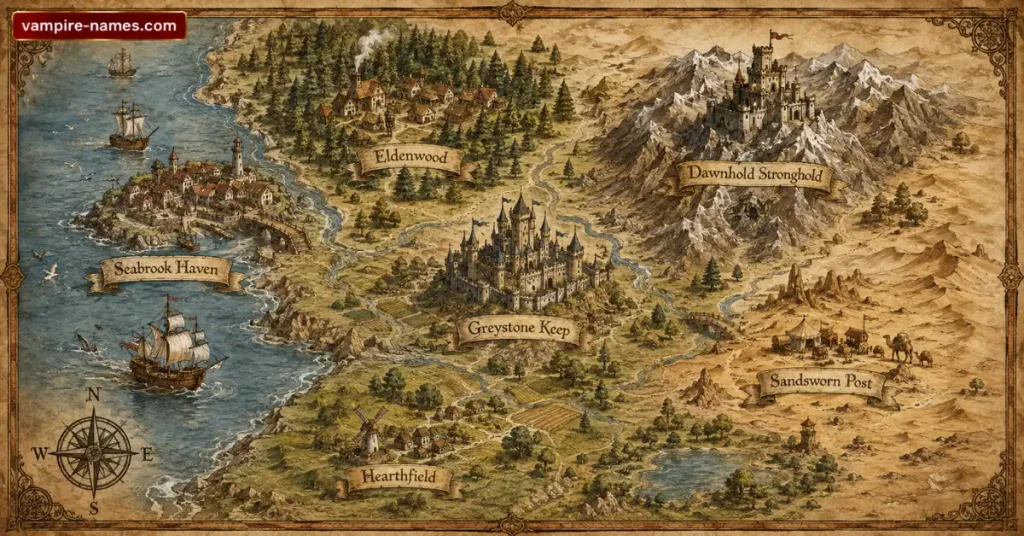
700+ Town Names for Stories: The Complete Guide to Fantasy, Medieval, Dark & Magical Town Name Ideas
A town’s name does more work than almost any other element in worldbuilding. Before a character arrives, before the reader meets a single inhabitant, before any description has been given the Vampire Names has already told us something. ‘Millhaven’ says there’s a mill, there’s water, and someone thought it was worth naming. ‘Grimwick’ says the place has a reputation. ‘Thornhaven’ says it’s a shelter in something thorny, which might be literal or metaphorical. ‘Faelight Forge’ says magic meets craft in some specific way that the rest of the story will have to explain.
The mistake most writers and worldbuilders make is choosing town names randomly or for pure sound. A name chosen only for how it sounds is a missed opportunity because a name chosen for what it means tells a story before the story begins. The medieval English settlers who named ‘Oxford’ (ford where oxen cross), ‘Chester’ (Roman fort), ‘Halifax’ (holy hair/holy field), ‘Wolverhampton’ (Wulfrun’s high settlement) weren’t being poetic. They were being practical, leaving a trail of information in the landscape for anyone who knew how to read it.
This guide covers 700+ town names across 30 categories fantasy, with meanings, magical, dark, haunted, evil, ancient, hidden, mythical, medieval, elven, dwarven, human-realistic, forest, mountain, coastal, desert, cute/peaceful, cool, funny, famous fictional with analysis, DnD campaign towns, A–Z reference, and a five-method generator system. But it starts where every good town naming guide should start: with the actual linguistics.
How Real Town Names Work — The English Suffix System & What It Means for Fiction
English place names are a compressed history of the British Isles — they carry Old English, Old Norse, Norman French, Celtic, and Latin elements. Understanding the suffix system (the second half of compound place names) lets you build fictional town names that feel authentic rather than invented.
| Name | Meaning / Notes |
| -ford | Old English — ‘ford’ (shallow river crossing). Oxford, Hereford, Stafford. Use for: towns on river crossings, trading posts on water routes. |
| -ton / -tun | Old English — ‘settlement, estate’. Brighton, Thornton, Easton. The most common English place suffix. Use for: any farming settlement or small town. |
| -wick / -wich / -wick | Old English — ‘dwelling place, specialised farm’. Norwich, Warwick, Berwick. Use for: specialist trade towns (dairy wick, salt wich, sheep wick). |
| -chester / -caster / -cester | Latin ‘castra’ (Roman fort) via Old English. Chester, Lancaster, Leicester. Use for: former military settlements, fortified towns with old stone walls. |
| -holm | Old Norse — ‘small island, river meadow’. Stockhom (literally ‘stock island’). Use for: river delta towns, island settlements, fenland communities. |
| -gate | Old Norse ‘gata’ (road, way). Not a physical gate — a route. Mickgate, Stonegate (York streets). Use for: towns at the junction of important roads. |
| -bridge | Old English — ‘bridge’. Cambridge (bridge over the Cam). Use for: towns that grew because someone built a bridge. |
| -vale / -dale | Old Norse/English — ‘valley’. Airedale, Wharfedale. Use for: valley settlements, sheltered communities. |
| -moor / -mere | Old English — ‘moor’ (open land) / ‘mere’ (lake, pond). Windermere, Whitmore. Use for: open upland towns, lakeside communities. |
| -haven | Old English — ‘harbour, port’. Millhaven. Use for: coastal harbours, sheltered anchorages. |
| -burg / -burgh / -borough | Old English — ‘fortified place’. Edinburgh, Canterbury (Cantwaraburg — fort of the Kent people). Use for: defensible hilltop towns, market towns with walls. |
| -croft | Old English — ‘small enclosed field’. Use for: farming hamlets, smallholder communities. |
| -lea / -ley | Old English — ‘woodland clearing’. Hadley, Barnsley. Use for: forest edge settlements. |
| -shaw | Old English — ‘small wood, thicket’. Allenshaw. Use for: communities within or beside forest. |
| -field | Old English — ‘open land, field’. Sheffield, Huddersfield. Use for: farming communities on open land. |
| -stow / -stowe | Old English — ‘holy place, meeting place’. Stow-on-the-Wold. Use for: religious centres, market meeting places. |
| -ham | Old English — ‘homestead, village’. Birmingham, Nottingham. Use for: any small settlement. |
| -thorpe | Old Norse — ‘secondary settlement, outlying farmstead’. Scunthorpe. Use for: daughter settlements of larger towns. |
| -by | Old Norse — ‘settlement, village’. Selby, Whitby, Derby. Use for: Viking-heritage towns in northern regions. |
| -hurst | Old English — ‘wooded hill’. Wadhurst. Use for: settlements on forested hills. |
The Worldbuilding Function of Town Names — What a Name Reveals Before Page One
Every element of a town name carries information. The best fictional town names tell a story in two words — the reader or player immediately understands something about the place’s history, geography, economy, or character before anyone sets foot there.
- Geography — ‘Stonebridge’ tells you there’s a stone bridge (probably important, probably old). ‘Highhollow’ tells you the hollow is elevated (possibly defensible). ‘Saltmere’ tells you there’s salt in the water (an economic resource).
- History — ‘Old Ford’ implies there’s a New Ford somewhere, which implies population growth. ‘Ashwick’ implies something burned. ‘Irongate’ implies there was once a gate important enough to name the whole town.
- Economy — ‘-wick’ towns (Berwick, Norwich) were specialist trade settlements. A fictional ‘Copperwick’ is a copper-trading town. A ‘Flourton’ is a flour-milling settlement. The economic specialisation is in the druid names .
- Character — ‘Grimwick’ suggests the town has a reputation. ‘Brighthollow’ suggests the opposite. ‘Whisperwick’ suggests secrets. These are invented names that immediately communicate tone before the story confirms it.
- Culture — Elvish naming conventions (flowing vowels, ‘-ael’, ‘-ith’, ‘-ara’ suffixes) signal a different culture than Dwarven naming (‘-gar’, ‘-dur’, ‘-thane’, hard consonants). The town’s name tells you who built it.
- Age — Latin-derived names signal Roman or Roman-adjacent origin. Old Norse names signal Viking settlement. Old English names signal Anglo-Saxon. Celtic names signal even older roots. Age is in the etymology.
Town Naming by Settlement Type
Different settlement types need different kinds of names — the fishing village has different naming logic than the mountain fortress or the desert trading post.
🏘️ Village Names — Small, Specific, Personal
Villages are named for the people who founded them or the specific feature that made the location worth settling. They’re intimate, often one or two syllable main elements.
| Millhaven | Briarwick | Fernhollow | Mossgate |
| Thornwick | Oakenseat | Elmgate | Birchvale |
| Cedarhollow | Willowmere | Hawthorn | Cloverfield |
| Rushford | Brookwick | Streamhollow | Rivergate |
| Stonebridge | Woodgate | Hillfoot | Valehaven |
| Fairham | Goodwick | Kindleby | Gentleford |
| Dustywick | Quietvale | Stillwater | Peaceholm |
| Smallfolk Haven | Three Farms | Two Bridges | One Mill |
🏙️ Town Names — Trade-Centre Scale
Towns are larger than villages — they have markets, guilds, inns, and a reason for people to travel to them. Their names often reflect their market function or their position in a road network.
| Crossgate | Marketford | Guildwick | Tradeston |
| Ironmarket | Copperwick | Silverford | Goldgate |
| Northgate | Southwick | Eastford | Westham |
| Highgate | Lowbridge | Midford | Centrewick |
| Kingsmarket | Queenwick | Lordgate | Masterford |
| Fairgate | Festivalwick | Gatherford | Meetingholm |
| Safehaven | Travellers Rest | Waypoint | The Crossing |
| Charter Town | Free Borough | Guild Hall Town | Market Cross |
🏰 City Names — Capital Scale
Cities need names with weight — the name should carry authority, history, and the sense of a place that has always been important.
| Ironhaven | Stonegate | Greymount | Blackwater |
| Silverkeep | Goldspire | Brightwall | Highhold |
| Kingsfall | Queensport | Lordspire | Imperion |
| Grandwick | Noblegate | Proudmount | Majestholm |
| Eternal Gate | Ancient Keep | Old Stone | First City |
| The Capital | The Seat | The Throne | The Hold |
| Almanthor | Varenholm | Stelburg | Drakenfall |
| Aurumgate | Argentwick | Crystallis | Diamondspire |
⚓ Port & Harbour Town Names
| Saltwick | Tidehaven | Wavemere | Harbourgat |
| Fisherman’s Rest | Sailor’s End | Anchor Point | Safe Port |
| Stormhaven | Calmsea | Clearwater Port | Deepwater Quay |
| Mermaid’s Rest | Siren’s Gate | Kraken Bay | Dragon’s Anchorage |
| Ironquay | Woodwharf | Stoneport | Copperdock |
| North Shore | South Quay | East Point | West Haven |
| The Landing | The Berth | The Dock | The Anchorage |
| Trader’s Port | Fisher’s Cove | Smuggler’s Rest | Pirate’s Gate |
⚔️ Fortress & Garrison Town Names
| Irongate | Stonewall | Battleford | Warwick (fictional) |
| Garrison | The Keep | Fortholm | Stronggate |
| Shield Wall | Sword Gate | Axe Hold | Spear Fort |
| The Rampart | The Bastion | The Bulwark | The Redoubt |
| Ironwatch | Steelkeep | Armourwick | Bladefort |
| Last Wall | First Defense | Only Bastion | Final Gate |
| North Watch | South Hold | East Guard | West Wall |
| King’s Fort | Queen’s Keep | Lord’s Gate | Knight’s Hold |
Town Naming by Economy & Function
What a town does determines what it’s called. Here are names organised by economic speciality — because a mining town, a market town, and a monastery town need completely different names.
| Name | Meaning / Notes |
| Mining Town Names | Copperwick, Irongate, Stonebreak, Coal Hollow, Silver Seam, Gold Shaft, Ore Haven, Deepmine, Quarry Gate, Stone Cut. The town is named for what comes out of the ground. |
| Farming Town Names | Flourton, Millhaven, Grainswick, Harvest Hold, Cropgate, Fieldwick, Meadow End, Barn Ford, Silo Town, Plough Gate. The town processes what grows around it. |
| Fishing Town Names | Saltwick, Net Haven, Hook Gate, Tide Ford, Fish Quay, Smoked Fish, Herring Gate, Cod Wick, Salmon Run, Eel Ford. The town is on the water and lives by it. |
| Religious/Temple Town Names | Holywick, Shrine Gate, Altar Ford, Chapel Hollow, Cathedral Spire, God’s Gate, Prayer Wick, Temple Hold, Blessing Ford, Sacred Ground. The town exists because of a holy site. |
| Craft/Trade Town Names | Smithwick, Potter’s Gate, Weaver Ford, Dyer’s Wick, Tanner Gate, Cooper Ford, Fletcher Wick, Mason’s Hold, Carpenter Gate, Merchant Ford. The town is a specialist workshop. |
| Military Town Names | Garrison Gate, Shield Wick, Sword Ford, Axe Hold, Arrow Gate, Cavalry Wick, Infantry Ford, Siege Hold, Battle Gate, War Wick. The town exists because soldiers are stationed there. |
| University/Knowledge Town Names | Scholar Gate, Ink Wick, Library Ford, Archive Hold, Scroll Gate, Sage Wick, Learning Ford, Study Hold, Knowledge Gate, Wisdom Wick. The town is an intellectual centre. |
| Magic Town Names | Faelight Forge, Spell Gate, Arcane Wick, Magic Ford, Witch Hold, Wizard Gate, Enchant Wick, Hex Ford, Charm Hold, Rune Gate. The town’s defining feature is magical. |
Fantasy Town Names for Stories — Main Collection
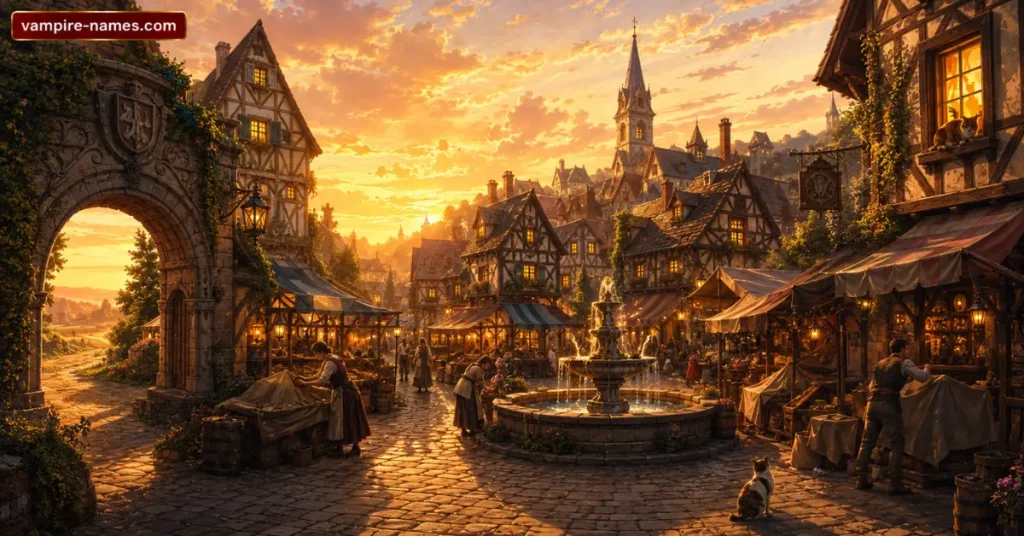
The main collection of fantasy town names for stories organised to cover the full range of fantasy worldbuilding needs.
| Faelight Forge | Moonwhisper | Starfall | Dawngate |
| Thornhaven | Ravenwick | Shadowmere | Grimhollow |
| Silverford | Goldspire | Ironwick | Stonebridge |
| Mossgate | Fernhollow | Briarwick | Willowmere |
| Crystalholm | Ambergate | Jadewick | Sapphireford |
| Dragonfall | Phoenixgate | Griffinwick | Unicornmere |
| Elfgate | Dwarfwick | Gnomeford | Halflingholm |
| Witchholm | Wizardwick | Mageford | Sorcerergate |
| Northhaven | Southwick | Eastford | Westmere |
| Highhollow | Lowgate | Midwick | Centreford |
| Oldstone | Newgate | Ancientwick | Modernford |
| Lostgate | Foundwick | Hiddenford | Forgottenmere |
| Brightvale | Darkhollow | Lightgate | Shadowwick |
| Peacehaven | Warwick | Calmgate | Stormwick |
| Fairhaven | Wickedgate | Kindwick | Cruelford |
| Smallvale | Greatgate | Tinymere | Vastwick |
Fantasy Town Names with Meanings
These names are built with genuine meaning — each one tells a specific story about the place and why it was named what it is.
| Name | Meaning / Notes |
| Faelight Forge | Where fae magic meets mortal craft. A town famous for enchanted metalwork — every smith here has fae blood or fae patrons. |
| Thornhaven | A haven surrounded by thorns — either literal (a thorn-hedge defense) or metaphorical (safety bought at a prickly price). |
| Ashwick | A settlement where something burned. Either the founding event (they built on ash) or the ongoing industry (charcoal making, smelting). |
| Brightwater | The water is literally clear and bright — a spring town, possibly with healing water. Also metaphorically: the mood of the place. |
| Grimhollow | The hollow is grim — either geographically (a valley with no sun) or reputationally (something terrible happened here). |
| Silverford | There is (or was) silver in the river bed. A former mining boomtown, or still actively prosperous. |
| Stonegate | A gate made of stone — which sounds obvious, but stone gates were expensive and permanent, suggesting this town was planned and funded. |
| Willowmere | A lake with willows — peaceful, melancholy, associated with the water and its reflections. |
| Ironwick | A specialist iron-working settlement. The ‘-wick’ suffix tells you it’s industrial. |
| Ravenwick | Ravens nest here — either literally (a rookery) or they’re sacred/significant here, possibly a religion built around them. |
| Moonwhisper | Something whispers here on moonlit nights. A supernatural quality is built into the founding name. |
| Dragonfall | A dragon fell here — died, was defeated, or simply landed. The Fursona Names preserves the event. |
| Shadowmere | A lake that casts unusual shadows, or a lake in perpetual shadow from surrounding heights. |
| Crystalholm | A river-island settlement known for crystals — either decorative, magical, or religious significance. |
| Saltwick | Specialist salt production — salt was medieval gold. A wealthy, strategically important settlement. |
| Lostgate | The gate to somewhere that can no longer be found. The destination is lost; the gate remains. |
| Highhollow | A paradox name — the hollow is high up. Either on a high plateau or the name has been corrupted from something else. |
| Fairhaven | The harbour is good — sheltered, reliable, fair for sailors. A promising anchorage town. |
| Crossgate | The gate at the crossroads. Every important road passes through here. |
| Oldstone | The oldest building here is the stone — everything else was built around it. The stone predates the town. |
Magical Fantasy Town Names
Magical town names carry an explicit or implicit supernatural quality — the name tells you immediately that this place is touched by something beyond ordinary reality.
| Faelight Forge | Moonwhisper | Starfall Gate | Arcane Hollow |
| Spellwick | Enchant Ford | Hex Haven | Charm Gate |
| Runewick | Glyph Ford | Sigil Gate | Ward Hollow |
| Witchwick | Wizardford | Mage Gate | Sorceror’s Haven |
| Crystalwick | Gemford | Jewel Gate | Prism Hollow |
| Glowwick | Shimmerford | Sparkle Gate | Radiance Hollow |
| Dreamwick | Visionford | Prophecy Gate | Oracle Hollow |
| Spirit Wick | Ghost Ford | Phantom Gate | Shade Hollow |
| Elementwick | Fire Ford | Water Gate | Earth Hollow |
| Alchemy Wick | Transmute Ford | Philosopher Gate | Elixir Hollow |
| Luminawick | Aetherford | Celestia Gate | Empyrean Hollow |
| Mirrorwick | Illusionford | Glamour Gate | Phantasm Hollow |
| Heartwick | Soul Ford | Mind Gate | Will Hollow |
| Ancient Magic Wick | Old Power Ford | Primal Gate | First Magic Hollow |
| Blessed Wick | Sacred Ford | Holy Gate | Divine Hollow |
| Faerie Ring | Pixie Hollow | Sprite Gate | Nymph Ford |
Dark Fantasy Town Names
Dark fantasy town names suggest places where something is wrong — where the shadows are slightly too deep, the welcome slightly too cold, the locals slightly too quiet. The Khajiit Names should feel like a warning that the characters ignore.
| Name | Meaning / Notes |
| Grimwick | The name announces the town’s reputation. Visitors are warned by the name itself. |
| Blackwater | The water is black — either literally (mineral-stained, polluted, cursed) or metaphorically (the town’s soul is stained). |
| Ashhollow | A hollow of ash — either burned or inhabited by something that leaves ash wherever it goes. |
| Dreadmere | The lake is dreaded. Something lives in it, or comes out of it. |
| Bonewick | What this town produces or what it’s built on. |
| Plagueford | The ford where the plague came from — or where you cross if you want to reach it. |
| Cursed Gate | The gate that’s cursed. Entering is the mistake. |
| Rot Hollow | The hollow where things rot. Everything here decays faster than it should. |
| Blightwick | Blight lives here — crop blight, moral blight, the blight that spreads from one person to another. |
| Mourn Gate | You pass through this gate mourning. Either it leads to a cemetery or something takes everyone who enters. |
| Graveholm | The river island where the dead are buried — or where the dead walk. |
| Shadowgate | The gate where the shadow falls permanently. The sun doesn’t reach this side. |
| Darkford | The ford in the dark — either unlit or the crossing is psychologically dark for those who use it. |
| Sorrowick | Where sorrow was made, or where sorrow resides. |
| Wither Hollow | Everything here withers. Plants don’t grow; animals don’t thrive. |
| Ruingate | The gate to the ruins — or the gate that is itself a ruin, still standing long after everything else fell. |
| Grimwick | Blackwater | Ashhollow | Dreadmere |
| Bonewick | Plagueford | Cursed Gate | Rot Hollow |
| Blightwick | Mourn Gate | Graveholm | Shadowgate |
| Darkford | Sorrowick | Wither Hollow | Ruingate |
| Despairwick | Doomford | Hellgate | Voidhollow |
| Wrathwick | Malice Ford | Spite Gate | Venom Hollow |
| Corruptwick | Tainted Ford | Blighted Gate | Poisoned Hollow |
| Nightmare Wick | Fear Ford | Terror Gate | Horror Hollow |
Haunted & Cursed Town Names
Haunted town names are a specific horror fiction tradition — the town name should sound almost normal but carry an undertone of wrongness. Stephen King’s Derry (from the Irish town Doire, meaning ‘oak grove’) is a masterclass: completely ordinary, barely ominous, yet it becomes one of the most terrifying places in horror fiction.
| Name | Meaning / Notes |
| Derry (King) | From the Irish ‘Doire’ (oak grove). Completely normal. The horror comes entirely from the content, not the name. This is the hardest to achieve. |
| Dunwich (Lovecraft) | ‘Dun’ (Old English: dull-coloured, dark) + ‘-wich’ (place). Almost plausible. Almost normal. Just wrong enough. |
| Innsmouth (Lovecraft) | ‘Inn’s mouth’ — the mouth of the inn, or the river’s mouth by the inn. Old-fashioned, specific, believable. The ‘mouth’ has a slightly threatening anatomical quality. |
| Silent Hill | Two entirely ordinary words. No supernatural content in the name. The juxtaposition of ‘silent’ and ‘hill’ is slightly unsettling without being overtly threatening. |
| Ravenhollow | Ravens + hollow. The two elements together produce a specific Gothic quality. |
| Whisper Wick | Something whispers here. The name tells you directly but you still don’t believe it. |
| Groan Gate | The gate groans. A slight personification that crosses into the uncanny. |
| The Hollow | No description. Just ‘The Hollow’. The refusal to name it properly is itself sinister. |
| Still Waters | Placid, pleasant, and deeply wrong. Still water hides things. |
| Pale Crossing | The crossing is pale — dawn light, moonlight, or something that drains colour from everything. |
| Bone Mill | The mill grinds something. The name doesn’t specify what. |
| Echo Vale | Sounds repeat in this valley. Including sounds that haven’t been made yet. |
| Nowhere | The town that doesn’t appear on maps. The address that doesn’t resolve. |
| The Last Town | After this, there’s nothing. Or rather, there’s something, but it can’t be called a town. |
| Ravenhollow | Whisper Wick | Groan Gate | The Hollow |
| Still Waters | Pale Crossing | Bone Mill | Echo Vale |
| Nowhere | The Last Town | The End Gate | No Return Wick |
| Haunt Haven | Ghost Gate | Specter Wick | Phantom Ford |
| Restless Dead | Unquiet Grave | Unwilling Return | Unbidden Guest |
| Moan Hollow | Wail Gate | Shriek Wick | Scream Ford |
| Forget Gate | Remember Wick | Never Ford | Always Hollow |
| Then Gate | Now Wick | After Ford | Before Hollow |
Evil & Demonic Town Names
| Hellgate | Demon’s Hollow | Devil’s Ford | Fiend Wick |
| Brimstone Gate | Sulfur Hollow | Ash Ford | Ember Wick |
| Dark Lord’s Hold | Evil Overlord Gate | Villain’s Wick | Tyrant’s Ford |
| Corruption Gate | Sin Hollow | Vice Ford | Depravity Wick |
| The Unholy | The Profane | The Sacrilege | The Blasphemy |
| Ruin Gate | Destruction Hollow | Devastation Ford | Annihilation Wick |
| Plague Gate | Disease Hollow | Pestilence Ford | Contagion Wick |
| Malice Gate | Spite Hollow | Venom Ford | Hatred Wick |
| Shadowlord’s Gate | Darkmaster’s Hollow | Evil Genius Ford | Arch Villain Wick |
| Nine Hells Gate | Abyss Hollow | Void Ford | Nothing Wick |
| Torture Gate | Pain Hollow | Agony Ford | Suffering Wick |
| The Damned | The Condemned | The Forsaken | The Abandoned |
Ancient & Ruined Town Names
Ancient and ruined town names suggest places with history — settlements that were once greater and have declined, or places so old they predate the current civilization.
| Name | Meaning / Notes |
| Old Stone | The oldest thing here is the stone — and the stone was here before the town. |
| Ruin Gate | The gate is a ruin — but it’s still standing, still marking the entrance to something. |
| First Town | This was the first settlement here. Everything else came after. |
| Ancient Ford | The ford is ancient — worn smooth by countless crossings over millennia. |
| Forgotten Hollow | It’s in the hollow, and it’s been forgotten. Except you found it. |
| Before the War | The name refers to a period that preceded whatever war defines the current age. |
| The Ancestor’s Gate | The gate the ancestors built. No one remembers which ancestors. |
| Elder Wick | The elder settlement. Not the oldest, but the one that survived long enough to be called elder. |
| When It Was Whole | A name that implies it is no longer whole. The name remembers what the place has lost. |
| The Foundation | All other towns were built on foundations that were built here. |
| Oldest Living | The oldest living settlement — which implies there are dead ones nearby. |
| The Buried City | The city that’s mostly underground now — either buried by time or deliberately interred. |
| Old Stone | Ruin Gate | First Town | Ancient Ford |
| Forgotten Hollow | Elder Wick | The Foundation | Deep Ruin |
| Long Ago Gate | Once Was Wick | Remembered Ford | Past Hollow |
| Fallen Spire | Broken Wall | Crumbled Gate | Sunken Wick |
| The Lost City | The Buried Town | The Drowned Wick | The Frozen Gate |
| Ancestor’s Hold | Elder’s Gate | Ancient’s Wick | Old One’s Ford |
| Pre-War Gate | Before-Time Wick | First-Age Ford | Origin Hollow |
| Founding Gate | Charter Wick | Original Ford | Established Hollow |
Hidden & Lost Town Names
Hidden and lost town names suggest places that don’t want to be found, places that have been removed from maps, or places that only appear under certain conditions.
| Lostgate | Hidden Hollow | Secret Wick | Invisible Ford |
| Off The Map | Between Maps | Not On Maps | Unmapped Hollow |
| Forgotten Gate | Remembered By Few Wick | Known Only To Ford | Kept Hidden Hollow |
| The Veiled | The Obscured | The Concealed | The Unseen |
| Mist Haven | Fog Gate | Cloud Hollow | Vapour Wick |
| Moonlit Only | Dawn Revealed | Dusk Hidden | Midnight Only |
| When You Stop Looking | Found By Accident | Sought And Never Found | Stumbled Upon |
| The Between Town | The Neither-Here-Nor-There | The Both-And-Neither | The In-Between |
| Fae-Hidden | Glamour-Cloaked | Enchantment-Veiled | Magic-Shrouded |
| Hollow Within Hollow | Gate Behind Gate | Town Inside Town | World Within World |
| Last Before | First After | Middle Of Nowhere | Somewhere Else |
| Known To Few | Fewer Know Now | Soon To Be Unknown | Already Forgotten |
Mythical & Legendary Town Names
| Camelot | Avalon Gate | Lyonnesse Ford | Arthurian Hollow |
| El Dorado Gate | Golden City Wick | Treasure Ford | Wealth Hollow |
| Shangri-La Gate | Paradise Wick | Utopia Ford | Perfect Hollow |
| Atlantis Gate | Sunken City Wick | Lost Civilization Ford | Ancient Wonder Hollow |
| Prester John’s Gate | Christian Kingdom Wick | Eastern Wonder Ford | Legendary Hollow |
| Cockaigne Gate | Plenty Wick | Abundance Ford | Excess Hollow |
| The Promised Land Gate | Milk and Honey Wick | Divine Provision Ford | Sacred Hollow |
| Olympia Gate | Mount Olympus Wick | God’s Home Ford | Divine Hollow |
| Valhalla Gate | Warriors’ Rest Wick | Hero’s Ford | Warrior Hollow |
| Elysium Gate | Paradise Wick | Blessed Ford | Worthy Hollow |
| Tir na Nog Gate | Youth Wick | Eternal Ford | Undying Hollow |
| Asgard Gate | God Realm Wick | Divine City Ford | Sacred Hollow |
Medieval Town Names
Medieval town names draw on the actual English, French, and Germanic place-name traditions of the medieval period. These femboy name feel authentic to historical fantasy settings.
| Name | Meaning / Notes |
| Ashford | A ford by ash trees. Simple, entirely plausible as a real medieval name. |
| Millhaven | A haven near a mill. The mill was the economic heart of medieval communities. |
| Stonegate | The stone gate — either the town’s main defensive gate or the gate of stone that defines entry. |
| Blackwater | A river or stream that appears black, possibly due to peat or mineral content. |
| Thornfield | Fields surrounded by thorn hedges — the medieval enclosure system. |
| Ironwick | A specialist iron-working settlement. Iron was medieval wealth. |
| Guildford | Where the guild controls the ford. Power through commercial association. |
| Abbeywick | The settlement associated with the abbey. Monastic communities created markets. |
| Marketgate | The gate to the market. Trade is this town’s reason for existing. |
| Prioryford | The ford controlled by the priory. Ecclesiastical toll-taking. |
| Castlegate | The gate of the castle. The town grew around the castle’s shadow and protection. |
| Commonfield | The common field where all the peasants farm their strips together. |
| Manorwick | The manor’s specialist settlement. A lord’s estate with a specific economic function. |
| Churchgate | The gate beside the church. The church was the anchor of medieval community. |
| Marketcross | The market cross — the physical centre of trade in the medieval town. |
| Fairwick | The settlement that holds the annual fair. The fair was the economic peak of the medieval year. |
| Ashford | Millhaven | Stonegate | Blackwater |
| Thornfield | Ironwick | Guildford | Abbeywick |
| Marketgate | Prioryford | Castlegate | Commonfield |
| Manorwick | Churchgate | Marketcross | Fairwick |
| Knightgate | Sergeantwick | Merchantford | Crafthollow |
| Tollgate | Bridgewick | Ferryford | Crosshollow |
| Coppergate | Silverwick | Goldford | Ironhollow |
| Weaverwick | Dyerford | Tannergate | Smithhollow |
Elven-Inspired Town Names
Elven town names across fantasy traditions use flowing vowels, liquid consonants (l, r, n, m), and specific suffix patterns. Tolkien’s Elvish languages (Quenya and Sindarin) are the dominant influence, but DnD’s Elvish and various video game interpretations have added their own conventions.
| Name | Meaning / Notes |
| Rivendell | Tolkien — ‘Imladris’ in Sindarin, meaning ‘deep valley of the cleft’. The English translation ‘Rivendell’ keeps the valley sense. Hidden, peaceful, in a deep cleft. |
| Lothlórien | Tolkien — ‘Lórien of the Blossom’ in Sindarin. A dreaming wood, a place of golden mallorn trees. |
| Mirkwood (Eryn Lasgalen) | Tolkien — the dark forest. The Elven name means ‘Wood of Greenleaves’ — what it was before the shadow. |
| Silvermoon City | WoW — the capital of the Blood Elves. Two ordinary English words that produce a specifically Elvish quality. |
| Shattrath City | WoW — the ancient holy city of the Draenei, also inhabited by elves. ‘-ath’ ending is common in fantasy Elvish. |
| Solthalas (invented) | ‘Sol’ (sun, Latin-adjacent) + ‘-thalas’ (Elvish ‘-thalas’ suffix meaning ‘city of’ or ‘land of’). The city of the sun. |
| Aelindra (invented) | ‘Ael-‘ (Elvish aesthetic prefix) + ‘-indra’ (within, Sanskrit-adjacent but feels Elvish). The within-place. |
| Starael (invented) | ‘Star’ + ‘-ael’ (Elvish suffix). The star-place. Where you go to watch stars. |
| Lunarity (invented) | ‘Luna-‘ (moon) + ‘-rity’ (quality of). The quality of the moon made into a place. |
| Sylvara (invented) | ‘Sylv-‘ (forest, Latin ‘silva’) + ‘-ara’ (she who is, Elvish aesthetic). The forest-she. |
| Aeltharion (invented) | Extended Elvish compound — ‘Ael’ + ‘thar’ (across/through) + ‘-ion’ (son of/place of). The across-place. |
| Celendria (invented) | ‘Celen-‘ (green, Elvish ‘celeb’ adjacent) + ‘-dria’ (place of). The green place. |
| Rivendell | Lothlórien | Silvermoon | Solthalas |
| Aelindra | Starael | Sylvara | Aeltharion |
| Celendria | Lunarity | Aethoria | Aelindra |
| Luminael | Silverwind | Goldleaf | Brightwood |
| Elmsong | Oakwhisper | Birchsong | Willowsong |
| Starfall | Moonrise | Dawnlight | Duskglow |
| Treeborn | Leafborn | Windborn | Skyborn |
| The Dreaming Wood | The Sleeping Forest | The Waking Grove | The Eternal Garden |
| Aeltharis | Celendath | Sylvindor | Aelthandris |
| Lunasthar | Soltharas | Aelindor | Starindra |
| Silverleaf Town | Goldenmallorn | The Mellyrn Wood | The High Forest Town |
| Elf-Gate | Elvenhome | Elvenwick | Elfenford |
Dwarven Town Names
Dwarven town names are built differently from elven names — harder consonants, underground references, words for stone and metal and deep places. Tolkien’s Khazad-dûm (Moria) establishes the pattern: compound of hard consonants, depth references, ancient authority.
| Ironhold | Stonedeep | Coppermine | Silverseam |
| Goldvein | Diamondpeak | Rubyshaft | Sapphiredepth |
| Mithrilhome | Adamantinehold | Steelwick | Irongate |
| The Deep | The Shaft | The Seam | The Vein |
| Khazad (Tolkien) | Khazad-dum | Erebor (Lonely Mountain) | Moria (Black Pit) |
| Underholm | Deepwick | Mineford | Shaftgate |
| The Great Hall | The Throne Room | The King’s Deep | The Elder Mine |
| Hammerwick | Anvilford | Forgegate | Smithhollow |
| Thornstone | Greyrock | Blackpeak | Ironpeak |
| Durgath | Khaldar | Moradin’s Hold | Dumathoin’s Deep |
| Stormbeard’s Gate | Ironmane’s Hold | Copperbeard’s Wick | Goldvein’s Ford |
| Under-Mountain | Down-Below | The Below | The Underneath |
Human Town Names — Realistic Fantasy
Human town names in fantasy should feel like real English (or real-world-adjacent) place names — grounded, practical, built from the actual naming logic of real settlements.
| Millhaven | Ashford | Thornwick | Stonebridge |
| Irongate | Copperwick | Silverford | Goldgate |
| Northwick | Southford | Eastgate | Westholm |
| Highfield | Lowmoor | Midwick | Centerford |
| Fairhaven | Goodwick | Kindwick | Gentleford |
| Oakwick | Elmford | Birchgate | Willowholm |
| Riverside | Hillside | Mountainside | Lakeside |
| Valley Bottom | Ridge Top | Cliff Edge | Shore Line |
| Old Mill | New Bridge | Ancient Road | First Ford |
| Market Cross | Church Gate | Castle Gate | Manor Ford |
| Three Rivers | Two Hills | One Mountain | The Great Plain |
| Named After Someone | Founder’s Settlement | Widow’s Ford | Orphan’s Gate |
Forest & Woodland Town Names
| Ravenwood | Oakengate | Elmwick | Birchford |
| Willowhollow | Mossgate | Fernwick | Ivyford |
| Thornbriar | Bramblegat | Nettlewick | Thistleford |
| Deepwood | Dark Forest Gate | Old Growth Wick | Ancient Trees Ford |
| Green Haven | Leaf Gate | Branch Wick | Root Ford |
| The Canopy | The Understory | The Forest Floor | The Deep Shade |
| Huntsman’s Gate | Woodsman Wick | Forester’s Ford | Ranger’s Hollow |
| Fox Gate | Deer Wick | Wolf Ford | Bear Hollow |
| Mushroom Gate | Truffle Wick | Herb Ford | Flower Hollow |
| Dryad Gate | Treant Wick | Green Man Ford | Wild Hunt Hollow |
| Songbird Gate | Owl Wick | Raven Ford | Crow Hollow |
| Green Gate | Forest Wick | Wood Ford | Grove Hollow |
Mountain & Highland Town Names
| Stonepeake | Ironmount | Greyridge | Blackpeak |
| Highholm | Coldpass | Snowgate | Frostwick |
| Cliffwick | Rockford | Bouldergate | Stoneholm |
| Eagle Gate | Hawk Wick | Falcon Ford | Condor Hollow |
| Mountain King’s Gate | Highland Warlord Wick | Peak Chieftain Ford | Summit Ruler Hollow |
| The Pass | The Summit | The Peak | The Ridge |
| Thin Air Gate | Cold Wind Wick | High Altitude Ford | Cloud Level Hollow |
| Mine Gate | Shaft Wick | Seam Ford | Vein Hollow |
| Goat Gate | Sheep Wick | Mountain Cattle Ford | Highland Beast Hollow |
| Ice Gate | Snow Wick | Frost Ford | Glacier Hollow |
| Thunder Gate | Storm Wick | Lightning Ford | Tempest Hollow |
| Old Mountain Gate | Ancient Peak Wick | Eternal Ridge Ford | Timeless Summit Hollow |
Coastal & Port Town Names
| Saltwick | Tidehaven | Wavemere | Stormhaven |
| Harborgate | Anchorwick | Mooringford | Dockshollow |
| Sailor’s Rest | Fisher’s Cove | Smuggler’s Den | Pirate’s Anchorage |
| Mermaid’s Rest | Siren’s Gate | Kraken Bay | Leviathan Anchorage |
| Coral Gate | Pearl Wick | Shell Ford | Sand Hollow |
| Trade Wind Gate | Monsoon Wick | Sea Breeze Ford | Ocean Hollow |
| Lighthouse Gate | Beacon Wick | Signal Ford | Warning Hollow |
| Deepwater Gate | Shallows Wick | Reef Ford | Atoll Hollow |
| North Shore Gate | South Quay Wick | East Point Ford | West Haven Hollow |
| Royal Navy Gate | Merchant Fleet Wick | Fishing Fleet Ford | Pirate Fleet Hollow |
| The Landing | The Berth | The Quay | The Wharf |
| Island Gate | Peninsula Wick | Cape Ford | Headland Hollow |
Desert & Arid Town Names
| Dustgate | Sandwick | Aridford | Droughthollow |
| Oasis Gate | Spring Wick | Water Ford | Precious Water Hollow |
| Sunburn Gate | Scorched Wick | Blister Ford | Heat Hollow |
| Caravan Gate | Trader Wick | Merchant Ford | Bazaar Hollow |
| Spice Gate | Silk Wick | Gold Ford | Gem Hollow |
| Camel Gate | Horse Wick | Mule Ford | Rider Hollow |
| The Red City | The Yellow City | The White City | The Golden City |
| Mirage Gate | Illusion Wick | Desert Dream Ford | Sand Vision Hollow |
| Nomad’s Rest | Wanderer’s Gate | Traveller’s Wick | Pilgrim’s Ford |
| Bone Gate | Skull Wick | Death Ford | Ruin Hollow |
| The Buried City | The Sand-Covered Town | The Lost Oasis | The Desert Ruin |
| Ancient Trade Gate | Old Silk Road Wick | Historical Ford | Legendary Hollow |
Cute & Peaceful Village Names
For lighter fantasy settings, cozy games, and stories where the protagonist needs a home worth protecting.
| Millhaven | Honeywick | Sugarford | Sweethollow |
| Clovergate | Daisywick | Roseford | Lavenderhollow |
| Sunflower Gate | Daisy Wick | Bluebell Ford | Primrose Hollow |
| Bakery Gate | Pastry Wick | Bread Ford | Cake Hollow |
| Kitten Gate | Puppy Wick | Bunny Ford | Lamb Hollow |
| Warmth Gate | Comfort Wick | Cozy Ford | Snug Hollow |
| The Happy Village | The Pleasant Town | The Cheerful Hamlet | The Joyful Wick |
| Cloud Nine Gate | Silver Lining Wick | Rainbow Ford | Sunshine Hollow |
| Grandma’s Gate | Grandpa’s Wick | Auntie’s Ford | Uncle’s Hollow |
| Tea Gate | Cookie Wick | Jam Ford | Honey Hollow |
| Book Gate | Library Wick | Story Ford | Tale Hollow |
| Friend Gate | Neighbour Wick | Community Ford | Together Hollow |
Cool & Unique Town Names
| Faelight Forge | Shadowmere | Crystalholm | Stormhaven |
| Ironwick | Ravenwood | Moonwhisper | Starfall Gate |
| Dawnbreak | Duskfall | Midnight Crossing | Noon Bridge |
| The Wandering Town | The Moving City | The Travelling Market | The Rolling Settlement |
| Nowhere Specific | Everywhere At Once | Sometimes Here | Often There |
| The Named Place | The Significant Location | The Important Spot | The Relevant Site |
| Threshold Gate | Liminal Wick | Borderland Ford | Between Places Hollow |
| Memory Gate | Forgotten Wick | Remembered Ford | Nostalgia Hollow |
| Echo Gate | Resonance Wick | Vibration Ford | Frequency Hollow |
| Paradox Gate | Contradiction Wick | Impossibility Ford | Paradox Hollow |
| Quiet Storm Gate | Gentle Thunder Wick | Soft Lightning Ford | Mild Tempest Hollow |
| Beautiful Ruin Gate | Lovely Decay Wick | Pretty Destruction Ford | Gorgeous Collapse Hollow |
Funny Town Names
For comedy settings, parody worldbuilding, and any campaign where the DM wants a laugh from the place names.
| Perfectly Normal Gate | Nothing Wrong Wick | Everything Fine Ford | No Problems Hollow |
| Definitely Not Evil Gate | Totally Innocent Wick | Nothing To See Ford | Move Along Hollow |
| Small But Adequate Gate | Medium Sized Wick | Above Average Ford | Exceptional Hollow |
| Technically A Town Gate | Arguably A City Wick | Possibly A Village Ford | Debatable Settlement Hollow |
| Why Are You Here Gate | Leave Now Wick | No Visitors Ford | Go Away Hollow |
| Budget Fantasy Gate | Discount Magic Wick | Affordable Adventure Ford | Value Settlement Hollow |
| The Last Inn Gate | No More Inns Wick | Full Up Ford | Overbooked Hollow |
| Map Error Gate | Misprint Wick | Typo Ford | Spelling Mistake Hollow |
| Named By Committee Gate | Designed By Board Wick | Approved By Council Ford | Voted By Town Hollow |
| Old Boring Gate | New Boring Wick | Slightly Interesting Ford | Barely Worth Hollow |
| Accidental Gate | Unplanned Wick | Unexpected Ford | Surprise Hollow |
| Population: A Few Gate | Residents: Some Wick | People: Several Ford | Inhabitants: Various Hollow |
Famous Fictional Town Names — With Analysis
These are the fictional towns that shaped the genre — understanding why their Evil Names work helps build better ones.
| Name | Meaning / Notes |
| Hobbiton (Tolkien) | ‘Hobbit-ton’ — literally the settlement of hobbits. The ‘-ton’ suffix (Old English settlement) grounds a fantastic creature in familiar English place-name logic. The name is both invented and immediately understandable. |
| The Shire (Tolkien) | From ‘shire’ — an administrative division of England. The Shire is just the administrative region hobbits happen to live in. Mundane name; magical content. |
| King’s Landing (GRRM) | Exactly what it says — where the king landed. Named for a specific historical event. Every time someone says it, they reference the origin of the kingdom. |
| Ankh-Morpork (Pratchett) | ‘Ankh’ (a river) + ‘Morpork’ (an invented term). The river name is real (the Ankh runs through it). ‘Morpork’ sounds like it means something unpleasant. The combination is perfect comic fantasy. |
| Midgar (Final Fantasy VII) | ‘Mid’ + ‘gar’ (Norse suffix for ‘enclosure/yard’). Midgard + the city. The city as the middle of the world. |
| Stormwind (Warcraft) | Two weather words. Simple, powerful, appropriate for a human city that has survived many wars. |
| Ironforge (Warcraft) | Iron + Forge. The Dwarven capital is literally a massive forge. The name is completely accurate. |
| Derry (Stephen King) | From the Irish town of Derry/Londonderry. A real name chosen for a fictional horror location. The mundanity of the name is precisely the point. |
| Dunwich (H.P. Lovecraft) | ‘Dun’ (Old English: dark/dull-coloured) + ‘-wich’ (place). Barely ominous. Just wrong enough. |
| Innsmouth (Lovecraft) | ‘Inn’s mouth’ — the mouth of the inn or the river mouth where the inn sits. The ‘mouth’ is anatomical in a way that’s slightly unsettling. |
| Silent Hill | Two completely ordinary words. No supernatural element in the name. The strangeness comes entirely from the content. |
| Ravnica (DnD/Magic) | Invented, vaguely Slavic-sounding. The ‘-ica’ suffix suggests an Italian/Latin-adjacent city-state. Urban, mysterious, ancient. |
| Waterdeep (Forgotten Realms) | Water + deep. The harbour is very deep. A matter-of-fact name for one of fantasy’s great cities. |
| Neverwinter (Forgotten Realms) | ‘Never-winter’ — the city that never freezes, thanks to the warm volcanic river. A geographical quality became the name. |
| Candlekeep (Forgotten Realms) | The keep that keeps candles — i.e., the keep of scholarship and light. The great library fortress. |
| Baldur’s Gate (Forgotten Realms) | Named for Balduran the explorer who built the city’s first wall. The gate he built became the gate of his city. |
DnD Campaign Town Names
For Dungeon Masters building worlds for their campaigns — these names work at the table, are easy to remember mid-session, and carry enough implied worldbuilding to generate plot hooks.
| Crossgate | Millhaven | Thornwick | Ashford |
| The Last Inn | Welcome Rest | Traveller’s Gate | Pilgrim’s Wick |
| Adventurer’s Hub | Hero’s Gate | Quest Start | Plot Hook Hollow |
| The Starting Town | The Home Base | The Return Point | The Safe Haven |
| Bandit Territory Gate | Monster Adjacent Wick | Dragon Nearby Ford | Danger Close Hollow |
| Merchant’s Gate | Guild Wick | Market Ford | Trade Hollow |
| The Corrupt Mayor’s Town | The Good Guard’s Gate | The Missing Sheriff’s Wick | The Evil Council Ford |
| Haunted Inn Gate | Cursed Well Wick | Poisoned Water Ford | Dark Basement Hollow |
| Ancient Dungeon Gate | Old Mine Wick | Forgotten Crypt Ford | Hidden Cave Hollow |
| Dragon Attack Gate | Orc Siege Wick | Bandit Raid Ford | Monster Invasion Hollow |
| Secret Society Gate | Hidden Cult Wick | Underground Network Ford | Conspiracy Hollow |
| McGuffin Town | Plot Device Gate | Necessary Location Wick | Story Reason Ford |
| Friendly NPCs Gate | Useful Contacts Wick | Information Source Ford | Quest Giver Hollow |
| Character Background Gate | Backstory Wick | Motivation Ford | History Hollow |
| Level Appropriate Gate | CR Matched Wick | Party-Sized Ford | Campaign Scaled Hollow |
| Session One Gate | Session Finale Wick | Mid-Campaign Ford | Story Arc Hollow |
Town Names A–Z Quick Reference
| Ashford | Anchorwick | Aelindra | Ashhollow |
| Briarwick | Blackwater | Brightwater | Bonemill |
| Crossgate | Crystalholm | Copperwick | Cursegatre |
| Darkford | Dreadmere | Dustgate | Dragonfall |
| Elmgate | Eastwick | Echovale | Elderwick |
| Faelight Forge | Fernhollow | Fairhaven | Frozengate |
| Grimwick | Goldspire | Greyridge | Grimhollow |
| Highhollow | Harborgate | Hauntwick | Hiddenford |
| Irongate | Ironwick | Ironhold | Ironmount |
| Jadegate | Jewelwick | Jungleford | Junctionholm |
| Kingsmarket | Knightgate | Kinwick | Keepford |
| Lostgate | Lunarity | Leafgate | Lightenwick |
| Millhaven | Moonwhisper | Marketgate | Mossgate |
| Northgate | Nightwick | Nowhereford | Netherhollow |
| Oldstone | Oasisgate | Oakwick | Outerford |
| Prioryford | Peargate | Peakswick | Plagueford |
| Ravenwood | Ruingate | Ravenhollow | Riversidewick |
| Saltwick | Starfall | Silverford | Shadowmere |
| Thornhaven | Tidehaven | Thornwick | Timberford |
| Underholm | Unknownwick | Utterford | Uniquehollow |
| Valegate | Veinwick | Veilford | Voidhollow |
| Willowmere | Wavemere | Whisperwick | Woodgate |
| Xenolithgate | Xenowick | Xenoford | Xenohollow |
| Yellowgate | Yearwick | Yonderford | Yesterhollow |
| Zenithgate | Zephyrwick | Zeroford | Zonehollow |
Town Name Generator — 5 Real Methods
Five methods that produce five completely different kinds of fictional town names, each grounded in a real naming tradition.
Method 1 — The Suffix System Method
Choose a suffix that matches your town’s function, then choose a first element that describes the most notable thing about the location. Suffix first: ‘-ford’ (you need a river crossing), ‘-wick’ (specialist trade), ‘-gate’ (junction of roads), ‘-haven’ (safe harbour), ‘-holm’ (river island), ‘-dale’ (valley). First element second: the geographic feature, founder’s name, notable event, or economic speciality. ‘Copperwick’ = copper trade town. ‘Saltford’ = salt being moved across a ford. ‘Millhaven’ = safe harbour near a mill. The formula: [Notable Thing] + [Settlement Function Suffix]. This method produces names that feel like they could exist in the real English place-name tradition.
Method 2 — The Tone Method
Decide the emotional tone the town should project and build the name entirely from vocabulary that produces that tone. Dark/ominous: choose words from ‘grim, blight, ash, bone, shadow, dark, rot, wither, mourn, ruin’ + a suffix. Peaceful/cozy: choose from ‘mill, honey, clover, daisy, rose, bright, warm, gentle, kind’ + a suffix. Mysterious: choose from ‘whisper, lost, hidden, echo, mist, fog, veil, secret’ + a suffix. Powerful/important: choose from ‘iron, stone, gold, grand, high, great, royal, crown’ + a suffix. The tone tells you the vocabulary; the vocabulary tells you the name.
Method 3 — The Historical Event Method
Name the town for the most significant thing that happened to it or in it. ‘Dragonfall’ — a dragon fell here. ‘Ashwick’ — it burned. ‘Oldstone’ — there was a stone here before there was a town. ‘Lostgate’ — something left through this gate and never came back. ‘Bonemill’ — the mill ground bones. The event is preserved in the name long after anyone remembers the details of the event itself. This method is particularly effective for creating towns with built-in mystery — the name implies a history that the reader/player wants to discover.
Method 4 — The Culture Method
Match the naming tradition to the culture that founded the town. Elvish: use flowing vowels, ‘-ael’, ‘-indra’, ‘-ara’, ‘-thal’ suffixes, avoid harsh consonants. Dwarven: use ‘-hold’, ‘-deep’, ‘-shaft’, ‘-seam’, hard consonants (th, gr, dr), mining vocabulary. Human (English medieval): use actual Old English suffixes (-ford, -wick, -ton, -gate, -holm) with practical first elements. Orcish: hard consonants, ‘-gur’, ‘-zag’, ‘-rak’ suffixes, violence vocabulary. Half-Elven settlement: softer elven aesthetics with practical human suffixes. The culture is audible in the name.
Method 5 — The Contrast Method
Give the town a name that contrasts with its actual nature — and let the contrast tell the story. ‘Brightwick’ that is perpetually dark. ‘Peacehaven’ that has never known peace. ‘Goodgate’ that leads somewhere terrible. ‘Millhaven’ that hasn’t had a working mill in a century. The contrast method produces towns that immediately generate questions: why is this place called Brightwick when it’s so dark? The name is the mystery. This works especially well for towns in horror fiction (the pleasant name concealing horror) or towns in decline (the aspirational name that no longer fits).
Frequently Asked Questions
Q: What should I name my fictional town?
A: The best fictional town names combine a geographic, economic, or cultural element with an appropriate suffix. Use the English suffix system as a starting point: ‘-ford’ (river crossing), ‘-wick’ (specialised settlement), ‘-gate’ (road junction), ‘-haven’ (safe harbour), ‘-ton’ (farming settlement), ‘-holm’ (river island). Then ask: what is the most notable thing about this town? Its location? Its history? Its economy? Its reputation? The answer is the first element. ‘Millhaven’ = the haven near the mill. ‘Ironwick’ = the specialist iron-working settlement. ‘Grimwick’ = the town with a grim reputation.
Q: What is the difference between a village, town, and city name?
A: Village names are typically more intimate, often named for founders or specific local features: ‘Millhaven’, ‘Briarwick’, ‘Fernhollow’. Town names reflect commercial importance — markets, guilds, road junctions: ‘Crossgate’, ‘Marketford’, ‘Guildwick’. City names carry authority and history — the name should feel like it’s been said a thousand times in important contexts: ‘Ironhaven’, ‘Stonegate’, ‘Almanthor’. Complexity correlates with settlement size: villages have simple descriptive names, cities have names that sound like they built the civilization.
Q: How do I make a dark fantasy town name?
A: Dark fantasy town names work best when they’re almost normal but slightly wrong. Completely obvious dark names (‘Hellgate’, ‘Doomwick’) are less effective than names that imply rather than announce: ‘Grimwick’ (the reputation is in the name), ‘Ashhollow’ (something burned and the name remembers), ‘Dreadmere’ (the lake is dreaded, but why?), ‘Whisperwick’ (something whispers here). The best dark fantasy town names make readers stop and ask ‘what happened here?’ — the history is implied by the name rather than stated by it.
Q: What are elven town names?
A: Elven town names in the fantasy tradition use: flowing vowels (a, e, i, ae, ai, el), liquid consonants (l, r, n, m), specific suffixes (‘-ael’, ‘-ara’, ‘-thal’, ‘-indra’, ‘-dor’, ‘-ion’), and avoid harsh consonant clusters. Famous examples: Rivendell (Tolkien), Lothlórien (Tolkien), Silvermoon City (WoW). Invented examples: Aelindra, Solthalas, Sylvara, Celendria, Lunarity, Starael. The name should be easy to say slowly and pleasant to hear — the opposite of orcish or dwarven naming conventions.
Q: What are good DnD town names?
A: The best DnD town names work at the game table — memorable in the chaos of a session, easy to say quickly, and carrying enough implied worldbuilding to generate plot hooks. Good options: Crossgate (junction of roads — someone controls trade here), Millhaven (safe and pleasant — a good starting base), Grimwick (has a reputation — adventure hooks built in), The Last Inn (ominous name for the closest settlement to wherever the players are going), Ancient Ford (something old is buried here). Give each town name one implied story, and let the players ask about it.
Q: What is ‘Faelight Forge’ as a town name?
A: ‘Faelight Forge’ is an excellent fantasy town name that does several things simultaneously: ‘Fae’ signals the supernatural/magical tradition of the fae/fairy folk; ‘light’ suggests illumination, beauty, and possibly magic; ‘Forge’ grounds it in craft and industry. Together they suggest a town where fae magic meets mortal metalworking — a town famous for enchanted weapons, magical jewellery, or some other craft that combines the natural and supernatural. The name immediately generates story questions: who are the fae involved? What do they want? What gets made here that can’t be made elsewhere?
Q: How do I create unique fantasy town names?
A: Five approaches for unique fantasy town names: (1) Use the English suffix system with unusual first elements. (2) Combine two words from completely different domains (Faelight + Forge, Stone + Whisper, Shadow + Haven). (3) Take a real English place name and change one element (Grimwick instead of Berwick, Moonhaven instead of Millhaven). (4) Name the town for an event or person from your world’s history that the reader doesn’t yet know about — the mystery is built in. (5) Use contrast: ‘Brightwick’ for a dark town, ‘Peacehaven’ for a place where violence happens.
Q: Can I use real town names in my story?
A: Yes — real town names in fiction are generally fine for towns that appear in real places. If your story is set in a real location, use the real town names. If your story is set in a secondary world, using real town names can feel jarring unless the setting is explicitly parallel to the real world. Using a real town name as inspiration (changing one element, keeping the suffix system) is an effective middle ground: your ‘Grimwick’ feels authentic because it follows the same linguistic rules as real ‘Berwick’, but no real community bears the name.
Conclusion
A town’s name is the first thing a reader or player encounters and it should be the last thing they forget. The best fictional town names do exactly what real English place names have always done: they carry compressed information about geography, history, economy, and culture in two or three syllables that a traveller could read as they approached. ‘Millhaven’ says safety and industry. ‘Grimwick’ says reputation and warning. ‘Faelight Forge’ says magic and craft and a specific kind of wonder.
The English suffix system is the most useful tool available for worldbuilders who want their fictional town names to feel authentic. ‘-ford’ (river crossing), ‘-wick’ (specialised settlement), ‘-gate’ (road junction), ‘-haven’ (safe harbour), ‘-holm’ (river island), ‘-dale’ (valley) these suffixes carry centuries of meaning that readers feel even if they can’t articulate why. Combine them with first elements that tell the specific story of your specific place, and you have a name that does real worldbuilding work before the first character speaks.
You now have 700+ town names across 30 categories, the full English suffix system with meanings, the worldbuilding function of place names, settlement-type naming conventions, economy-based naming, famous fictional town analysis, DnD-specific guidance, and five real generator methods. Whether you’re naming a cozy village for a comfort fantasy, a haunted settlement for a horror story, a Dwarven fortress for a DnD campaign, or an elven city for an epic fantasy the name is here. Choose it carefully. Your readers will live in it.
“The name is the first thing the traveller sees as they approach. Make sure it tells them what they need to know.”