The Ultimate Guide to Powerful Names for Every Character
Fantasy | Viking | Samurai | Celtic | Mythology | Female Warriors | D&D
| 800+Warrior Names | 26+Categories | With MeaningsEvery Entry | All CulturesCovered |
800+ Warrior Names with Meanings: The Ultimate Guide to Powerful Names for Every Character
Every warrior name carries a weight that ordinary Vampire Names don’t. It’s not just a label it’s a declaration. When you hear ‘Leonidas,’ you think of three hundred men holding a pass against an empire. When you hear ‘Shaka,’ you think of a man who revolutionized warfare across an entire continent. These names don’t just describe people; they define them.
That’s what this guide is about. Not a random list of names that sound vaguely tough, but a real exploration of warrior names across cultures, time periods, and fictional traditions with meanings, origins, and the context that makes each name actually useful. Whether you’re naming a D&D fighter, writing a war novel, looking for a baby name with genuine strength, or building a game character who needs to sound like they’ve survived things this is your resource.
We’ve covered 800+ warrior names across 26 categories. Male and female warriors. Viking, Celtic, Greek, Roman, Aztec, African, Japanese, Biblical, and fantasy traditions. Names that literally mean warrior in a dozen languages. Last names that mean warrior. Names meaning fire warrior and tiny warrior two specific categories that almost nobody covers properly. Warrior nicknames and titles. And a full section on creating your own warrior name from scratch.
Start wherever you need. Every section stands alone. But if you read the whole thing, you’ll walk away understanding not just what warrior names to use, but why certain names sound powerful and how to replicate that in anything you create.
Why Warrior Names Carry Centuries of Weight
In almost every culture in human history, warriors received special names — either at birth, at coming-of-age ceremonies, or at the moment of their first battle. The name was never accidental. It was chosen to encode something essential about who this person was meant to be.
The Spartans named their boys to reflect martial virtues. ‘Leonidas’ means ‘son of the lion’ — not metaphorical, but literal in intent. He was meant to be lion-hearted before he ever picked up a spear. The Zulu naming tradition worked similarly: Shaka’s name derived from a specific intestinal beetle, but the name itself became synonymous with total military transformation. The Vikings named their children after gods and qualities they wanted those children to embody: Gunnar (battle warrior), Bjorn (bear), Sigrid (victory wisdom).
What’s interesting and what most name lists miss — is that the most enduring warrior names aren’t always the most violent-sounding ones. ‘Arthur’ means ‘bear’ or possibly ‘iron.’ ‘Gideon’ means ‘mighty warrior’ but also ‘feller of trees’ someone who clears the way. ‘Brynn’ means ‘hill’ in Welsh. The physical landscape was the warrior’s world, and names reflected that intimacy with terrain.
The names that survived centuries did so because they carried meaning beyond their original bearer. They became archetypes. When you name a character ‘Achilles,’ you’re not just picking a name you’re invoking a whole tradition of brilliant, fatal, world-altering warriors. That’s the power these names carry. Use it deliberately.
Warriors Who Made Their Names Legendary — Historical Reference
| Name | Meaning / Notes |
| Leonidas | Greek: ‘son of the lion’ — led 300 Spartans at Thermopylae, 480 BC |
| Hannibal | Phoenician: ‘grace of Baal’ — Carthaginian general who crossed the Alps |
| Shaka Zulu | Zulu: named from a beetle — transformed Zulu military into a continental power |
| Arjuna | Sanskrit: ‘bright, shining’ — the divine archer-warrior of the Mahabharata |
| Temujin | Mongolian: ‘of iron’ — became Genghis Khan; conquered more land than anyone in history |
| Joan of Arc | French: ‘God is gracious’ — led France at 17, burned at 19; made a saint |
| Boudicca | Celtic: ‘victory’ — British queen who nearly drove Rome from Britain |
| Miyamoto Musashi | Japanese: legendary swordsman; went 61 duels undefeated |
| Saladin | Arabic: ‘righteousness of faith’ — recaptured Jerusalem in 1187 |
| Alexander | Greek: ‘defender of men’ — conquered from Greece to India by age 30 |
| Vercingetorix | Gaulish: ‘king of great warriors’ — united Gaul against Caesar |
| Tomoe Gozen | Japanese (female): legendary onna-bugeisha — said to be worth a thousand warriors |
What Makes a Name Sound Like a Warrior’s?
This isn’t mystical it’s phonosemantics, the study of how sounds carry meaning associations. Linguists have documented consistent patterns in how humans perceive the emotional weight of different sounds, and warrior names exploit those patterns deliberately.
Hard plosive consonants K, G, T, D, B project force and decisiveness. ‘Kael,’ ‘Draven,’ ‘Torgan,’ ‘Borak.’ These sounds literally require more muscular effort to produce, and that physicality registers subconsciously. Compare ‘Keldric’ to ‘Mellowy.’ The difference isn’t just aesthetic — it’s kinesthetic.
Short, punchy vowel sounds reinforce that force. ‘Ax,’ ‘Grim,’ ‘Drak,’ ‘Balt.’ One syllable with a hard consonant is the phonetic equivalent of a fist. Two syllables with a hard opening and a clean close is the full punch: ‘Theron,’ ‘Draven,’ ‘Kaldric,’ ‘Goran.’ Three syllables can work if the stress falls early: ‘ALdric,’ ‘SIGurd,’ ‘LEONidas.’
Length follows function. Foot soldiers had short names — called across battlefields, easy to shout in crisis. Commanders could have longer Great Warrior Names because they were spoken with more deliberation. A four-syllable warrior name usually belongs to someone with power and dignity. ‘Vercingetorix’ wasn’t a grunt; he was a king. That’s not coincidence.
Finally: ending matters more than most people realize. Names ending in hard consonants ‘Aldric,’ ‘Theron,’ ‘Goran’ feel decisive, finished. Names ending in open vowels ‘Kaia,’ ‘Zara,’ ‘Tyra’ feel fast and mobile. Names ending in resonant consonants like N, R, L ‘Aldren,’ ‘Valor,’ ‘Keldril’ feel epic, like echoes in a stone hall. Choose the ending based on what your warrior does, not just what sounds nice.
Best Warrior Names
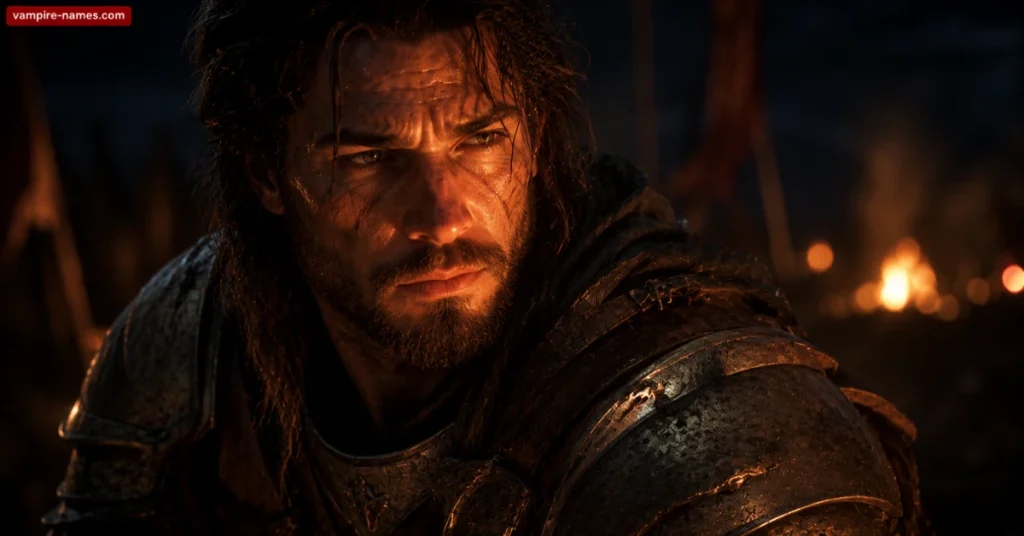
The flagship names the ones that work across every genre, gender, and setting. These have been chosen for phonetic strength, meaningful roots, and versatility. Each one would look right in a fantasy novel, a D&D campaign sheet, a war movie, or a baby name list.
Best Warrior Names with Meanings
| Name | Meaning / Notes |
| Aldric | Old German: ‘noble ruler’ — the warrior who commands respect without raising his voice |
| Theron | Greek: ‘hunter’ — predatory patience; strikes when the moment is exactly right |
| Kaelith | Invented: ‘kael’ (hard/iron) + ‘ith’ — the iron-hard warrior who doesn’t break |
| Draven | Invented but widely adopted — dark precision, slightly dangerous, an antihero’s name |
| Valor | Latin: ‘valor, courage’ — the virtue made into a name; simple and devastating |
| Sigrid | Old Norse (female): ‘victory wisdom’ — wins because she thinks, not just fights |
| Torvan | Invented Norse-feel: ‘tor’ (tower/thunder) + ‘van’ (hope) — thundering hope |
| Bryndis | Old Norse (female): ‘armored goddess’ — carries divinity and battle simultaneously |
| Gideon | Hebrew: ‘mighty warrior / feller of trees’ — the one who clears the path |
| Kira | Multiple origins (female): ‘ruler’ or ‘dark’ — commands from front lines |
| Aldren | Invented Old English feel: ‘alder’ (tree) + ‘ren’ — deep-rooted, ancient strength |
| Zara | Arabic (female): ‘princess, flower’ — the warrior who doesn’t announce herself |
| Cormac | Irish: ‘chariot son’ — the driven warrior; always moving forward |
| Valkyrie | Old Norse: ‘chooser of the slain’ — the one who decides who lives and dies |
| Tyran | Invented: from ‘tyrant’ root but warrior-feel — iron will, unbreakable |
| Rhea | Greek (female): ‘flowing stream’ — the Titan mother; older and deeper than anyone guesses |
| Gunnar | Old Norse: ‘bold warrior’ — from ‘gunnr’ (war) + ‘arr’ (warrior); pure battle-name |
| Seraphine | Hebrew (female): ‘fiery one’ — the angel class; burns everything she touches |
More Best Warrior Names — Quick Reference
| Blade | Calix | Doran | Edric |
| Ferox | Garen | Harlan | Ivar |
| Joran | Kaine | Lysander | Magnus |
| Niall | Orion | Pierce | Quinlan |
| Roran | Stellan | Toryn | Ulric |
| Vance | Wulfric | Xander | Yorick |
Male Warrior Names
Male warrior names span every tradition from the monosyllabic grunt of ancient battlefields to the elaborate compound names of Viking skalds. These are organized by strength of meaning, not just sound, because a name with real roots carries more weight than a name that just sounds tough.
Male Warrior Names with Meanings
| Name | Meaning / Notes |
| Achilles | Greek: ‘pain of the people’ — the greatest warrior of the Trojan War; fatal flaw included |
| Alaric | Gothic: ‘ruler of all’ — Visigoth king who sacked Rome in 410 AD |
| Arminius | Latin form of Germanic name — the warrior who destroyed three Roman legions in Teutoburg Forest |
| Beowulf | Old English: ‘bee-wolf’ (bear metaphor) — the warrior-king of the oldest English epic |
| Crixus | Gaulish: possibly ‘curly-haired’ — Spartacus’s lieutenant; fought to the death |
| Darius | Old Persian: ‘upholder of good’ — King of Persia; built an empire through military genius |
| Einar | Old Norse: ‘one warrior’ — the singular fighter; alone but enough |
| Finn | Irish: ‘fair, white’ — Fionn mac Cumhaill, Ireland’s greatest warrior-hero |
| Galahad | Arthurian: possibly Welsh ‘battle territory’ — the perfect knight; wins because he is pure |
| Hakon | Old Norse: ‘high son’ — Norwegian warrior-kings bore this name for centuries |
| Idris | Welsh: ‘ardent lord’ — giant warrior-giant in Welsh mythology |
| Jarl | Old Norse: ‘chieftain’ — not just a warrior but the one warriors follow |
| Kael | Invented/Gaelic-feel: hard, sharp, decisive — the archetypal fantasy warrior name |
| Leofric | Old English: ‘beloved ruler’ — the noble warrior who earns loyalty rather than demanding it |
| Magnus | Latin: ‘great’ — twelve Norwegian and Swedish kings bore this name; it earned its meaning |
| Njal | Old Norse: ‘champion’ — the wise counselor-warrior of the Icelandic sagas |
| Odoacer | Germanic: ‘wealth, fortune’ — deposed the last Roman emperor in 476 AD |
| Perseus | Greek: ‘destroyer’ — slew Medusa; turned an entire army to stone with her head |
| Quintus | Latin: ‘fifth-born’ — Roman military name; multiple legendary generals |
| Roland | Old French/Germanic: ‘famous land’ — Charlemagne’s greatest paladin |
| Scipio | Latin: ‘staff bearer’ — Scipio Africanus defeated Hannibal; one of Rome’s greatest |
| Theseus | Greek: possibly ‘to set’ — the Athenian hero who killed the Minotaur and unified Attica |
| Uther | Welsh: ‘terrible’ — Uther Pendragon, Arthur’s father; the violent king before the just one |
| Vidar | Old Norse: ‘wide ruler’ — the silent god; one of the few who survive Ragnarok |
| Wulfric | Old English: ‘wolf ruler’ — fierce, territorial, loyal to his own |
| Xerxes | Old Persian: ‘hero among heroes’ — led the largest invasion force in ancient history |
| Yamato | Japanese: ‘great harmony’ — the mythological warrior-spirit of Japan itself |
| Zephyr | Greek: ‘west wind’ — arrives before you knew he was coming; gone before you recover |
More Male Warrior Names — Quick Grid
| Arden | Brant | Corvin | Drest |
| Eldric | Ferris | Gareth | Hadric |
| Ingvar | Jovan | Kendric | Lothar |
| Maren | Nolan | Orin | Phelan |
| Rylan | Soren | Tavin | Ulvar |
| Valdric | Warden | Xenos | Zarek |
Female Warrior Names
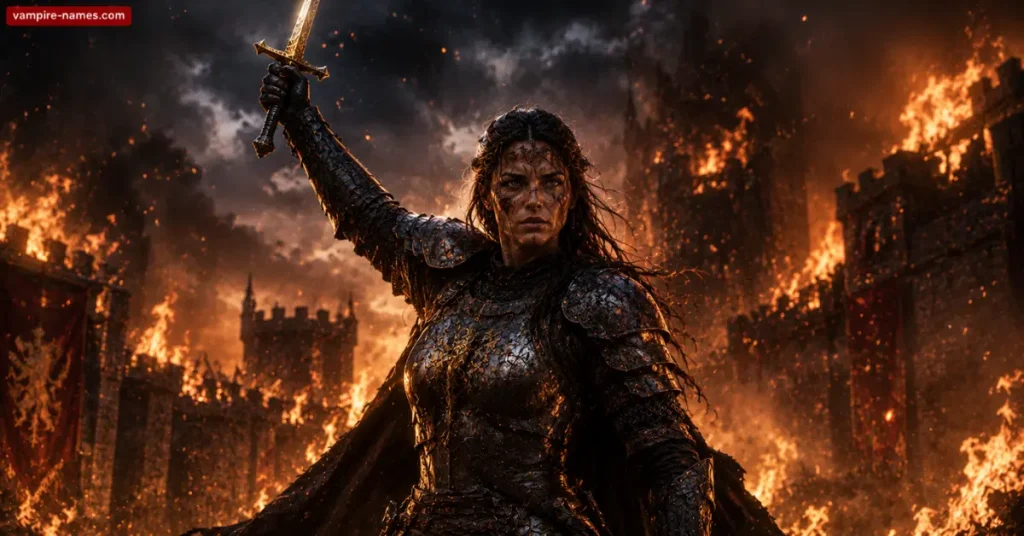
Female warrior names have a tradition as long and as powerful as male ones and it’s been consistently underrepresented in name guides. Boudicca led an army of 100,000 against Rome. Tomoe Gozen was said to be worth a thousand warriors. The Dahomey Agojie were an elite female military unit that terrified everyone they faced. These Pirate Names honor that tradition.
Female Warrior Names with Meanings
| Name | Meaning / Notes |
| Boudicca | Celtic: ‘victory’ — British warrior-queen who nearly ended Roman Britain |
| Tomoe | Japanese: ‘turning’ or ‘friend’ — the legendary onna-bugeisha; unstoppable in battle |
| Thyra | Old Norse: ‘Thor’s battle’ — Danish warrior-queen; built the Ravning Bridge fortification |
| Aela | Old English/invented: ‘oak’ or ‘sharp’ — the defender of the deep forest |
| Valdis | Old Norse: ‘the dead goddess’ — the Valkyrie figure; chooses who lives |
| Bryndis | Old Norse: ‘armored goddess’ — divinity and battle worn simultaneously |
| Kira | Persian/Irish: ‘ruler’ or ‘dark’ — commands from the front, never the rear |
| Seraphine | Hebrew: ‘fiery one’ — burns through opposition; hard to look at directly |
| Morrigan | Irish: ‘great queen’ or ‘phantom queen’ — goddess of war, fate, and death in Irish myth |
| Freydis | Old Norse: ‘noble woman of Freyr’ — the historical Vinland warrior who fought alone against natives |
| Varia | Invented Latin-feel: ‘variable, shifting’ — the unpredictable warrior; no one reads her correctly |
| Nyx | Greek: ‘night’ — the primordial goddess of night; older than the Olympians |
| Astrid | Old Norse: ‘divinely beautiful’ — the one everyone underestimates, catastrophically |
| Lozen | Apache (historical): holy warrior and prophet; said to predict enemy positions |
| Cynane | Macedonian (historical female): half-sister of Alexander; trained in warfare; killed in battle |
| Yennefer | Slavic-influenced: fictional but deeply rooted — the powerful woman who refuses limitations |
| Reva | Sanskrit: ‘moving, the star Arcturus’ — always in motion, impossible to pin down |
| Aethelflaed | Old English: ‘noble beauty’ — real Anglo-Saxon queen who fought the Vikings |
| Zenobia | Greek/Aramaic: ‘life of Zeus’ — queen of Palmyra who conquered Egypt from Rome |
| Tyra | Old Norse: ‘goddess of battle’ — named for Tyr, the warrior-god of justice |
| Rowena | Celtic: ‘white spear’ or ‘slender’ — the noble warrior who leads by example |
| Mira | Sanskrit/Slavic: ‘ocean’ or ‘peace/world’ — the warrior who fights for something real |
| Lagertha | Old Norse (legendary): the shieldmaiden of the sagas; commanded her own army |
| Isolde | Old Welsh: ‘ice ruler’ — coldly precise, Arthurian legend’s most tragic warrior-woman |
| Kestrel | Old French: the small falcon — strikes fast, accurate, completely underestimated |
| Zahra | Arabic: ‘flower, brilliant’ — the warrior whose beauty is also her weapon |
More Female Warrior Names — Quick Grid
| Aella | Briallen | Ceira | Dwyn |
| Eira | Ffion | Gwyneth | Hilde |
| Inara | Jessa | Kara | Lysa |
| Maren | Niamh | Oona | Petra |
| Quinn | Sable | Tara | Ulva |
| Vesper | Willa | Xyla | Yara |
Norse & Viking Warrior Names
Norse warrior names are among the most phonetically powerful in any tradition. They were built to be called across storm winds and battlefield noise short, hard, full of consonant clusters that cut through chaos. The Vikings named their children after gods, qualities, and animals, and they meant every syllable.
Viking Warrior Names with Meanings
| Name | Meaning / Notes |
| Gunnar | Old Norse: ‘battle warrior’ — from ‘gunnr’ (war) + ‘arr’ (warrior); it literally means war |
| Bjorn | Old Norse: ‘bear’ — the berserker warrior; patient, territorial, devastating when roused |
| Sigurd | Old Norse: ‘victory guardian’ — the dragonslayer of Norse myth; Siegfried in German |
| Ivar | Old Norse: ‘bow warrior’ — Ivar the Boneless; led the Great Heathen Army into England |
| Ragnar | Old Norse: ‘judgment warrior’ — the legendary Viking king of the sagas |
| Ulf | Old Norse: ‘wolf’ — the lone predator; patient, effective, works alone |
| Thorvald | Old Norse: ‘Thor’s ruler’ — the thunder-king’s favored warrior |
| Leif | Old Norse: ‘heir, descendant’ — carries the weight of lineage into battle |
| Hakon | Old Norse: ‘high son’ — the elevated warrior; noble by birth and by action |
| Sigrid | Old Norse (female): ‘victory wisdom’ — the tactical warrior who plans three battles ahead |
| Lagertha | Old Norse (female): legendary shieldmaiden who led her own army after her divorce |
| Freydis | Old Norse (female): sailed to Vinland; drove off attackers single-handed while pregnant |
| Ragnvald | Old Norse: ‘counsel power’ — the strategist-warrior; wins by thinking |
| Einar | Old Norse: ‘one warrior’ — the singular fighter; needs no army |
| Brynhildr | Old Norse (female): ‘armored battle’ — the Valkyrie; fought the gods themselves |
| Eirik | Old Norse: ‘ever powerful’ — Erik the Red; warrior and explorer |
| Angrbodr | Bragr | Dagr | Egil |
| Floki | Grimnir | Halfdan | Ingimundr |
| Jarl | Ketill | Ljufvina | Njord |
| Olaf | Perun | Rognvald | Skuli |
| Torfinn | Unn | Vigdis | Wulfnoth |
Ancient Greek & Roman Warrior Names
Greek and Roman warrior names carry a particular cultural weight centuries of literature, philosophy, and conquest compressed into a single syllable pattern. These cultures named their children with explicit intention: Greek Fake Country Names encoded the qualities parents wanted their children to have; Roman names often encoded family lineage, military rank, and civic duty simultaneously.
| Name | Meaning / Notes |
| Achilles | Greek: ‘pain of the people’ — the Iliad’s central warrior; brilliant, wrathful, mortal in one spot |
| Ajax | Greek: ‘of the earth’ — the strongest Greek warrior at Troy; second only to Achilles |
| Leonidas | Greek: ‘son of the lion’ — Sparta’s king at Thermopylae; died holding the pass |
| Perseus | Greek: ‘destroyer’ — the hero who slew Medusa and founded Mycenae |
| Theseus | Greek: ‘to set, to place’ — unified Attica; killed the Minotaur |
| Hector | Greek: ‘to hold, to possess’ — Troy’s greatest defender; knew he would lose and fought anyway |
| Castor | Greek: ‘to shine’ — the warrior twin; expert boxer and horseman |
| Diomedes | Greek: ‘cunning in battle’ — wounded Ares himself at Troy; the most aggressive Greek hero |
| Maximus | Latin: ‘greatest’ — the Roman ideal of warrior-virtue compressed into one word |
| Scipio | Latin: ‘staff’ — Scipio Africanus who defeated Hannibal at Zama in 202 BC |
| Gaius | Latin: ‘to rejoice’ — Julius Caesar’s first name; warriors can have soft-meaning names |
| Valerian | Latin: ‘strength, health’ — Roman emperor and general; complex, powerful |
| Octavian | Latin: ‘eighth-born’ — became Augustus; turned a republic into an empire through military will |
| Quintus | Latin: ‘fifth-born’ — numerous Roman generals; the name became associated with command |
| Lysander | Greek: ‘liberator’ — the Spartan admiral who ended Athenian naval supremacy |
| Atalanta | Greek (female): ‘equal in weight’ — the huntress hero; outran everyone, fought anyone |
| Zenobia | Greek/Aramaic (female): ‘life of Zeus’ — queen who seized Egypt from Rome in 270 AD |
Celtic & Irish Warrior Names
Celtic warrior names are among the oldest in the Western tradition many predate written history and survive only because they were recorded by the Romans they were fighting. Irish and Welsh warrior names carry particular depth: Ireland produced warrior-hero cycles (the Ulster Cycle, the Fenian Cycle) that rival any epic tradition in the world.
| Name | Meaning / Notes |
| Cú Chulainn | Irish: ‘hound of Culann’ — the Ulster hero; went into battle-frenzy (ríastrad) beyond human form |
| Fionn | Irish: ‘fair, white’ — Fionn mac Cumhaill; leader of the Fianna warrior band |
| Cormac | Irish: ‘chariot son’ — the driven warrior; king and fighter simultaneously |
| Niall | Irish: ‘champion’ — Niall of the Nine Hostages; High King who raided Roman Britain |
| Conn | Irish: ‘reason, intelligence’ — Conn of the Hundred Battles; won by being smarter |
| Vercingetorix | Gaulish: ‘great king of warriors’ — united Gaul against Caesar; almost succeeded |
| Caratacus | Celtic: ‘beloved’ — British king who resisted Rome for nine years |
| Boudicca | Celtic (female): ‘victory’ — led 100,000 warriors and sacked three Roman cities |
| Bran | Welsh/Celtic: ‘raven’ — the dark-feathered intelligence; patient warrior |
| Cadwallon | Welsh: ‘battle scatter’ — the king who defeated Edwin of Northumbria |
| Drust | Pictish: ‘riot, tumult’ — Pictish warrior-king; Tristan in later legend |
| Cadfael | Welsh: ‘battle metal’ — literally forged for battle; pure Welsh warrior-name |
| Eoghan | Irish: ‘born of the yew tree’ — the yew is the warrior’s tree; long-lived and deadly |
| Ferdiad | Irish: ‘man of smoke’ — Cú Chulainn’s greatest friend; died in single combat with him |
| Gwydion | Welsh: ‘born of trees’ — the great magician-warrior of the Mabinogion |
| Rhiannon | Welsh (female): ‘great queen’ — divine horse-goddess; power expressed without violence |
| Aedan | Broccan | Cainnech | Diarmuid |
| Ercol | Fergal | Goibniu | Heremon |
| Irial | Jarlath | Kieran | Lugaid |
| Maedoc | Nechtan | Oisin | Phelim |
| Ronan | Senchaid | Tuathal | Uidhrin |
Japanese & Samurai Warrior Names
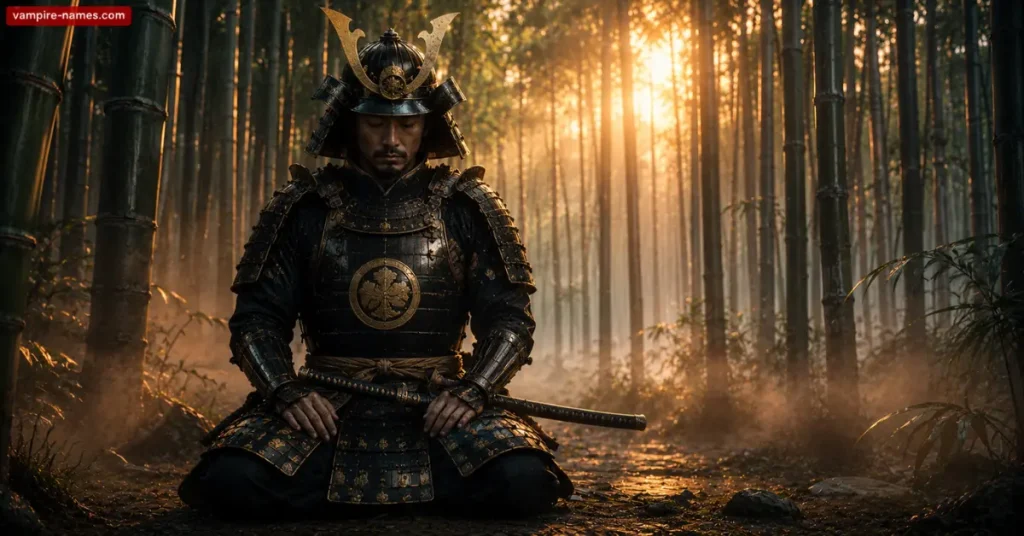
Japanese warrior names operate under different principles than Western ones. The samurai tradition prized precision, restraint, and the cultivation of both martial and artistic skill simultaneously. A samurai warrior’s name was expected to carry aesthetic beauty as well as martial weight. These names reflect that dual tradition.
Japanese Samurai Warrior Names with Meanings
| Name | Meaning / Notes |
| Musashi | Japanese: place name — Miyamoto Musashi went 61 duels undefeated; wrote ‘The Book of Five Rings’ |
| Yoshitsune | Japanese: ‘good, constant’ — Minamoto no Yoshitsune; Japan’s most beloved tragic warrior |
| Yoritomo | Japanese: ‘head friend’ — founded the Kamakura shogunate; the warrior who became government |
| Nobunaga | Japanese: ‘long reputation for truth’ — Oda Nobunaga; transformed Japan through military genius |
| Takeda | Japanese: ‘military field’ — the Takeda clan; legendary cavalry warfare |
| Kenshin | Japanese: ‘sword heart’ — Uesugi Kenshin; the ‘God of War’ of the Sengoku period |
| Masamune | Japanese: ‘correct, sincere’ — the greatest swordsmith in history; also a daimyo’s name |
| Hiroaki | Japanese: ‘widespread brightness’ — the far-reaching illumination of a great commander |
| Saito | Japanese: ‘purified wisteria’ — a major samurai clan name |
| Tomoe | Japanese (female): ‘turning, friend’ — Tomoe Gozen; the legendary female samurai |
| Hattori | Japanese: ‘weavers’ — the Hattori clan; Hattori Hanzo the legendary ninja-warrior |
| Katsumoto | Japanese: ‘victory origin’ — the name immortalized in The Last Samurai |
| Nasu no Yoichi | Japanese: the archer who hit a fan from a moving boat at sea — precision as legend |
| Ryoma | Japanese: ‘dragon horse’ — Sakamoto Ryoma; the reformer-warrior who changed Japan |
| Jubei | Japanese: classical samurai name — made famous through fiction and film |
| Yuki | Japanese: ‘snow’ or ‘courage’ — the quiet warrior; still until the moment of action |
More Japanese Warrior Names
| Akira | Botan | Daisuke | Fujiwara |
| Gorou | Hayate | Isamu | Jin |
| Katsu | Makoto | Nori | Osamu |
| Raiden | Shin | Takashi | Ukyo |
| Yasuo | Zenji | Kaito | Haruki |
Aztec, African & World Warrior Names
These traditions are criminally underrepresented in most warrior name guides. The Aztec warrior tradition produced some of the most ferocious fighting forces in the ancient Americas. The African continent has warrior traditions spanning thousands of years and dozens of cultures. These names deserve as much attention as any Viking or Greek warrior name.
Aztec Warrior Names
| Name | Meaning / Notes |
| Cuauhtémoc | Nahuatl: ‘descending eagle’ — last Aztec emperor; resisted the Spanish to the end |
| Itzcoatl | Nahuatl: ‘obsidian serpent’ — founded the Aztec Empire; brilliant military organizer |
| Tlacaelel | Nahuatl: ‘the heart of man’ — the power behind three emperors; rewrote Aztec history |
| Xolotl | Nahuatl: ‘dog monster’ — the lightning deity; guide of the dead; fierce protector |
| Ahuitzotl | Nahuatl: ‘water dog monster’ — expanded the Aztec Empire to its greatest size |
| Chimalli | Nahuatl: ‘shield’ — the warrior who protects; defensive excellence |
| Tlapalteotl | Nahuatl: ‘red god’ — the color of war in Aztec tradition |
| Ocelotl | Nahuatl: ‘jaguar’ — the jaguar warriors were Aztec elite military; highest honor |
African Warrior Names
| Name | Meaning / Notes |
| Shaka | Zulu: personal name — Shaka kaSenzangakhona transformed Zulu into a military empire |
| Mzilikazi | Zulu/Ndebele: ‘the great road’ — warrior king who founded the Matabele nation |
| Sundiata | Manding: ‘hungry lion’ — founded the Mali Empire after being unable to walk as a child |
| Chaka | Variant of Shaka — used as an independent warrior name across Africa |
| Kamau | Kikuyu: ‘quiet warrior’ — the warrior who wins through silence and patience |
| Tariq | Arabic: ‘one who knocks at the door’ — Tariq ibn Ziyad who conquered Spain |
| Hannibal | Phoenician: ‘grace of Baal’ — Carthaginian general; Rome’s greatest nightmare |
| Narmer | Ancient Egyptian: ‘striking catfish’ — unified Upper and Lower Egypt by force |
| Piankhi | Nubian: uncertain — the Kushite king who conquered all Egypt around 728 BC |
| Yaa Asantewaa | Akan (female): queen-mother who led the Ashanti against the British in 1900 |
| Amara | Baraka | Chidi | Dawit |
| Ekundayo | Farai | Garang | Hamza |
| Idris | Jabari | Kofi | Letsego |
| Musa | Nnamdi | Obinna | Pita |
| Rashid | Seun | Tafari | Uche |
Fantasy Warrior Names
Fantasy warrior names live in the productive tension between invented and familiar. Too invented, and they feel like gibberish. Too familiar, and they feel borrowed. The best fantasy warrior names feel like they belong to a specific culture within a fictional world — with internal logic, consistent sound patterns, and a sense of history behind them.
Fantasy Warrior Names with Meanings
| Name | Meaning / Notes |
| Vaelthorn | Invented: ‘vael’ (wind) + ‘thorn’ — the wind that cuts; fast and invisible until it hurts |
| Keldric | Invented Germanic-feel: ‘keld’ (cold spring) + ‘ric’ (ruler) — the cold king |
| Grimvael | Dark compound: ‘grim’ + ‘vael’ (wind) — the grim wind; arrives without warning |
| Solindra | Female, invented: ‘sol’ (sun) + ‘indra’ — the sun-warrior; blinding and powerful |
| Dawnbreaker | Fantasy title-name: the warrior who ends the long dark; hope weaponized |
| Torgan | Invented: ‘tor’ (high rocky peak) + ‘gan’ — the warrior of the high place |
| Ashveil | Dark compound: shoots from ash and shadow; grey-warrior energy |
| Vexara | Invented female: slightly sinister; the warrior who troubles sleep |
| Ironmark | Fantasy compound: the warrior who leaves iron marks on everything she fights |
| Kaelith | Invented: ‘kael’ + ‘ith’ (suffix) — the iron-tested warrior; hardened by trials |
| Grimthorn | Dark compound: the thorn that grows in grim places; hurts more because unexpected |
| Embervast | Fantasy: ’ember’ + ‘vast’ — the vast burning warrior; fire on a continental scale |
| Nightfall | One-word fantasy name: arrives in the dark; ends things quietly |
| Stormwall | Fantasy compound: the warrior who stops things the size of storms |
| Cinderpeak | Fantasy: forged in volcanic fire at the highest possible temperature |
More Fantasy Warrior Names
| Aldenvast | Blackveil | Cindergate | Doomwall |
| Edgefall | Frostmark | Grimvast | Hawkwall |
| Ironveil | Jadestorm | Keldfall | Lorewall |
| Moonmark | Nightvast | Obsidwall | Pyremoor |
| Quickfall | Rimvast | Stormgate | Thornwall |
| Umbraveil | Voidmark | Windwall | Xenith |
Dark Warrior Names
Dark warrior names carry menace without necessarily being evil. A dark warrior name suggests someone who has been through something that changed them — a trauma, a betrayal, a loss — and emerged more dangerous for it. These are names for antiheroes, fallen champions, and warriors who operate in the moral grey.
| Name | Meaning / Notes |
| Mordred | Arthurian: possibly ‘great judge’ — Arthur’s betrayer; the darkness inside the court |
| Draven | Invented: dark precision; the warrior who is more dangerous for being controlled |
| Malgath | ‘Mal’ (evil) + ‘gath’ (gathering) — the dark lord’s most effective weapon |
| Vrothgar | Invented: sounds orcish, brutal, occupying — the warrior who takes without asking |
| Grimveil | Dark compound: operates behind the veil of grimness; you never see him clearly |
| Shadowmark | Fantasy compound: leaves marks in places you can’t see until they’re wounds |
| Dreadhollow | Fantasy: born from the hollow place where hope used to be |
| Blightwalker | Fantasy: the warrior whose passage causes corruption — even victory costs something |
| Skullvane | Fantasy: reads the battlefield by the dead; uses fallen warriors’ patterns |
| Ashvenom | Dark compound: ash and poison; the warrior who leaves nothing behind |
| Vexmael | Invented: sounds cursed; the warrior who has been marked by something old |
| Rothmael | ‘Roth’ (red/blood) + ‘mael’ (iron prince) — the blood-iron warrior |
| Nocturnis | Latin roots: the night-warrior; works best where light doesn’t reach |
| Skarrath | Invented harsh: every consonant cluster is designed to be uncomfortable |
| Umbravex | ‘Umbra’ (shadow) + ‘vex’ — the shadow that troubles; disquieting presence |
| Bloodveil | Corpsewall | Darkmark | Deathvast |
| Fellgate | Gravenmoor | Hexveil | Ironbane |
| Jadedark | Killwall | Lostmark | Maledark |
| Nightbane | Obsidmark | Painwall | Ruinveil |
Mythical & Legendary Warrior Names
These Khajiit Names come from the actual mythological traditions of the world — not invented, not borrowed loosely, but genuine names from genuine traditions. They carry the weight of cultures that took warrior-naming seriously enough to encode it in stories that survived thousands of years.
| Name | Meaning / Notes |
| Achilles | Greek: ‘pain of the people’ — dipped in the River Styx; mortal only at the heel |
| Beowulf | Old English: ‘bee-wolf/bear’ — killed Grendel, Grendel’s mother, and a dragon |
| Cuchulainn | Irish: ‘hound of Culann’ — the Ulster hero who single-handedly held a ford |
| Gilgamesh | Sumerian: ‘the old man is still young’ — the world’s first named warrior-hero |
| Heracles | Greek: ‘glory of Hera’ — the Twelve Labors; semi-divine; the warrior archetype |
| Arjuna | Sanskrit: ‘bright’ — the supreme archer of the Mahabharata; guided by Krishna |
| Sigurd | Old Norse: ‘victory guardian’ — slew the dragon Fafnir; bathed in dragon blood |
| Roland | Old French: ‘famous throughout the land’ — Charlemagne’s paladin; died at Roncevaux |
| Rama | Sanskrit: ‘pleasing, beautiful’ — the divine warrior-king of the Ramayana |
| Rostam | Persian: uncertain origin — the greatest hero of the Shahnameh; killed his own son |
| Patroclus | Greek: ‘glory of the father’ — Achilles’ companion; his death broke the war open |
| Cú Roí | Irish: ‘hound of the plains’ — the invincible warrior who tested all others |
| Baldr | Old Norse: ‘bold, brave’ — the radiant god who died from a mistletoe dart |
| Enkidu | Sumerian: uncertain — Gilgamesh’s warrior companion; the wild man tamed by civilization |
| Anansi | Akan: the spider trickster — wins not by force but by intelligence; warrior of wits |
Medieval Warrior Names
Medieval warrior names draw from the real linguistic palette of the period — Old English, Old Norse, Middle French, Latin, and Welsh. They feel grounded and believable because they are, in fact, the names that actual medieval warriors bore. These are names for knights, mercenaries, soldiers, and lords in any low-magic or historical fantasy setting.
| Name | Meaning / Notes |
| Aldric | Old German: ‘noble ruler’ — the respected warrior-commander; leads by example |
| Cuthbert | Old English: ‘famous bright’ — the village warrior; everyone knows and trusts him |
| Godwin | Old English: ‘God’s friend’ — Harold Godwinson’s family; powerful and doomed |
| Leofric | Old English: ‘beloved ruler’ — loyal, competent, the backbone of any army |
| Ranulf | Old Norse-English: ‘shield wolf’ — the fighting man who protects while fighting |
| Osric | Old English: ‘god ruler’ — the pious warrior; fights for something larger than himself |
| Edmund | Old English: ‘rich protector’ — three English kings; multiple warrior-saints |
| Wulfric | Old English: ‘wolf ruler’ — fierce, territorial, completely committed |
| Giscard | Old French-Germanic: ‘brave warrior of the Normans’ — Norman conqueror energy |
| Bertrand | Old French-Germanic: ‘bright raven’ — the clever Norman warrior |
| Godfrey | Old French-German: ‘God’s peace’ — Godfrey of Bouillon; led the First Crusade |
| Tancred | Norman: ‘think carefully, counsel’ — the considered warrior; smart before brutal |
| Peregrine | Latin: ‘pilgrim, traveler’ — the wandering knight; serves where needed |
| Aldhelm | Old English: ‘noble helmet’ — the well-protected warrior; defense and nobility |
| Mabry | Medieval English (female): variant of Mabel — the village defender-woman |
| Thomasin | Medieval English (female): feminine of Thomas; steady, reliable, consistent |
Anime Warrior Names
Anime has produced some of the most iconic warrior characters in modern storytelling — and some genuinely memorable names. These span shounen battle manga, dark fantasy anime, and historical warrior series. They’re drawn from both genuine Japanese names and invented names created for fictional warriors.
| Name | Meaning / Notes |
| Guts | Berserk — one of anime’s most iconic warriors; brutal, scarred, refuses to die |
| Zoro | One Piece — three-sword style; carries weight of dead promises into every fight |
| Levi | Attack on Titan — humanity’s strongest soldier; cold efficiency |
| Erza | Fairy Tail (female): armor magic; overwhelming force wrapped in discipline |
| Ryuko | Kill la Kill (female): ‘dragon child’ — the half-scissor warrior |
| Ichigo | Bleach: ‘one who protects’ — the Soul Reaper warrior with an inner hollow |
| Kenshin | Rurouni Kenshin: ‘sword heart’ — the former assassin who swore never to kill again |
| Mikasa | Attack on Titan (female): ‘three bamboo hats’ — the most skilled human fighter |
| Goku | Dragon Ball: ‘aware of emptiness’ — the Saiyan warrior who surpasses every limit |
| Yato | Noragami: ‘night’ — the forgotten war-god; deadly and desperately lonely |
| Demon Slayer | Tanjiro — ‘charcoal seller’; the gentle warrior who cries for every enemy he kills |
| Saber | Fate series (female): King Arthur; she chose to be a warrior-king, knowing the cost |
| Itachi | Naruto: ‘weasel’ — the warrior who destroyed everything he loved to protect it |
| Gohan | Dragon Ball: ‘rice’ — the warrior who never wanted to fight, becoming the strongest anyway |
| Rukia | Bleach (female): ‘violet’ — Soul Reaper; small, precise, absolutely lethal |
Biblical & Scriptural Warrior Names
The Bible contains some of the most powerful warrior narratives in literature — Gideon’s three hundred, David’s mighty men, Samson’s final act, Deborah leading Israel to victory. These names carry three thousand years of cultural weight and still read as genuinely strong today.
| Name | Meaning / Notes |
| Gideon | Hebrew: ‘mighty warrior / feller of trees’ — defeated an army of 135,000 with 300 men |
| David | Hebrew: ‘beloved’ — killed Goliath as a teenager; became Israel’s greatest warrior-king |
| Samson | Hebrew: ‘sun’ — the judge whose strength came from his consecration to God |
| Joshua | Hebrew: ‘God is salvation’ — Moses’s military successor; conquered Canaan |
| Caleb | Hebrew: ‘dog’ (loyal) — the warrior who scouted Canaan and didn’t fear the giants |
| Uriah | Hebrew: ‘God is my light’ — David’s most loyal warrior; died by David’s order |
| Benaiah | Hebrew: ‘God has built’ — killed a lion in a pit on a snowy day; one of David’s thirty |
| Deborah | Hebrew (female): ‘bee’ — the judge who led Israel to military victory; prophet and warrior |
| Jael | Hebrew (female): ‘mountain goat’ — killed the enemy general with a tent peg |
| Abigail | Hebrew (female): ‘father’s joy’ — negotiated peace when her husband wouldn’t; saved her household |
| Eleazar | Hebrew: ‘God has helped’ — one of David’s three greatest warriors; held a field alone |
| Joab | Hebrew: ‘God is father’ — David’s general; brilliant, loyal, ruthless, eventually dangerous |
| Nimrod | Hebrew: ‘rebel, hunter’ — the first great hunter and warrior after the flood |
| Phinehas | Hebrew: ‘serpent’s mouth’ — the priest-warrior who stopped a plague by killing its cause |
| Ehud | Hebrew: ‘strong’ — the left-handed judge who assassinated a king with a concealed blade |
Names That Mean Warrior Across Languages
These aren’t warrior-themed names — they literally mean warrior, fighter, battle, or strength in real languages. If you want a name whose meaning is inseparable from its warrior identity, this is the definitive list.
| Name | Meaning / Notes |
| Gunnar | Old Norse: ‘battle warrior’ — from ‘gunnr’ (war) + ‘arr’ (warrior) |
| Ivar | Old Norse: ‘bow warrior’ — ‘yr’ (bow) + ‘arr’ (warrior) |
| Viggo | Old Norse: ‘war, battle’ — from ‘vigr’ (battle-ready) |
| Aldric | Old German: ‘noble ruler/warrior’ — noble + power compound |
| Cadell | Welsh: ‘battle’ — pure Welsh battle-name |
| Cadfael | Welsh: ‘battle metal’ — the weapon-warrior |
| Gunhild | Old Norse (female): ‘battle warrior’ — ‘gunnr’ + ‘hildr’ (both mean battle) |
| Hilda | Old Norse (female): ‘battle’ — from ‘hildr’ |
| Matilda | Old German (female): ‘battle mighty’ — ‘maht’ (might) + ‘hild’ (battle) |
| Louella | Old German (female): ‘famous warrior’ — ‘hlud’ (fame) + ‘wiga’ (warrior) |
| Ludwig | Old German: ‘famous warrior’ — the masculine form of the above |
| Ebba | Old Norse (female): ‘strength of the boar’ — the warrior’s animal |
| Chadwick | Old English: ‘warrior’s settlement’ — the warrior who built something permanent |
| Evander | Greek: ‘good man / strong man’ — virtue and strength in one |
| Bataar | Mongolian: ‘hero, warrior’ — the Mongolian warrior-name tradition |
| Mujahid | Arabic: ‘one who struggles/fights’ — the holy warrior tradition |
| Vira | Sanskrit: ‘hero, brave’ — the warrior virtue in Sanskrit |
| Ranjit | Sanskrit: ‘victorious in battle’ — the triumphant warrior |
| Batur | Turkish/Mongolian: ‘brave warrior’ — across the steppe cultures |
| Tigran | Armenian: ‘tiger’ or ‘arrow’ — Tigranes the Great; warrior-king |
Names That Mean Fire Warrior
Fire warrior names combine two of the most powerful naming traditions — fire imagery and warrior identity. These work for characters with fire magic, fiery temperaments, or warriors whose intensity burns through everything they touch.
| Name | Meaning / Notes |
| Aidan | Irish: ‘little fire’ — the fire that isn’t large yet; don’t underestimate it |
| Ignatius | Latin: ‘fiery one’ — from ‘ignis’ (fire); the burning warrior |
| Kenneth | Scottish Gaelic: ‘born of fire’ — the fire-born warrior |
| Seraphine | Hebrew (female): ‘fiery one’ — the seraphim were the burning angels |
| Brenna | Irish (female): ‘raven’ or ‘little flame’ — the small fire warrior |
| Pyrrhus | Greek: ‘flame-colored, red’ — King Pyrrhus whose victories cost too much |
| Tindra | Swedish: ‘to twinkle, sparkle’ — the fire warrior whose light draws enemies in |
| Vulcan | Roman: god of fire and forge — the warrior-craftsman; makes the weapons |
| Blaze | Old English: ‘fire’ — the most direct fire warrior name possible |
| Ember | Old English: ‘low-burning fire’ — the warrior who burns slow but doesn’t go out |
| Ignis | Latin: ‘fire’ — the fire itself as a warrior name |
| Pyriel | Invented Hebrew-feel: ‘fire of God’ — the divine fire warrior |
| Soleil | French: ‘sun’ — the greatest fire; the warrior who burns at the center of everything |
| Kindra | Invented: from ‘kindle’ — the warrior who starts fires, literal and metaphorical |
| Ashford | Old English: ‘ford by the ash trees’ — but ‘ash’ as fire remnant; the aftermath warrior |
| Pele | Hawaiian (female): goddess of fire and volcanoes — the most powerful fire warrior of mythology |
Names That Mean Tiny Warrior
‘Tiny warrior’ names are perfect for characters whose size is deliberately subverted — the small fighter who is more dangerous than the large one, the child with warrior potential, or the character whose diminutive name is an ironic contrast to their actual ferocity. These are also genuinely popular baby names.
| Name | Meaning / Notes |
| Brian | Irish: ‘strong, virtuous’ — despite its modern softness, this name means ‘high, noble’ |
| Finn | Irish: ‘fair, white’ — Fionn mac Cumhaill was a small boy who became a great warrior |
| Wren | Old English: the tiny bird with a huge song — the warrior who punches far above weight |
| Pip | Old English: short form of Philip; ‘lover of horses’ — small but rides hard |
| Kit | Old English: short form of Christopher — ‘bearer of Christ’ — small but carrying weight |
| Lark | Old English: the high-flying small bird — the tiny warrior who reaches heights others can’t |
| Bran | Celtic: ‘raven’ — the small dark bird that outwits the eagle |
| Robin | Old French/Germanic: small bird, also ‘bright fame’ — Robin Hood was a small-statured outlaw |
| Jay | Old French: the jaybird — small, loud, territorial, completely unintimidated by larger birds |
| Cael | Irish: ‘slender’ — the slender warrior is harder to hit and faster to strike |
| Rue | Old English: herb name — small, bitter, medicinal — the tiny warrior who leaves a mark |
| Twig | Old English: a small branch — easily broken? No. The most flexible part of the tree |
| Mite | Old English: ‘tiny creature’ — fully embracing smallness as an identity; supremely confident |
| Sprite | Old French/Latin: ‘spirit’ — the tiny magical warrior; hits harder than the physics allow |
| Smidge | Modern English: a tiny amount — the warrior who only needs a smidge to change everything |
| Puck | Old English: ‘mischievous sprite’ — Shakespeare’s Puck is tiny and causes more chaos than armies |
Last Names That Mean Warrior
This category is almost completely missing from competitor articles, but it’s one of the most-searched keyword groups. Last names that mean warrior come from occupational surnames, place names associated with battle, and family names derived from warrior-ancestor nicknames. These work as surnames for characters, or as standalone warrior names in settings where one-name characters are the norm.
| Name | Meaning / Notes |
| Armstrong | Old English: ‘strong arm’ — the fighter whose physical power defines the family |
| Gunnarsson | Old Norse: ‘son of Gunnar (battle warrior)’ — carries battle in the bloodline |
| Fletcher | Old English: ‘arrow maker’ — the family that supplied warriors with arrows |
| Archer | Old English: ‘bow user’ — the surname became the warrior identity |
| Draper | Old English: ‘cloth maker’ — but also used for sword-belt makers who served armies |
| Ward | Old English: ‘guardian, watchman’ — the warrior family that guarded something important |
| Warden | Old English: ‘guardian of the forest’ — the warrior protector of contested land |
| Hale | Old English: ‘hero’ — the heroic family; warrior ancestors in every generation |
| Hartley | Old English: ‘stag clearing’ — the hunting warrior’s family ground |
| Ironside | Old English: literal — Edmund Ironside; the warrior king who never yielded |
| Strongbow | Historical: Richard de Clare’s nickname — the Norman archer-lord of Ireland |
| Dreadnought | Old English: ‘fears nothing’ — the surname that replaced the family name entirely |
| Wulfric | Old English: ‘wolf ruler’ — the fighting family descended from wolf-warrior ancestors |
| Blackwood | Old English: ‘dark forest’ — the warrior family of the shadowed borderlands |
| Grimshaw | Old English: ‘grim copse’ — the warrior family of the dark woodland |
| Steele | Old English: ‘hard as steel’ — the surname that became a warrior identity |
| Valor | Latin: ‘courage’ — a surname that carries the virtue itself |
| Shields | Old English: ‘the shield-bearer’ — the defensive warrior family; protectors first |
| Braverman | Old English-German: ‘brave man’ — literally carries bravery as family identity |
| Strongarm | Old English: the fighting family defined by physical combat ability |
Warrior Titles & Nicknames
Warrior titles and nicknames are different from Kitsune Names — they’re earned, not given. The best ones tell a story in two words. ‘The Unbroken.’ ‘Ironside.’ ‘The Wolf of the North.’ They’re used by enemies who respect the warrior, by allies who follow them, and by historians who are still talking about them centuries later.
Warrior Titles That Became Names
| Name | Meaning / Notes |
| The Lionheart | Richard I of England — his courage in battle earned this forever |
| Ironside | Edmund II of England — never broke under Danish assault |
| The Hammer | Charles Martel — stopped the Islamic advance into Europe at Tours, 732 AD |
| The Great | Alexander — used so rarely because it means so much |
| Bloodaxe | Erik Bloodaxe — Viking king; the axe came before the throne |
| The Undefeated | Scipio Africanus — never lost a major engagement |
| Berserker | Old Norse warrior-class — fought in trance-fury states; terrifying and effective |
| Shieldmaiden | Old Norse female warrior class — existed historically; not just legend |
Warrior Nicknames for Characters
| Deadeye | Ironwall | Stormcaller | Ashwalker |
| Coldblood | Firstblade | Grimwall | Hawkeye |
| Ironhide | Laststand | Moonblade | Nightfall |
| Oathkeeper | Pyrehand | Quickdraw | Ruinbringer |
| Steelborn | Thornwall | Unbroken | Voidwalker |
| Warborn | Xanatos | Yelloweye | Zerocold |
Badass & Cool Warrior Names
Sometimes you need a name that passes the simple, instinctive test: does this sound like someone you don’t want to fight? These names all pass. They’re phonetically powerful, culturally grounded, and work across every genre.
| Blade | Crest | Dread | Ember |
| Ferox | Grim | Havoc | Inferno |
| Jade | Kaine | Lynx | Maul |
| Nova | Onyx | Pierce | Quake |
| Riven | Slate | Thorn | Umbra |
| Valor | Wrath | Xander | Zeal |
| Axel | Bolt | Crash | Doom |
| Edge | Fang | Gore | Hex |
Unique Warrior Names
Unique warrior names occupy territory nobody else has claimed. They feel fresh because they’re drawn from traditions that don’t get used enough, or because they combine elements in ways that are genuinely inventive rather than random.
| Name | Meaning / Notes |
| Kamandar | Persian: ‘bow-holder’ — rarely used in Western fantasy; stands out immediately |
| Bataar | Mongolian: ‘hero, warrior’ — carries the steppe warrior tradition; genuinely uncommon |
| Ekundayo | Yoruba: ‘sorrow becomes joy’ — the warrior who transforms grief into victory |
| Vira | Sanskrit: ‘brave, heroic’ — clean, beautiful, universal in meaning |
| Tigranes | Armenian: ‘tiger/arrow’ — Tigranes the Great; rarely used outside history books |
| Cadfael | Welsh: ‘battle metal’ — the forged warrior; linguistically unique in English fantasy |
| Itzcoatl | Nahuatl: ‘obsidian serpent’ — Aztec warrior-name; hard to find in any name list |
| Lozen | Apache: the historical holy warrior — unique, female, spiritually powerful |
| Paikea | Maori: the whale rider — the warrior who rides impossible things to victory |
| Quinlan | Irish: ‘fit, perfectly formed’ — the warrior built for exactly what they do |
| Rostam | Persian: greatest hero of the Shahnameh — almost unknown in Western fantasy |
| Sundiata | Manding: ‘hungry lion’ — the lame boy who founded an empire; unique and profound |
How to Create Your Own Warrior Name
Method 1: Lead with Phonetic Force
Warrior names that hit hard start with hard sounds. K, G, T, D, B — these consonants require physical effort to produce and register as strong. Pair them with short vowels: ‘Kal,’ ‘Gor,’ ‘Thar,’ ‘Drik.’ Add a second syllable that resolves cleanly: ‘Kaldric,’ ‘Goran,’ ‘Theron,’ ‘Dravex.’ The pattern is: hard opening, short vowel, clean close. Say it aloud three times. If it sounds right on a battlefield, it probably is.
Method 2: Use Real Warrior-Meaning Etymology
Multiple languages have words that literally mean warrior, battle, or strength: Norse ‘gunnr’ (war), Welsh ‘cad’ (battle), Latin ‘bellum’ (war), Sanskrit ‘vira’ (hero), Arabic ‘mujahid’ (fighter), Mongolian ‘bataar’ (hero). Take one of these roots and build around it. ‘Cadric’ (battle-ruler), ‘Virand’ (hero-land), ‘Bellax’ (from bellum), ‘Gundrin’ (from gunnr). You get the semantic depth of real etymology with the freshness of something invented.
Method 3: Choose an Animal That Fights
Every warrior culture used animal names as warrior names — and they chose the animals that embodied specific fighting virtues. Bears: immense strength, protective ferocity. Wolves: pack tactics, endurance, hunting patience. Eagles: superiority, vision, striking from above. Ravens: intelligence, battlefield presence, surviving everything. Lions: power and dignity. Serpents: patience and precision. Choose your warrior’s fighting style and find the animal that matches it. ‘Bjorn’ (bear) tells you everything about that fighter before he swings.
Method 4: Name After a Battle or Wound
The most powerful warrior names are often earned names — names that came from what the warrior survived or achieved. This is a worldbuilding goldmine. A warrior who survived a battle at Ash Bridge becomes ‘Ashmark.’ A warrior who took an arrow through the shoulder and kept fighting becomes ‘Ironshoulde.’ A warrior who fought on after everyone else fled becomes ‘Laststand.’ These names work because they’re already stories. The name IS the character introduction. Don’t just pick something that sounds tough — let the character’s history name them.
Method 5: Borrow from an Underused Culture
Western fantasy oversaturates Norse and Greek warrior names, which means Aztec, Mongolian, Maori, West African, and Central Asian warrior names stand out immediately. ‘Bataar’ (Mongolian: hero) is more distinctive than ‘Gunnar’ simply because it’s less used. ‘Cadfael’ (Welsh: battle metal) reads as genuinely unusual in any English-language fantasy setting. ‘Itzcoatl’ (Nahuatl: obsidian serpent) will be remembered in any game or story it appears in. The further you go from the overcrowded traditions, the more your character’s name will stand out — and the richer the cultural heritage you’re honoring.
Frequently Asked Questions About Warrior Names
Q: What is a strong warrior name?
Strong warrior names share specific phonetic qualities: hard opening consonants (K, G, T, D, R), short vowels, and clean endings. ‘Theron,’ ‘Kaldric,’ ‘Gunnar,’ ‘Draven,’ ‘Magnus’ all follow this pattern. But strength in a name also comes from meaning — ‘Gideon’ (Hebrew: mighty warrior) carries three thousand years of scriptural weight; ‘Leonidas’ carries 2,500 years of Spartan legacy. The strongest warrior name is the one that combines phonetic power with genuine roots. ‘Valor’ is a single word that encodes everything a warrior should be.
Q: What are good female warrior names?
The female warrior tradition is ancient and global. From mythology: Artemis, Atalanta, Morrigan, Brynhildr, Skadi. From history: Boudicca (Celtic: ‘victory’), Tomoe Gozen (Japanese), Aethelflaed (Anglo-Saxon queen who fought Vikings), Zenobia (conquered Egypt from Rome), Lozen (Apache holy warrior). Fantasy options: Valkyrie, Bryndis, Seraphine, Kira, Kestrel, Varia. For modern use: Tyra, Mira, Quinn, Petra, Sable. The best female warrior names carry the same phonetic force as male ones — they don’t soften for gender. ‘Bryndis’ (Old Norse: armored goddess) is harder-sounding than half the male warrior names on any list.
Q: What are last names that mean warrior?
Several English surnames carry warrior meaning: Armstrong (strong arm), Ward (guardian), Warden (forest guardian), Hale (hero), Ironside (like Edmund Ironside), Fletcher (arrow maker), Archer (bow user), Shields (shield-bearer), Steele (hard as steel), Strongbow (the Norman archer-lord), Valor (the virtue itself). Less common but genuine: Gunnarsson (son of a battle warrior), Wulfric (wolf ruler), Grimshaw (grim woodland warrior). These work as character surnames in any setting, or as standalone names in cultures that use one-name conventions.
Q: What are names that mean fire warrior?
Fire warrior names combine two strong naming traditions. Direct fire names with warrior application: Blaze, Ember, Ignatius (Latin: fiery), Aidan (Irish: little fire), Kenneth (Scottish: born of fire), Seraphine (Hebrew: fiery one), Brenna (Irish: little flame). From mythology: Vulcan (god of fire and the forge — warrior-craftsman), Pele (Hawaiian goddess of fire and volcanoes), Pyrrhus (Greek: flame-colored; King Pyrrhus of Epirus). Invented compound options: Pyrevast, Embermark, Cinderwall. The key is whether the fire quality is the character’s primary fighting mode or just their elemental affiliation.
Q: What are names that mean tiny warrior?
Names for small but fierce warriors are often found in bird and animal names that subvert size expectations: Wren (tiny bird, huge song), Robin (the small outlaw), Lark (small bird that flies highest), Jay (small bird, completely territorial), Sprite (tiny magical creature). Also from Irish/Celtic tradition, where many warrior-heroes start small: Finn (Fionn was a boy before he was a legend), Bran (the raven — not large, but always there). For invented names: Mite, Twig, Pip. The irony of a tiny warrior name works best when the character has already proven they don’t need the name to be big.
Q: What are good fantasy warrior names?
The best fantasy warrior names feel like they belong to a specific culture within a fictional world — with internal linguistic logic and a sense of history. Strong options: Vaelthorn (wind that cuts), Keldric (cold ruler), Grimvael (grim wind), Torgan (warrior of the high place), Ironmark, Ashveil, Stormwall. Match the sound to the culture: harsh consonant clusters for northern warrior cultures; flowing vowels with hard endings for older, more aristocratic warrior traditions; short monosyllabic names for common soldiers; long, weighted names for warrior-kings. Consistency within your world matters more than any individual name choice.
Q: What are ancient warrior names?
Ancient warrior names come from the oldest recorded civilizations. From Mesopotamia: Gilgamesh (Sumerian: ‘old man still young’), Enkidu (Gilgamesh’s warrior companion), Sargon (Akkadian: ‘true king’). From Egypt: Narmer (unified Egypt by force), Thutmose III (the Napoleon of ancient Egypt). From Greece: Achilles, Ajax, Theseus, Perseus, Leonidas. From Persia: Darius, Xerxes, Cyrus. Celtic/British: Vercingetorix, Caratacus, Cunobelinus. The oldest warrior names are often the most phonetically powerful — they were never intended to be subtle.
Q: What are warrior nicknames?
The best warrior nicknames are earned, not given — and they tell a story instantly. Historical examples: ‘The Lionheart’ (Richard I), ‘Ironside’ (Edmund II), ‘The Hammer’ (Charles Martel), ‘Bloodaxe’ (Erik). For fiction: Deadeye (never misses), Ironwall (never breaks), Coldblood (no emotion in battle), Firstblade (always first in, always survives), Laststand (fought alone when everyone else fled), Unbroken (self-explanatory). The formula is simple: take a specific thing the warrior did or is, and compress it into two words. The best nicknames work because they’re literally true — they describe an actual quality that everyone who’s seen the warrior in action would confirm.
Conclusion
A great warrior name doesn’t just sound powerful — it earns its power. Every name in this guide comes from somewhere real: a culture that took warrior-naming seriously, a linguistic tradition that encoded strength into sound, a historical figure who made a name mean something beyond itself. When you use these names, you’re borrowing from all of that.
The best warrior character you create will probably give you the name, not the other way around. You’ll build the character — their history, their wounds, their fighting style, what they protect, what they’ve lost — and then you’ll search this guide and something will click. ‘That’s them.’ That’s the feeling you’re hunting for.
Eight hundred names is a lot of starting points. Use them directly, combine them, let them suggest something entirely new, or use the creation methods to build something that fits your world and nobody else’s. Just make sure it’s a name worth carrying into battle.
“A warrior’s name is the last thing standing when the battle is over. Make sure yours is worth remembering.”